The shift
A customer may start with AI, move to a human, and pass through several automated workflows — all in one journey. These are no longer separate worlds, and the handoff between them is often the most critical moment in the experience.
Having AI is becoming table stakes. Knowing whether it works is not.

Still the core
Empathy, judgment, compliance, resolution. Still the heart of complex customer work.

Arriving now
Showing up in production right now. Different vendors, different data, different oversight — and unproven results.

The connective tissue
Real-time guidance and orchestration, weaving humans and AI into a single experience.
The issue
The AI vendor has one set of analytics. The CCaaS platform has another. Operational dashboards have something else. So when leadership asks how the AI agents are performing, the answer is surprisingly hard to produce.
Say an AI agent is containing 70% of calls. Is that good? Maybe. But what if those customers call back two days later with the same issue? Containment alone cannot answer that.

Visibility
Your dashboards can’t see AI and human agents in one place, or follow the full customer journey across them.

Accountability
The board will ask how the AI agents are performing — on top of an IVR and CCaaS transition that already carries risk. There is no single answer to give them.

Outcomes
Was it the AI, the human, or the handoff between them? And what specifically should be fixed?
Why AI agents need quality management
Traditional IVAs were deterministic. They were built for a specific purpose and designed around control — run the same interaction a hundred times and you would expect the same path. You could test one script and trust the rest. AI agents don’t work that way.
You already run quality management on human agents for this reason: people exercise judgment, so you have to observe the work itself, not just the disposition code. AI agents now exercise judgment too. The same logic applies — and unlike a person, an AI agent will repeat a bad judgment at scale, silently, until someone measures it.
AI-powered, but still rule and flow driven.
Testable once. If the flow works in QA, it works in production.
Conversational, goal-driven, understands intent and adapts in real time.
Handles a hundred interactions a hundred different ways — which is exactly why it needs continuous evaluation, not a one-time test.
The same conversation, scored two ways
This is an illustrative healthcare member conversation. Read it once as an AI vendor's dashboard would score it, then again as the customer experienced it.
Nothing in the AI vendor’s assessment was inaccurate. It was simply measuring the wrong thing — and it was grading its own work.
Hi, I got a bill for $340 — I thought my visit was fully covered under my plan.
I checked your claim. It was processed correctly per your copay terms. I've emailed your explanation of benefits.
So there's nothing else that can be done about this?
Your request has been resolved. Is there anything else I can help with today?
I'm calling back about that same billing issue. It's still not fixed.
AI vendor assessment
✓ Deflected
No transfer to a human agent. The interaction was contained, the request was closed, and the record counts as a successful self-service resolution.
SuccessKPI full CX view
✗ Not fully resolved
The customer had to contact the company again about the same issue. The interaction was closed, but the problem was not durably solved.
The measurement trap
Containment, automation rate, and cost per contact can all look excellent while the customer’s problem goes unsolved.
Measure the outcome
Five dimensions that define a genuinely successful outcome — for humans and AI alike. Cost across intents matters, but it matters after the customer experience.
Compliance + Accuracy + Resolution + Effort + Sentiment = a successful outcome, defined the same way for both workforces.
Did the agent stay within its intended scope?
Was the judgment and the action correct — and did the AI know when it should escalate?
Did it truly and durably solve the issue? One simple test: did the customer come back within 72 hours?
How hard did the customer have to work to get the issue solved?
How did the customer feel across the whole interaction?
Measure by intent
There is no universal answer. AI may outperform people on a password reset and lose badly on a complex billing dispute — and the right answer can shift with capacity, time of day, and customer value.
Same framework, a different answer per intent. That is the conversation leaders need to have — and the one they cannot have today.
| Intent | Human resolution | AI resolution | Sentiment | Accuracy | Cost of success | Best workforce |
|---|---|---|---|---|---|---|
| Password reset | 91% | 96% | AI better | 99% | AI lower | AI |
| Billing dispute | 88% | 69% | Human better | 74% | Human higher | Human |
| Order status | 94% | 97% | Similar | 98% | AI lower | AI |
| Cancellation | 87% | 81% | Human better | 85% | Mixed | Hybrid |
Illustrative figures
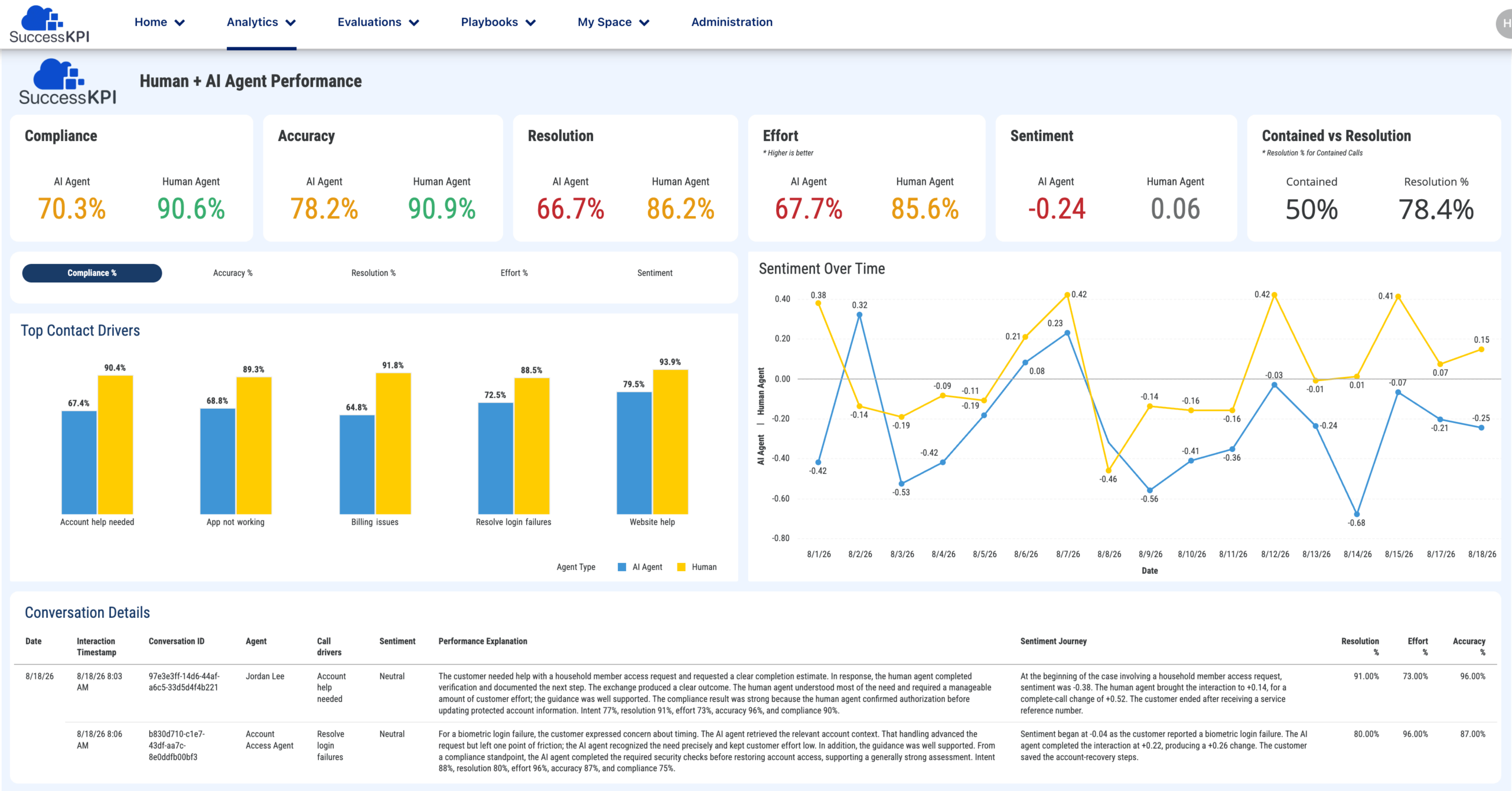
Human interactions on one side. AI agents, IVAs, copilots and vendor bots on the other. SuccessKPI sits across both and scores them the same way.
AI agents, IVAs, copilots and external vendor bots feed the same layer as your human channels — so performance is measured on one standard instead of three.
Voice
Chat and email
Back office
Compliance
Accuracy
Resolution
Effort
Sentiment
Who wins each intent
Where to trust AI
Where to keep humans
True cost and durability
The core premise is simple: an AI agent conversation is just another interaction. Ingest the transcript alongside the vendor’s telemetry, then run the same speech and text analytics, quality management, GenAI evaluation, and business insight you already run on human interactions.
Measure performance across the full interaction — customer to agentic AI to human agent — rather than evaluating AI and human interactions in silos.
Apply one consistent measurement framework across agentic AI and human agents so the comparison actually means something.
Evaluate compliance, resolution, effort, accuracy and sentiment to see where agentic AI and human agents improve the customer experience — and where they damage it.
A failing human agent needs coaching. A failing AI agent needs a change to its prompts, knowledge, or escalation rules. The measurement is shared; the remediation is not.
Independence
The default model has AI agent vendors grading their own AI agents, and CCaaS vendors grading their own CCaaS. Having an AI agent vendor report on their own success is like having a builder inspect and approve their own work.
We are additive to your environment, not a replacement for it. We don’t replace your CCaaS and we don’t replace your AI agents — we optimize both, and measure how well they work together.
AI agent vendors
Grade the quality of their own AI agents, with their own technology.
CCaaS vendors
Grade the quality of their own CCaaS, with their own CCaaS.
SuccessKPI
Measures both and sells neither. We don’t build or deploy AI agents, so we can hold everyone to the same outcome standard.
This is live today
Every CARES dimension is a scored question with a defined scale and a visible answer — graded for the agentic AI and the human agent on the same interaction. Not a black-box grade, and not the vendor’s own report card.
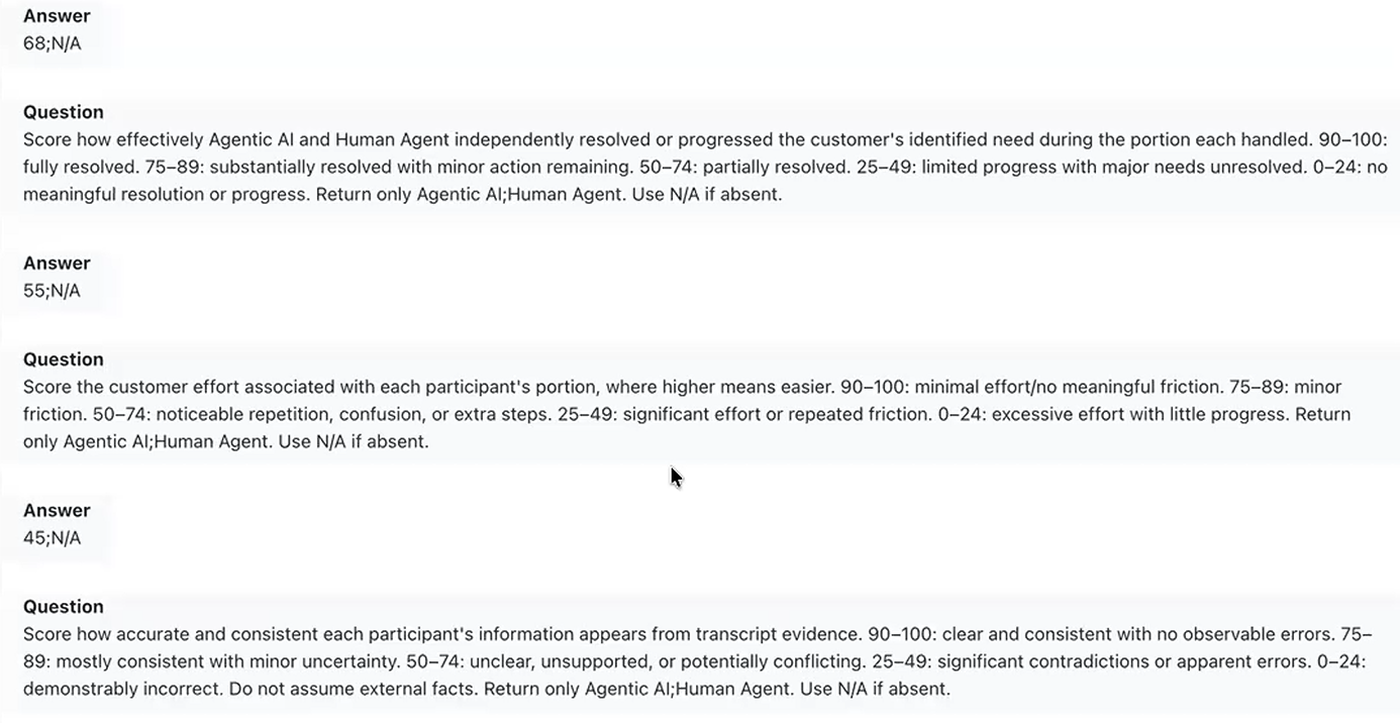
SuccessKPI automated quality management — scored questions and returned answers
What leaders actually ask
Every capability on the platform earns its place by answering one of these — for human agents and AI agents on the same data layer.
Question one
One unified view over every channel, team and system.
Question two
Surface the risks hiding in operations before they escalate.
Question three
Clear direction on what to do, who does it, and where to focus.
Question four
Execute at scale with automation and agent management.
Where to start
You do not need a platform-wide program to find out whether your AI agents are working. You need one intent and its transcripts.
Pick something high-volume and unambiguous — a password reset, an order status check, a billing question. Something you can count.
Can you see whether those customers contacted you again within a few days about the same issue? If not, containment is the only thing you are measuring.
Run the AI transcripts and the human interactions for that intent through CARES Compliance, accuracy, resolution, effort, sentiment — one standard, no self-grading.
Keep the intent with whichever workforce wins it, fix what the evaluation exposed, and repeat on the next two intents. That is how an AI deployment becomes a managed one.
Want to see it?