Table of Contents
This isn’t meant to be your typical “competitor comparison” post, with a feature grid built by us that rates SuccessKPI as a 10 and Calabrio/Verint as a 5.5. In fact, it’s interesting that if you ask around on the AI tools, you get something like this, “There is a compelling case for SuccessKPI over Calabrio, but it isn’t that SuccessKPI is a better WFM or WEM platform across the board. There are too many similarities to claim that.”
That’s telling in and of itself. The reality is, companies have issues with technologies, or want a change over time. We’re simply offering up SuccessKPI as the most viable replacement or alternative to Calabrio/Verint.
We’ll cover workforce management, quality, conversation analytics, reporting, and other areas of the contact center, where we think SuccessKPI is the better choice, and when you may be better off with Verint. Most contracts (Calabrio or otherwise) renew without much fanfare. Procurement may send a reminder 90 days out, the WFM and QA leads confirm nothing is broken, and the paperwork goes through. With the merger, Calabrio is now part of Verint, which has said it will bring both product lines together on one platform, but that can get tricky and will take time. And if your Calabrio software came to you as Cisco Webex WFO, Cisco has already set an end-of-life date for it.
Neither of those is a reason to leave. They are reasons to spend an hour asking questions before you sign for another few years. This post gives you those questions, shows where each part of your Calabrio setup would land in SuccessKPI, and tells you plainly when we think you should stay.
Why SuccessKPI as a replacement for Calabrio/Verint?
While they are very similar when comparing features, SuccessKPI offers a different approach to contact center performance management, particularly for enterprises operating across multiple technologies and introducing AI agents alongside human agents.
Verint and Calabrio help enterprises manage their contact center workforce. SuccessKPI helps enterprises independently understand, measure, govern, and improve the performance of their entire workforce—human and AI—across the technologies they use.
At its most basic, here are four differentiators:
- Independent performance intelligence, rather than relying solely on the contact center technology provider’s own reporting.
- Unified visibility across human and AI agents, with consistent measurement, quality management, and governance.
- Analytics that connect interactions to business outcomes, not simply recording, scoring, and reporting on activity.
- The ability to complement existing investments, rather than requiring customers to replace their entire WFO infrastructure.
Where each part of your Calabrio setup would land
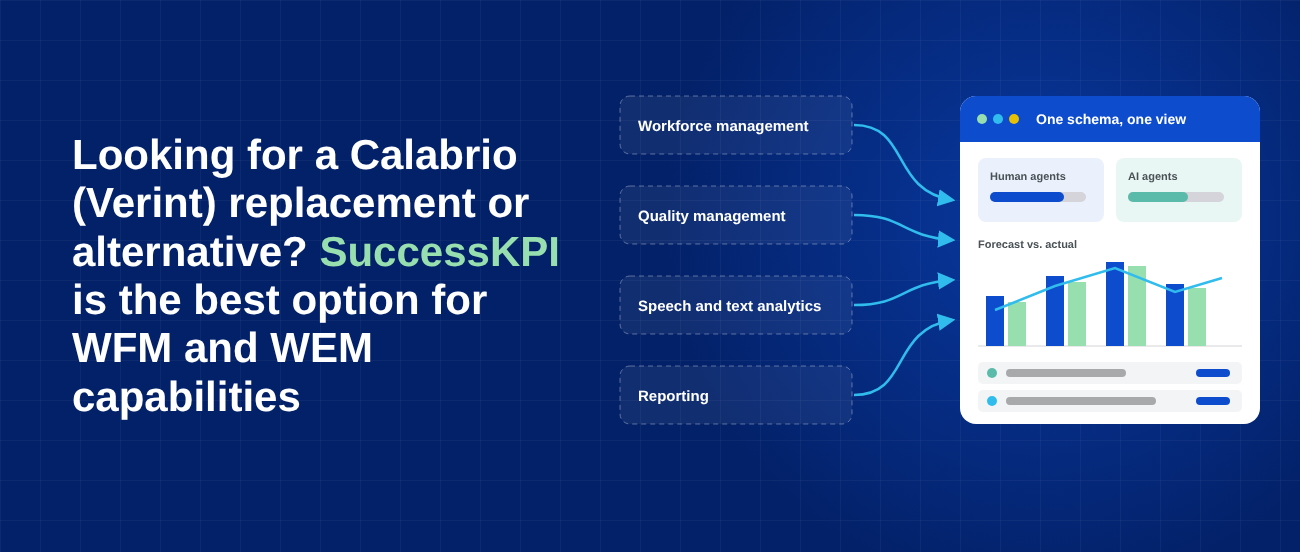
| What you run in Calabrio | Where it goes in SuccessKPI | What your team gets |
| Workforce management | SuccessKPI WFM | Machine learning forecasts, real-time adherence, and long-term capacity planning, stored next to your quality and conversation data |
| Quality management | SuccessKPI QM | AI and/or manual scoring on your own evaluation forms, with reasoning your evaluators can read and override |
| Speech and text analytics | Speech & Text Analytics and the AI suite | Topics in more than 50 languages, plus Deep Prompt answers to plain-language questions on each conversation |
| Reporting | BI and Command Center | WFM, quality, conversation, and endpoint data in one schema, with your own reports built on top |
You keep what you built. Your evaluation forms, scoring weights, categories, compliance phrases, and KPI definitions become the starting point for the new setup.
What do the deployment and ongoing management of SuccessKPI look like?
SuccessKPI is a singular platform, built with a UI that’s easy to use for our customers. Both of these are important for the deployment and ongoing management of the system. Yes, moving software platforms can take time to get “just right”, but you’re not dealing with a codebase that includes legacy systems from mergers and acquisitions.
Four things you’d notice in the first month
The way the data is organized, and the analytics suite give you data you’ve never seen. Most suites built planning, quality, and analytics separately and joined them through acquisitions, and each product kept its own data. SuccessKPI stores forecasts, schedules, and adherence in the same warehouse as transcripts, topics, and quality scores. When handle time runs long on a Tuesday, one dashboard shows which contacts ran over, what they were about, and whether the right people were on the floor. With two vendors, that answer usually takes an export, a reconciliation, and about a week.
Your QA team can see why the AI scored a call the way it did. AI scoring answers the questions on the evaluation forms your evaluators already use. A quality leader writes plain-language guidance for each question and tests it on a real call before it goes live. Evaluators read the reasoning, then apply or override the suggested answer. The platform keeps the original score, the revised score, and the name of whoever changed it.
You can put a question to every conversation in scope. Deep Prompt, in our GenAI packages, takes a question such as “Did the agent verify identity before discussing the account?” and answers it on each conversation. The answer comes back as a field you can filter and report on next to queue, agent, and sentiment. A topic you configure once can also filter a report, trigger an automated workflow, send a call to evaluation, and, on supported platforms, prompt the agent while the customer is still on the line.
A low score arrives with the agent’s audio conditions attached. Last Mile Agent Observability measures the agent’s headset, device, and network on each voice call. A supervisor can tell a skill gap from a bad connection before coaching the wrong problem. Last Mile runs on Amazon Connect and Genesys Cloud today.
If your sites are split across platforms, say Webex in one region and Genesys Cloud or Amazon Connect in another, SuccessKPI pulls them into one place for quality, analytics, and workforce data.
Workforce management (WFM) resides within the same data that measures the work
Labor is most of what a contact center costs. Your planning tool decides how well you spend it. Most suites built their planning, quality, and analytics products separately, then joined them by acquisition. Each product tends to keep its own data model.
SuccessKPI stores forecasts, schedules, and adherence in the same warehouse as transcripts, topics, and quality scores. That matters on the day handle time runs long. Conversation analytics shows which contacts ran over and what they were about. Adherence and intraday reports show whether the right people were on the floor. An analyst builds a dashboard that puts both views side by side, then reuses it. With two vendors, the same answer takes an export, a reconciliation, and usually a week.
The planning work itself covers what a planner expects:
- Forecasts for inbound voice, chat, and email, built with machine learning, a weighted average you control, or your own uploaded forecast
- Workplans that mix fixed and flexible shifts, with breaks that slide inside a set window when volume spikes
- Adherence that updates in real time, plus intraday monitoring of forecast against actual volume in 15-minute intervals
- Time-off banks, shift trades, and exception policies that approve or decline requests automatically, with supervisor override
- A forecast accuracy dashboard that compares each forecast with what actually happened
Quality scoring and conversation analytics you can understand
Automated quality scoring is no longer rare. Verint, Calabrio, and SuccessKPI all score far more interactions than a manual sample can reach. So coverage alone won’t separate vendors. What separates them is whether your quality team can see why the AI answered the way it did.
In SuccessKPI, AI scoring answers the questions on the same evaluation forms your evaluators use. You get full coverage on the questions you configure. A quality leader writes plain-language guidance for each question and tests it on a real call. Evaluators see the reasoning behind each answer. Evaluators apply or override the suggested answer. When a score is disputed, the platform keeps the original score, the revised score, and who changed it.
Conversation analytics follows the same idea. Topics are detected in more than 50 languages, and you configure each topic once. That one topic can filter a report, trigger a playbook, and route an interaction to evaluation. Playbooks can combine topic, sentiment, and a score threshold in a single rule. On supported platforms, the same topic also prompts a live agent. Deep Prompt, in our GenAI packages, answers a plain-language question on each conversation. The answer comes back as a field you can filter and report on next to queue, agent, and sentiment.
Sentiment is read from the words in the conversation, not from tone of voice.
Contact center analytics that help you improve
SuccessKPI is known most extensively as the best reporting tool for contact center data. Ask a contact center leader where their reporting really happens, and many will name a spreadsheet or some other utilitarian reporting tool. Data comes out of the planning tool, the quality tool, and the routing platform. Then someone reconciles it by hand, and the answer arrives late.
SuccessKPI keeps CCaaS, agent, quality, workforce, conversation, and endpoint data in one schema, within a data lakehouse. One dashboard can show adherence, evaluation scores, and conversation topics for the same agents and dates. Out-of-the-box reports run roughly an hour after your data starts flowing. Your team builds its own reports from there, without a modeling project. Scheduled delivery sends reports to people or writes CSV, JSON, or Excel files to your own storage bucket.
Endpoint data answers a question quality teams rarely get to ask. Last Mile agent observability measures the agent’s headset, device, and network on each voice call. A supervisor can tell a skill gap from an audio fault before coaching the wrong problem.
On top of this data, we built generative and agentic AI. Our Insights AI analysis structure allows you an open prompt to query the data for specific insights. Enter a simple question, in your own terms, and Insights AI will return multiple things, including an answer to your question, the data and charts to back it up, and explanation of the AI interpretation, and recommended next steps. This is what analysts everywhere have been looking for.
Why independent measurement matters
There are a handful of viable companies that have software good enough to compete in at least some elements in the WEM space – Calabrio/Verint, Aspect, Observe.ai, Cresta (now Salesforce), LevelAI (now Five9), and products within CCaaS including NiCE, Genesys, and Five9. Many of them have a stake in the game, and SuccessKPI gives you true independence in analysis and governance of your contact center data. We don’t sell the CCaaS or the AI agents. We provide the independent tool for you to get insights and move forward.
We measure your results not ours. The value isn’t simply independence; it’s the ability to apply common standards and independently validate results. This is particularly compelling when enterprises deploy multiple technologies for CCaaS and/or AI agents in their tech stack.
When Calabrio/Verint may still be a good fit
Some requirements point away from us, and it’s better you hear them now. If several of these describe your operation, staying with Verint is probably the safer choice.
- You need on-premises or hybrid deployment. SuccessKPI runs only as multi-tenant cloud software on AWS.
- You have niche use cases for WFM. For example, you want the system to do a unique rebalance intraday on its own. Or you’re the type of business Verint has built niche features for in the past.
- Gamification is part of your agent program. We don’t include a gamification module.
How a switch from Calabrio/Verint to SuccessKPI works
Start before your renewal date. You’ll want time to switch, and ideally time to run both systems concurrently.
Bring three questions from last quarter that took too long to answer, and ask each vendor to answer them with your data instead of a demo dataset. For workforce management, ask us to run a forecast on your own history next to your current one. It changes nothing in your operation.
If you decide to move, SuccessKPI Professional Services runs the transition with both platforms live, and your Calabrio contract runs through its term.
- Discover. Review your current setup and pick the first teams.
- Connect. Turn on SuccessKPI for your contact center platform.
- Configure. Set up QM, analytics, and WFM, starting from the forms and definitions you use today.
- Run in parallel. Planners and QA leads compare results side by side.
- Move in waves. A few teams at a time, at your pace.
- Go live. Focused support as each team switches over.
Ready to compare? Talk with our team about the questions your renewal needs answered. Request a demo →
Frequently Asked Questions
Yes. Thoma Bravo, which has owned Calabrio since 2021, closed its acquisition of Verint in December 2025 and combined the two. In February 2026 the company said it would operate under the Verint name.
Webex WFO was built with Calabrio and sold by Cisco. Cisco stopped selling it on July 25, 2026, and the last date to renew is July 30, 2027.
Yes. Most teams start with the module that matters most, usually QM or WFM, run it alongside Calabrio, and add the rest later.
They become the starting point for your SuccessKPI configuration, so your QA team isn’t rebuilding from a blank page.
SuccessKPI works with most CCaaS vendors – Webex Contact Center, Genesys Cloud, and Amazon Connect, among others – which is especially important for companies running multiple CCaaS environments across their world. Feature coverage varies by platform, and our team will confirm what applies to yours.
What does the future look like with Calabrio/Verint?
Your renewal may have a conflict mid-term
When two product lines become one platform, somebody decides which data model survives, which screens your agents use, and which roadmap gets engineering time. Verint has said it will keep investing in the products its installed base uses, and that may hold for a long time. You’ll still want to know which planning engine and which quality product your contract will run on in three years. If the answer is “a new version,” you’ll be migrating anyway, just on someone else’s schedule.
Cisco Webex WFO customers already have a date
Webex WFO was built with Calabrio, so if your contact center runs on Webex, you’re closer to this decision than most. Cisco stopped selling Webex WFO on July 25, 2026. You can renew or add licenses until July 30, 2027, and support for active subscriptions ends July 31, 2031 (Cisco’s end-of-life notice).
Every path from there involves moving something. Staying on Calabrio likely means buying Calabrio ONE directly, which as we understand it brings a new contract, a new tenant, a data migration, and SSO reconfiguration. Webex Contact Center’s built-in AI tools keep you inside Cisco, though teams with a mature QA program or complex scheduling should check them against what they run today. SuccessKPI is a Cisco SolutionsPlus partner with an included Webex Contact Center connector, and you can move one module at a time while WFO keeps running. Our Cisco WFO migration post walks through that path.