According to a report in Healthcare IT Today, the top priorities for healthcare leaders include: EHR optimization, data analytics, artificial intelligence, patient engagement, and more. But what unifies these priorities? Deep patient insights driven by contact center interactions. If delivering optimal care and support is only as good as the insight into the patient’s situation, then it is imperative that agents are empowered and equipped with cloud-based toolsets to provide a positive patient experience.
See how healthcare and health tech organizations can unlock the full potential of cloud contact centers, leverage automation for a better patient experience, and drive and retain member satisfaction.
Resource Challenges
The troubling truth is that while 70% of decision makers agree that contact centers are critical to their success, only 25% are content with their contact center performance, according to a new study by Forrester. Furthermore, due to technical complexity and lack of resources, leaders are left frustrated and at a loss after migrating to the cloud with only 23% of survey respondents saying they experienced a completely successful migration to CCaSS solutions. This, combined with low optimization rates, means that many healthcare organizations are left struggling in their transitions, keeping them far from their goal of achieving best-in-class patient experience.
The Full Potential
Cloud toolsets facilitate and improve ongoing usage and adoption while ironing out experience-related issues for all users. This gets organizations closer to delivering an improved service experience for members by:
Bringing together a-single-source-of-truth with sentiment analytics and automated actions.
Delivering a full journey visibility by unifying EHR data, real-time and historic contact center data, and interactions from multiple communication channels.
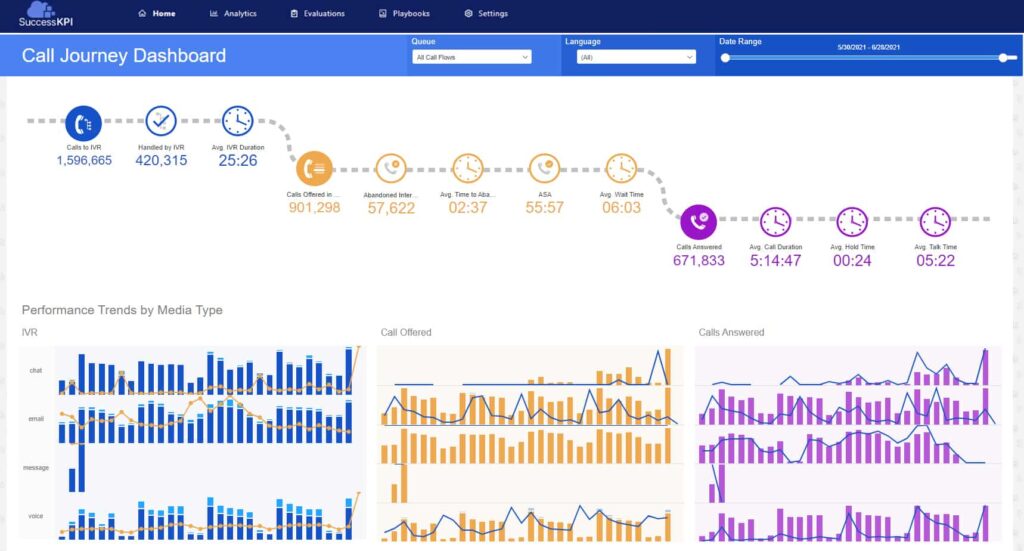
Empowering care teams to give agents a view of every interaction, coupled with real-time guidance and coaching.
Understanding the most value from your cloud migration is top priority. SuccessKPI can help you transform patient care, deliver thoughtful service, and empower your care teams.
See how healthcare providers are transforming patient experience today.
In 2022, the government’s global contact center satisfaction index reached its peak since 2013, while in contrast, the private sector witnessed a decline to its lowest rating since 2019.
Working with government contact center BPO partners and specializing in contact center technology, I’ve had the opportunity to observe this trend first-hand. Several key factors have contributed to the rise, including the shift to the cloud catapulted forward by the pandemic, the Administration’s focus on citizen experience, and agile cloud technology adoption. We’ve seen our Federal, Government, and BPO customers focused on these key initiatives:
Leveraging Better Technology
By incorporating AI-powered chatbots and virtual assistants, government contact centers have been able to address a wide range of common inquiries quickly and efficiently. Not only does this reduce the workload for human agents, but this automation also decreases wait times, contributing to an overall improvement in the customer experience. Taking technology deployments to the next level with advanced analytics exponentially increases the outcomes.
Empowering Agents
While AI improves the efficiency of government contact centers, human expertise still remains a top focus. As AI makes simple things easy, it’s important to empower human agents to handle inquiries with more complexity. Government agencies have recognized the importance of investing in comprehensive training and skills development programs for their staff. These programs ensure that human agents are well-equipped to handle more complex inquiries and provide personalized support, resulting in higher satisfaction levels.
Strategic BPO Partnerships
Collaborating with BPO (Business Process Outsourcing) partners has been another critical factor in the success of government contact centers. By partnering with the right BPOs, government agencies can tap into the partner’s experience and expertise in process optimization and resource management. This collaboration results in a more agile, streamlined operation that ultimately improves the citizen experience, as end-users reap the benefits of improved service quality and faster response times.
A Focus on Accessibility and Inclusivity
Government contact centers have also made concerted efforts to prioritize accessibility and inclusivity. By providing support in multiple languages, offering services for individuals with disabilities, and ensuring equitable access to resources, government agencies are better positioned to serve diverse populations. This commitment to inclusivity has led to increased satisfaction among a broader range of customers.
Driving Measurable Results
Government agencies are driving results by adopting agile technologies to achieve its mission while focusing on empowering their workforce with the right tools and trainings. And for government agencies that partner with BPOs with years of experience in driving results, they can more easily tap into the toolsets that edge out their competition. Most of all, human-centered AI deployments remain the key to success.
In 2022, the government’s global contact center satisfaction index reached its peak since 2013, while in contrast, the private sector witnessed a decline to its lowest rating since 2019.
Working with government contact center BPO partners and specializing in contact center technology, I’ve had the opportunity to observe this trend first-hand. Several key factors have contributed to the rise, including the shift to the cloud catapulted forward by the pandemic, the Administration’s focus on citizen experience, and agile cloud technology adoption. We’ve seen our Federal, Government, and BPO customers focused on these key initiatives:
Leveraging Better Technology
By incorporating AI-powered chatbots and virtual assistants, government contact centers have been able to address a wide range of common inquiries quickly and efficiently. Not only does this reduce the workload for human agents, but this automation also decreases wait times, contributing to an overall improvement in the customer experience. Taking technology deployments to the next level with advanced analytics exponentially increases the outcomes.
Empowering Agents
While AI improves the efficiency of government contact centers, human expertise still remains a top focus. As AI makes simple things easy, it’s important to empower human agents to handle inquiries with more complexity. Government agencies have recognized the importance of investing in comprehensive training and skills development programs for their staff. These programs ensure that human agents are well-equipped to handle more complex inquiries and provide personalized support, resulting in higher satisfaction levels.
Strategic BPO Partnerships
Collaborating with BPO (Business Process Outsourcing) partners has been another critical factor in the success of government contact centers. By partnering with the right BPOs, government agencies can tap into the partner’s experience and expertise in process optimization and resource management. This collaboration results in a more agile, streamlined operation that ultimately improves the citizen experience, as end-users reap the benefits of improved service quality and faster response times.
A Focus on Accessibility and Inclusivity
Government contact centers have also made concerted efforts to prioritize accessibility and inclusivity. By providing support in multiple languages, offering services for individuals with disabilities, and ensuring equitable access to resources, government agencies are better positioned to serve diverse populations. This commitment to inclusivity has led to increased satisfaction among a broader range of customers.
Driving Measurable Results
Government agencies are driving results by adopting agile technologies to achieve its mission while focusing on empowering their workforce with the right tools and trainings. And for government agencies that partner with BPOs with years of experience in driving results, they can more easily tap into the toolsets that edge out their competition. Most of all, human-centered AI deployments remain the key to success.
From decades of experience at leading CCaaS providers, Angel and Genesys, I saw firsthand the challenges contact centers face. CX was not delivering enough of the X and outcomes were far from their potential. Even decades later, enterprises still face similar challenges in leveraging digital transformation to achieve improvement in operations and customer experience.
The newly released study conducted by Forrester Consulting and commissioned by SuccessKPI has quantified it: Only 25 percentof all CCaaS operators surveyed are content with the performance of their contact centers. That is because some vital needs get lost in the inexorable transition from legacy to more complex cloud contact centers. But all is not lost.
Building Something New
SuccessKPI was built by a group of leaders inspired to build something that would address the evolving challenges faced by contact centers migrating to the cloud. We knew we needed to build something new for the entire CX industry. Something collaborative, virtual, and born in the cloud. And we also wanted to build something more: a transformational experience for both our customers and their outcomes, and for our own employees. Our core values shine through in the team we have assembled to solve problems for our customers.
CCaaS platforms have set the stage for an amazing next era. Their platforms help customers engage with end customers across multiple channels and improve how those interactions can get routed to the best agents. They also provide important reporting, but the built-in depth of insight and task automation requires deeper focus to run an intelligent and efficient contact center. That is why top CCaaS platforms partner with companies like SuccessKPI which offers cloud-based toolsets, to augment and help customers not only move to the cloud but evolve and improve in the cloud.
The market has seen a notable increase in demand for systems that can support greater levels of sophistication in support of digital channels, self-service, interaction, and journey analytics, and artificial intelligence (AI) and machine learning (ML) to provide enhanced levels of automation and insight. However, CCaaS vendors’ support for these capabilities often lacks the functional maturity to meet customers’ demands. As a result, CCaaS vendors typically must rely on technology partners to deliver the depth of solutions that customers demand.
This is where cloud toolsets from partners like SuccessKPI come into play. Cloud toolsets not only fill in these analytics gaps but also enable efficiency, planning, and automation assistance to drive better employee and customer experience with high-level employee utilization.
Praphul Kumar, Co-Founder and Chief Product Officer of SuccessKPI
Future of Fully Optimized Cloud Contact Center
Today approximately 61% of contact centers have migrated to the cloud, according to Metrigy’s Customer Engagement Transformation study. It is only a matter of time before they all do, regardless of industry or market segment. That means they must be optimized to deliver the exponentially better results and efficiencies that were promised.
Ultimately, we are all seeking the truth – about our customers and ourselves. Amid the myriad data sources and ways to interpret them, a single source of truth must emerge for enterprises to reach their true potential. And a fully optimized cloud contact center analytics toolset is the key to discovery.
Cloud Contact Center Success (Forrester Study)
Conducted by Forrester Consulting on behalf of SuccessKPI, the commissioned study “The Frustrating Journey to Cloud Contact Center Success” indicates the move to the cloud has been a frustrating journey, and that cloud toolsets are essential to success in the cloud.
Getting meaningful data to the right people and the right time is more important than ever. My number one tip for creating meaningful reports is “Less is more!” mentality. Avoid the trap of trying to build single view dashboards and reports that are one size fits all for your entire reporting audience. More reporting isn’t better, insight is better. In this blog post explore six tips for creating meaningful and actionable a reporting.
Focus on the End Goal
When creating reports, it’s important to have a clear understanding of what you want to assess or achieve with the information. Map out the questions do you need to answer and insights types you can benefit from, including current knowledge gaps or areas for performance improvement. This could include evaluating the performance of agents, supervisors or teams, identifying high value accounts at risk, or monitoring for real time opportunities to coach, train or improve resourcing.
Gather Data from Relevant Sources
To capture a full picture of your customer journey, it’s important to gather data from all the relevant touchpoints. This could include data from your CRM, accounting systems, and more.
Choose the Best Data Acquisition Method
Depending on the type and volume of data you need to gather, different data acquisition methods may be appropriate. For example, if you need to extract data from multiple systems, an automated data extraction tool may be the most efficient method.
Design Reports with the End User in Mind
Your information audience will have preferences and needs for how they consume information and insights. Agents may need detailed reports on individual items with specific examples, while supervisors and managers may prefer summaries of situations and performance. Building the reporting with the end user in mind will increase its usability and
Decide on the Frequency of the Report
Some insights may need to be viewed in real time like fraud detection. Other insights may be best for hourly, daily, weekly and so on. Take into account the actions that need to be taken as a result of the update when deciding how frequently to deliver.
Use Reports to Drive Action
Most importantly, your reports should be actionable. Identify gaps in performance, areas for growth and opportunities for strategic change. For example, if you identify a trend of late payments on certain segment of your accounts, you may want to adjust how you communicate or manage that subset of accounts.
By focusing on the end goal, gathering data from multiple sources, and designing reports with the end user in mind, you can create reports that are relevant, actionable, and help drive successful business outcomes.
Contact center analytics solutions are a great option to improve customer experience and achieve positive business outcomes. However, the majority of contact centers don’t implement the right analytics solutions. As a result, they must deal with poor customer experiences and high churn rates that, in turn, reduce revenue. Businesses should adopt various analytics solutions that can help create great customer experiences to avoid that.
Speech analytics helps contact center managers monitor calls in real time or review prerecorded transcripts. This software analyzes live conversations to extract meaningful data for business intelligence. The speech recognition software finds helpful information, audio patterns, and main keywords.
With speech analytics software, you can easily gain greater insights from what customers say about your brand. Modern speech analytics no longer transcribe phone calls but provide emotion recognition, keyword detection, etc. From the interactions, you can learn various things, such as customer preferences and desires.
Sentiment Analytics
Sentiment analytics solutions analyze conversations to uncover contexts behind each message, such as emotion, intent, and tone. They mine critical data from raw conversations using natural language processing and machine learning. Ideally, sentiment analytics solutions help organizations get behind customer’s words and dig valuable data from them.
This analysis provides customer service, marketing, and product development teams with a wealth of information about customer opinions. With this information, organizations can work toward improving customer experience and turning pain points into strengths.
Text Analytics
Text analytics solutions are similar to sentiment analytics. However, they analyze text conversations. Call centers use them to translate data from large volumes of unstructured text into measurable data for actionable insights. With a text analytics solution, you can analyze messages from various channels to find patterns and topics of interest.
With data from the text analytics software, you can detect product issues, monitor brand reputation, etc. The ability to analyze large data volumes helps resolve issues promptly.
Self-Service Analytics
Self-service analytics solutions are business intelligence (BI) tools that enable users to ask questions and generate rapid reports. These tools provide organizations with the ability to gain insights from their data seamlessly.
Users can explore and visualize available data with self-service analytics and generate meaningful efforts even with technical expertise. This helps organizations harness the power and value of their data faster and build a data-driven culture.
Cross-Channel Analytics
Cross-channel analytics solutions link different data sources and analyze them to provide the organization with customer and marketing intelligence. These solutions are beneficial for marketing teams as they help analyze customer behavior. With cross-channel analytics, you can understand the relationship between marketing channels and achieve more effective modeling capabilities.
Predictive Analytics
Predictive analytics solutions look into the current and historical data to forecast future events. These solutions use machine learning, statistical algorithms, modeling techniques, and historical data to predict the future. With predictive intelligence, you can tweak certain call center tasks and processes to achieve your desired outcome.
The Bottom Line
All the above solutions are helpful for various reasons and can be great additions to your call center. Consider implementing the various contact center analytics solutions that align with your business needs to improve customer outcomes.
SuccessKPI provides a comprehensive contact center analytics solution that packs all the above solutions in a single platform. With SuccessKPI, you can analyze sentiments, speech and text conversations, etc. Book a demo or contact us today to understand how SuccessKPI works!
Speech and Text Analytics, if done right, can help you improve many business outcomes and Reducing Churn is no exception. Before we look at how speech platforms can help businesses improve customer retention, let’s understand what churn is and how its valuable to businesses.
In very simple terms, churn is the rate at which you are losing your customers. So, if you have 100 customers in total and you lose 5 of them every year, your churn is 5%. Each customer retained is customer gained for 2 reasons – Life time value (LTV) a customer brings and Cost to acquire a customer at first place (Acquisition Cost, AC).
How do we find the LTV for a customer? Well, first look at average revenue they bring every year. For a cellphone company, that would be $600 assuming average customer is paying $50/month ($50×12=$600). Next thing we need to find out is how long an average customer stays with the business? The answer lies in the churn rate. Assuming average churn rate is 5%, Life expectancy of a customer is 1/Churn = 1/5% = 20 years. So, average customer stays for 20 years with the business providing yearly revenue of $600. Putting it together, LTV (Life Time Value) of a customer in this case would be $600 x 20 yrs = $12,000. You can go crazy with math from here and start bringing down the value of $600 over 20 years to today’s value by taking into the inflation but we don’t have to do all that. I am assuming you will more than compensate for inflation by improving the margin for your business or cross-selling them other products/services. Another thing to consider is the cost to acquire those customers. A lot of that is driven by marketing and sales strategies adopted by businesses but it’s only fair/conservative to assume that its around 25% of yearly revenue, $120. In this case, this number is not that meaningful but can be huge for business with higher churn or acquisition cost.
Now imaging millions of calls coming to your contact center where customers are showing signs of churn like showing dissatisfaction or threatening for cancellation or talking about competitive offers being better. Most of the agents don’t capture those critical pieces of information and it’s not humanly possible to listen to all the call recordings looking for these insights. That’s where Speech Analytics comes to rescue. It analyzes all the calls, looks for phrases which indicate possible churn and then alert/update the system so that businesses could take pre-emptive measures like calling them to understand their issues better or offering them better services etc. Imagine improving churn by 0.5% for a business with 1 Million customers in this case. Yearly gain would be 1M x 0.5% x $600 = $300M. That’s the contribution to your topline every year.
Question is how much you are willing to pay for it? I would leave that question for you to answer J But we must understand one thing, we must pick a vendor whose solution is focused on driving these business results. SuccessKPIs has build platform which offers library of playbooks which are driven by these business outcomes. Importing these playbooks automatically creates and stack up all the underlying artifacts to help customers detect topics, score them and then take actions. Add to that the out-of-box BI integration with seamless blending of IVR and ACD data, customers can get 360degree view of the contact center.
The Case for Conversation Analytics
This short guide features real-world use cases and sample parameters that our customers have used to assess and measure value and the impact.
Customer experience (CX) is on everyone’s radar. Great experience drives churn reduction, revenue growth and builds competitive advantage. Though the importance is ubiquitously acknowledged, most CX leaders don’t believe they currently have the strategy in place to improve customer experience in a transformational way.
The difficult reality is that it’s far easier to envision thought leadership on this topic than it is to operationalize it. There’s a huge gap between best practice visions and where most businesses are operating. Of course, the vision work is critical to building the roadmap, but brining business goals, business unit functions, and all related technology and all supporting people into the path is incredibly complex.
Gartner reports that despite a requirement to deliver exceptional customer experience, more than 70% of CX leaders struggle to design projects that increase customer loyalty and achieve results. Not only that, fixing the obvious experience customer service interactions isn’t enough on its own to drive long -term brand loyalty. Experience programs that are rooted in a holistic view on overall product and brand experience are the ones that drive the deepest loyalty.
Get an actionable and holistic CX strategy by tackling these 3 common barriers
Insufficient executive focus. Achieving transformational CX is more than a ROI driven success strategy managed by a CX team. To reach a differentiated and sustainable status, the very spirit of experience needs to travel through the nervous system of your company, starting at the top.Experience must be engrained in how your business operates.This may require a major dialogue shift. ROI driven decisions are an approachable entry to shifting the way leadership prioritizes CX, but often result in a hyper-focus on specific metrics and losing touch of the actual goal.What leadership can do to enact change. Businesses need to define experience. What does this experience mean to the business? Within the industry? And what does it means across each unit and role in the organization? How should those roles align and work together? What data and systems do they need to facilitate that? And will there be proper budget to support? Answers to these questions help build effective strategy and align each role and person to the plan. Communication through vision, strategy, funding, measurement and review is the backbone to this shift.
Expecting a silo to transform CX alone. Often a business unit will own specific CX goals, but aren’t cross-functionally aligned to other groups within the organization. While this focus by each department can make a dent in achieving goals, it can cultivate inherent team misalignment and data silos. If only one business unit is responsible for the outcome (and only one is funded to achieve the outcome), the other supporting teams may not be incentivized to align.Empower teams withCX strategy as the grand unifier. Develop (and fund) a cross functional team that has executive voice and an aligned cross-functional strategy for internal motions, tech stack and service partners. Aligning across all related functions and systems will enable a holistic view of your customer journey.
Limited technology strategy. Customer experience happens on a complex cross-channel journey. The entire experience from brand awareness through product use and gathering feedback on experience are the backbone of the journey. In mid-size and large enterprises, there may be hundreds, thousands or tens of thousands of people supporting this full journey. These employees are likely to be in different departments and using different tools to support the unique needs of their specific portion of the journey. Being able to properly strategize, understand, track and enable experiences across this complex spectrum relies heavily on a shared source of truth about the experience. Data that gets siloed with teams or systems creates missed opportunities within the businesses. Solving for siloed data is one of the most challenging issues in today’s digital world.Align on data to unlock holistic understanding of the customer journey. Leading companies are twice as likely (55% versus 26%) to be able to translate customer data in action according to Accenture research. These leaders noted there are limits to data and what you can do with it, but to truly transform customer experience better ways of managing this is a necessity. In order for data to be leveraged, a single source of truth must exist within your systems.
What if your data is siloed now and you need to start this dialogue shift?
Look to the contact center for untapped single source of truth.
On the front lines of customer experience, the contact center manages a large share of conversations. Even in informational inquiries, there may be learnings about issues or improvement areas that stem from the barriers designed by limitations of the organization’s customer experience model. From lack of executive focus on customer experience to lack of shared business unit goals to major gaps in data sharing across the buyers journey, many vectors contribute to overall experience.
The contact center has unique potential for achieving CX super powers by harnessing all this data and playing a central role in achieving larger digital transformation and customer experience goals. The contact center can access data to illuminate the effectiveness of digital strategies and experience throughout the organization. With this, contact centers can improve customer experience by validating assumptions of the business through customer feedback data.
Expand your view on technology and programs Data is one of the most powerful assets in your organization. Contact center leaders can devise a strategy that brings data out of silos and into the hands of the business users who can improve critical KPIs across the organization.
For example, does marketing have visibility into how their campaigns are impacting communication and requests to the contact center? Could they increase their results by understanding and tuning programs based on how customers talk about and reach to information marketing brings to market? Having a full 360 view of conversation data empowers organizations to align with customer focus across business units to achieve maximum outcome for the business
By selecting the right technology stack, the contact center has a unique opportunity to connect all conversation and experience data into a unified view. With this, they can build reports and validate initiatives through customer feedback. This powerful data can help the contact center to take lead on:
Choosing the right technology to get a unified view of customer experience
Getting data out of silos, up-leveling and aligning the CX conversation across teams
Making the business case to leadership to shift business focus to key CX alignment areas
Build a business case around the core KPIs that you will improve CX at the forefront of the organization. Backed by data from a holistic view, show how the business can reduce customer churn, improve employee retention, improve product satisfaction and product experiences.
SuccessKPI transforms the contact center by unifying cross-channel Conversation Analytics, Speech & Text Analytics, Quality Management and outcome data to provide a 360 degree view of the customer and agent experience. Learn more!
Today’s contact center leaders maintain a delicate balance between managing their day-to-day responsibilities, helping busy executives make informed decisions during a time of constant digital evolutions, and juggling employee retention and customer satisfaction.
By providing personalized business intelligence to each wing of the contact center, you’re able to arm executives and agents alike with data that will help them make key decisions. However, handing them a complex spreadsheet guarantees it may never get read. While it’s important to package information in an easily-digestible way, it should also not mean dedicating hours of your day manually combing through data.
In this article, we’ll share how to simplify and position best-in-class contact center metrics to communicate contact center performance with your agents, supervisors, and executive leadership.
Managing Success for Contact Center Supervisors
If you are directly managing and coaching contact center agents, you need meaningful insights into agent performance and productivity. You need to know which metrics to monitor, what they mean, and how they help address any gaps in process, technology tools, and training.
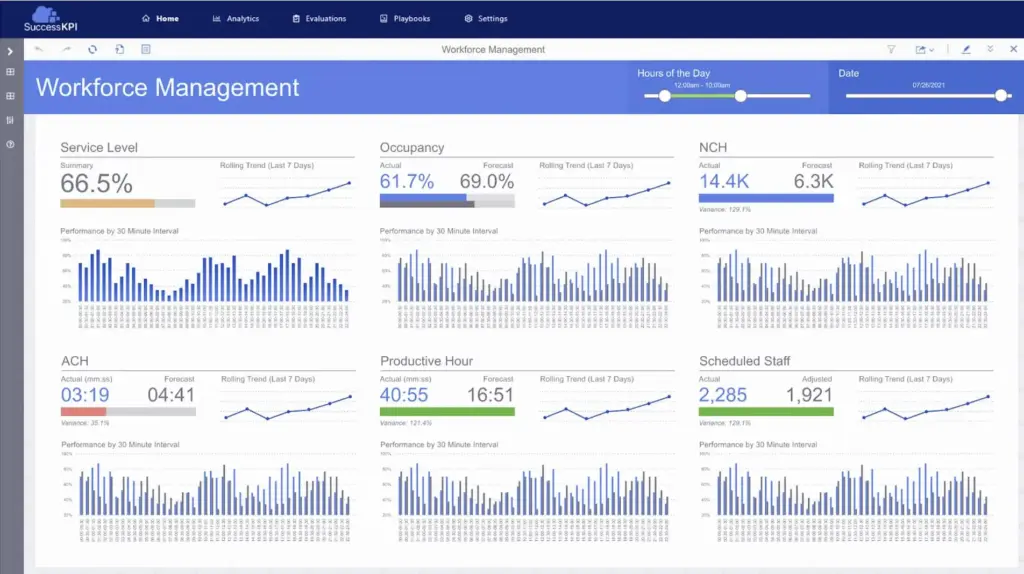
The overall performance of a contact center cannot be distilled down to any one metric. From routing inbound customer queries to agent staffing and service-level expectations, every contact center has a plethora of moving pieces that contribute to how and how well it functions. Many metrics, such as Service Level, can only tell us so much on their own but serves as an excellent roll-up that summarizes multiple data points. By looking at both the big picture as well as being able to drill down at a glance, you can quickly view actionable reports that help you improve contact center operations.
For example, Average Hold Time and Average Speed of Answer might tell you that you have underperforming agents or that you need to adjust your staffing levels. To be really meaningful, this data needs to be cross-referenced with other metrics like Occupancy Rate, Average Handle Time, First Contact Resolution, and Average After-Call Work Time. As you can see, on their own, these metrics do not paint the whole picture but when brought together with proper analysis, they can help you make decisions about staffing levels, streamlining agent processes, or providing additional training resources. Many contact centers staff their agents based on forecasting data and the ability to compare actual metrics in the context of forecasted data is critical in optimizing the staffing and achieving better operational efficiency.
Ultimately, success for both contact center supervisors and their agents will be shaped by timely and ready access to dashboards that synthesize the contact center’s logistical data alongside individual agent performance metrics.
This will make room for micro- and macro adjustments to effect positive change with each customer interaction.
Transparent Performance for the C-Suite
While contact center supervisors are focused on the day-to-day operations, the C-Suite is typically occupied with the bigger implications data has on the organization as a whole. Just like it’s difficult to effectively navigate a ship away from shoals in a heavy fog, so is trying to drive a business forward without clear data to base your trajectory on.
It’s clear that building an effective lighthouse for the C-Suite to be able to navigate through the fog of complex decision-making means distilling a myriad of customer data into key insights that clearly illuminate the way forward. The big question is: how do you transparently identify business performance and key customer trends?
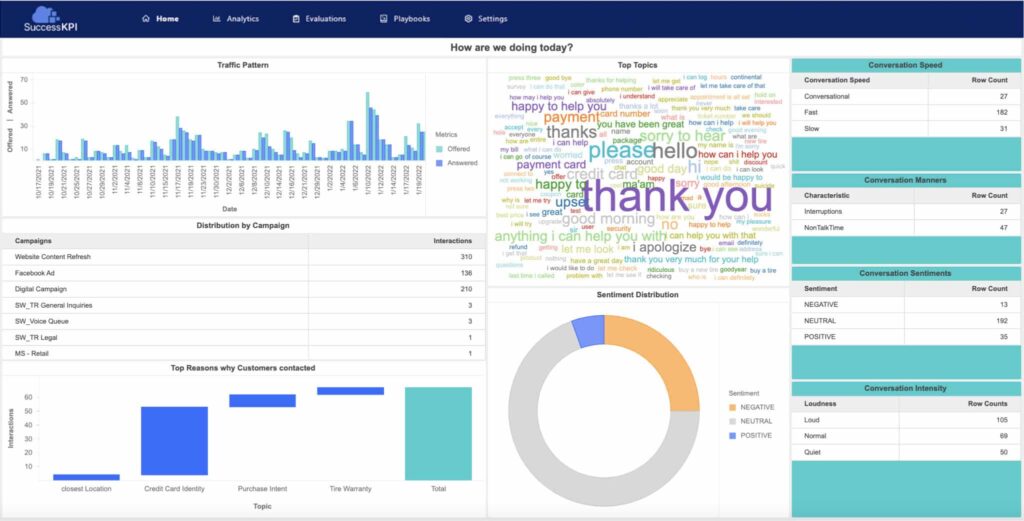
Individual metrics tell decision-makers very little about the true direction in which the winds are blowing. What the C-Suite needs are dashboards that present clear roll-ups, analysis, and the resulting insights that can be gleaned from the data presented. Of course, the contact center is an absolute treasure trove of data like the top reasons for customer contacts and sentiment trends. At-a-glance operational data helps the C-Suite see quick performance roll-ups that can alert to changing customer needs or product issues.
Take Sentiment Trends data, for example –– there are so many contributing factors, how do you know what to address in order to effectively turn those tides? After all, sentiment data is only as deep as the data it’s built on: Are customers unhappy with their customer service experience or are they connecting with the contact center because of other issues? A deeper dive into your contact center data can answer these questions, and more, and help you better understand where to focus efforts that will better serve your customers.
Strategic Analytics for VPs
VPs focus is on establishing and maintaining best practices for contact center metrics, from business performance to financial and compliance standpoints. VPs need to balance the books on efficiency, effectiveness, and the overall costs of the contact center. This often means mitigating expenses without negatively impacting the customer experience. Ultimately, they need best in class contact center data analytics.
To succeed, VPs should leverage customer data around the most common reasons for initial contact, preferred customer contact channels, as well as which self-service channels they utilize and why. This data can point to opportunities to expand self-service offerings and automations. Of course, doing so will require implementing tools and processes that allow agents to work with customers across multiple channels, leveraging AI-driven automations, and gathering all the critical metrics necessary to monitor KPIs and drive the business forward while proactively maintaining regulatory compliance.
With the right tools, all the best in class contact center metrics can be collected and costs can be contained without sacrificing customer satisfaction or experience.
In Summary
As a contact center leader, your key to success will be in understanding which data points your stakeholders need to see to make strategic business decisions and which data points you need to leverage in order to improve the experience for your staff and customers. The magic lives in understanding how to aggregate them in a way that provides an unobstructed view into what it’ll take to drive positive outcomes.
In an increasingly-connected world, omnichannel analytics solutions will help you see the big picture from all possible angles and AI/ML-driven customer experience tools will help you keep your finger on the pulse of what your customers really need to stay happy.
SuccessKPI comes preloaded with 50+ pre-built dashboards and visualizations designed to meet common contact center needs. To see how you can blend multiple data sources and your brand colors into a visual dashboard in just a few clicks, schedule a demo.
What a week! SuccessKPI is still buzzing after connecting with all the great customers, partners, and colleagues at the #1 customer contact series in the world, Customer Contact Week 2022 in Las Vegas. SuccessKPI had a packed week sponsoring the show, from attending the CCWomen Summit, on-stage presentations, and throwing a partner launch party. Relive some of the best moments with us and learn how to connect with us next.
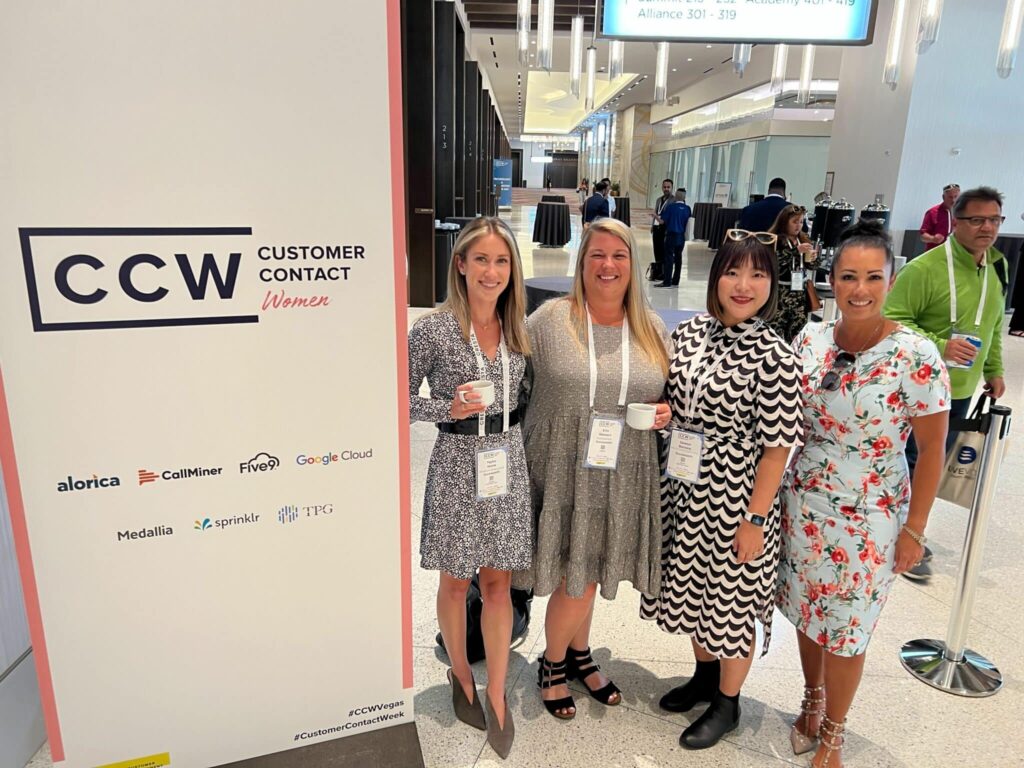
Successers at the CCWomen Summit
SuccessKPI kicked off the week at the CCWomen Summit. During our time together we learned ways to empower one another, the importance of celebrating our own achievements, and brainstormed ways to navigate career paths. Learn more about careers and life at SuccessKPI.
On Stage at CCW
Erin Stewart, Executive Director of Emerging Markets at SuccessKPI; Michelle Paiz, VP of Citizen Engagement at Maximus and Brett Hamilton and Head of Business Development at Amazon Web Services, took the stage to co–present a panel discussion, “Improve the customer journey and contact center experience using call center analytics.”
This presentation filled a full-capacity room, as the presenters shared a success story of how Maximus Federal was able to derive insightful call center analytics across thousands of agents to answer millions of calls per month across multiple CCaaS platforms. SuccessKPI’s post-call analytics solution fueled increased capacity, automated quality review, agent compliance, and performance improvements for government agencies. Learn more about the Maximus’ success story.
Partner Events
Partner launch party with SuccessKPI + LiveVox During CCW SuccessKPI and LiveVox hosted a joint party at the Icebar, celebrating the recently announced partnership. The partnership features a seamless integration, which provides LiveVox customers with instant access to SuccessKPI’s all-in-one cloud analytics insight and action platform so that they can utilize artificial intelligence and automation to improve business outcomes across the entire customer journey.
Benefits of the integration include:
184 adapters to instantly integrate popular third-party applications and enterprise and third-party data sources into SuccessKPI’s contact center insight and action platform. Through SuccessKPI’s real-time speech analytics, LiveVox provides real-time agent assist and immediate customer value.
The partnership enables agents, managers, and decision makers to access customer journey views to improve their decision-making and customer satisfaction. Learn more about partnering with SuccessKPI.
Talkdesk Passport to Partners
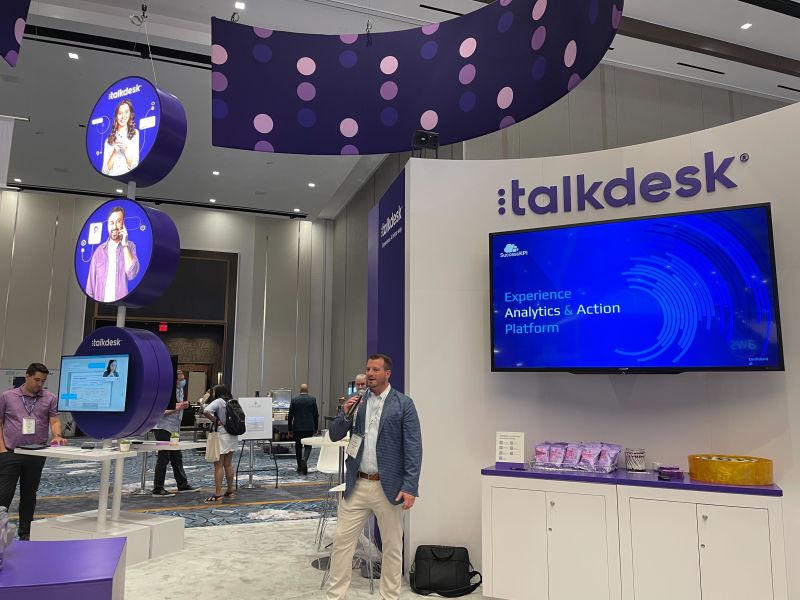
Emil Modugno, Head of Channel at SuccessKPI presenting at the Talkdesk booth
Emil Modugno, Head of Channel at SuccessKPI spoke at the Talkdesk booth theater about how SuccessKPI’s insight and action platform is helping Talkdesk customers utilize artificial intelligence and automation to improve business outcomes across the entire customer journey.
SuccessKPI just recently announced the launch of its ‘all-in-one’ cloud analytics insight and action platform on Talkdesk® AppConnect™, enabling businesses to seamlessly combine SuccessKPI insight and action platform with their existing Talkdesk CX Cloud™ solution.
Learn more about SuccessKPI and connect with us or schedule a demo to see the platform today!
Converging simple and complex metrics to get the most out of your conversational intelligence software
The modern digital world provides consumers with more choices than ever, meaning their expectations have never been higher. Users demand personalized experiences across devices and channels. Rather than a nice-to-have, it has become expected that companies leverage key customer experience tools, including developing methods for measuring its efficacy.
The COVID-19 pandemic has also inspired a stronger push for self-service and online support options, reinforcing the standard for around-the-clock customer service. To help fill these needs, conversational intelligence software and chatbots are being used across industries for appointment booking, medical triage, banking, and all manner of customer support interactions. Their usage growth is exponential, with one industry prediction expecting that “… consumer retail spend via chatbots worldwide will reach $142 billion—up from just $2.8 billion in 2019.”
While leveraging automated and AI-powered tools can indeed help organizations more effectively service customers, conversational intelligence software presents unique challenges around natural language and unstructured data processing. In a recent webinar, we discussed not only the best ways to design, develop, and train your semantic models and chatbots but how to better measure performance to reveal insights and opportunities that will help you fine-tune your customer’s journey.
Building conversational intelligence (or how to train your dragon chatbot)
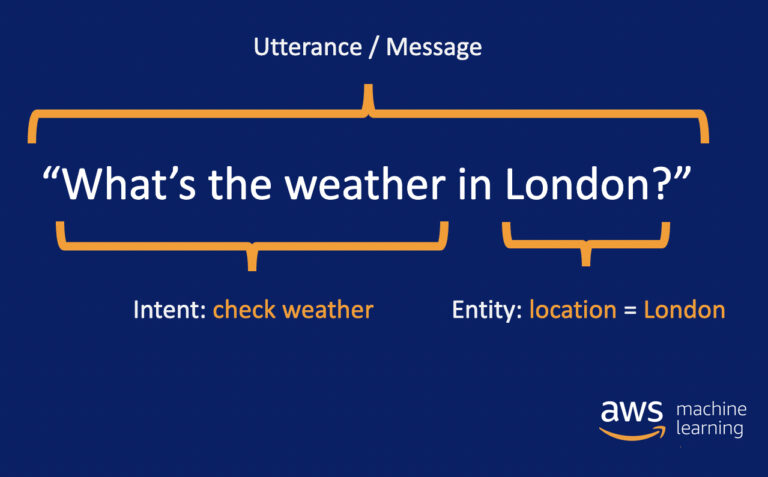
The goal of many chatbots and conversational intelligence software as a whole is to improve the customer journey, so you must have a clear understanding of the routes your customers may take. That’s why, when training a chatbot, the best place to start is your existing data. You can dig into the top reasons your customers contact your business and leverage semantic analysis to determine customer intent and related training phrases. Start simple, and build complexity as you go.
As you design your conversational flows, you want to focus on providing an intuitive experience. Artie Merrit, Global Segment Leader for Conversational AI at AWS advises that “…the best ways to do that are to greet the user, welcome them, and let them know what the chatbot can do to try to help guide them.” For text-based systems, this can include providing quick replies and prompts.
But what do you do when the chatbot doesn’t understand the user input? How well-trained is your conversational intelligence software to understand the different ways people may ask for the same information? You need fallbacks to keep the user from hitting a dead end, but longer term, how can you use this information to improve your flows and build a smarter chatbot? This is where natural language understanding allows us to dive deeper than simply processing.
This is where context and AI-driven personalization can help your bot create more relevant experiences for customers. It also means that your various channels and customer experience tools need to share data in appropriate ways to successfully achieve consistent levels of support. One example of this would be integrating CRM data with your chatbot platform. Doing this would make it possible for the bot to pick up on whether or not a conversation has been initiated by a new or existing customer, making it easier to offer appropriate solutions.
Ask yourself: “What do you know about the user already? What are they currently doing? What have they done in the past, because this will help speed up the experience and make it much more enjoyable.” – Artie Merrit, AWS
Plan to connect your tools for data integration, but keep GDPR/CCPA compliance in mind when you do.
Measuring for success: conversational intelligence insights and opportunities
Once you have chatbots in production, you’ll want to monitor them for performance and fine-tune them. There are a number of key metrics that can be used to measure success, however more can be derived from the data itself than baseline performance. Your data, when combined, can provide deeper insights and opportunities to build seamless customer experiences.
First, let’s look at five categories of insights that you can derive from your chatbots to help you improve and refine them. These include:
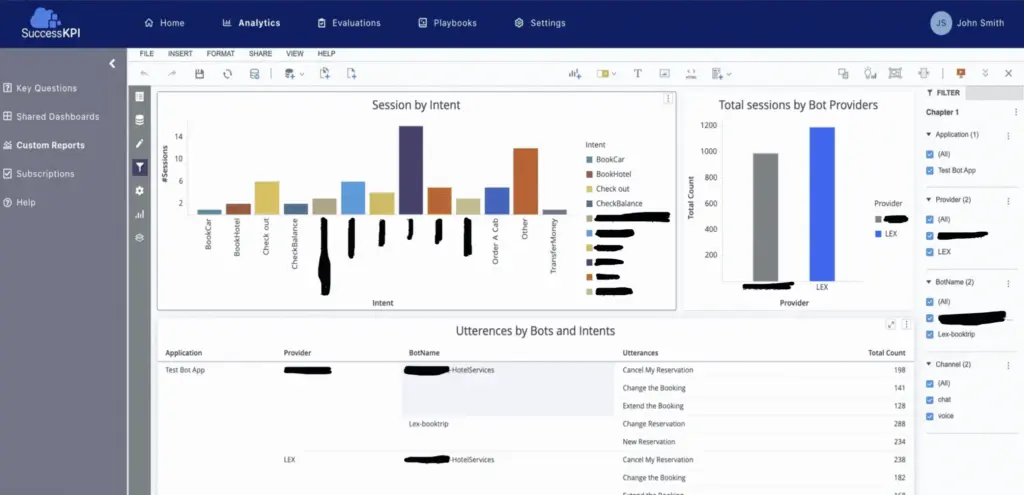
How are your customers interacting with your bot? Which bots are capturing which intents? Do customers like your bot? Is this task better suited for bot or website self-service? Does your bot need enrichment? The goal of each of these insights is to look deeper into your metrics and combine them to help you better answer each of these questions. By utilizing those answers, you can better determine if your QA bot is ready for primetime, and if your production bots need further refinement. With custom dashboards, you can pull together your key metrics and visualize your bot’s performance and the resulting customer journey and experience.
Next up, let’s explore the opportunities that monitoring your bots can offer when it comes to better understanding and ultimately improving your contact center operations.
Gayetri Bhattacharjeei, a SuccessKPI product expert and veteran of the contact center technology space, points out that, “…since you have put a machine in between, there are some automatic insights and aggregations that the machine can bring to you if it understands your customer conversations.” These insights include:
Conversation Analysis: Gain a deeper understanding of your business and customers by analyzing conversations, including the ones your chatbot is leading. These insights can include customer sentiment about your product or brand, reasons they want to cancel a service or subscription, or any trends happening within your business. Workforce Planning: Many organizations fail to include self-service data in their workforce planning dashboards, however this can provide key insights by looking at occupancy rates, levels of self-service, and containment. Containment data can help determine effectiveness of your chatbots, assuming that they have an appropriate escalation path built in. By better understanding customer service trends that include self-service, you can more efficiently plan staffing and workforce needs, as well as identify additional tasks that chatbots may be well-positioned to handle. Collaboration: One final opportunity is a collaboration between automated assistants and contact center agents. This would allow for agents to provide contextual assistance while also giving them the opportunity to rate a bots efficacy. This can help determine what FAQ or Knowledge Base data is presented to a customer based on context, sentiment, and conversational intelligence. This also provides you with the opportunity to utilize the same piece of AI to support both internal and external needs while getting direct feedback. Taken together, these insights can help you build best in class chatbots, leverage your conversational intelligence software to its full potential, and foster high customer satisfaction and loyalty with your customer experience tools.
To learn more about what our experts have to say as well as how SuccessKPI can help you effectively integrate these tools in your business, sign up for the webinar replay.