Are you looking to shift your contact center to the cloud? If so, then you are far from alone. A recent study reports that more than sixty-four percent of IT decision-makers say that their cloud strategy is essential to remaining competitive in their industry. Gartner predicts that at least 50 percent of contact centers will adopt Contact Center as a Service (CCaaS) by 2022.
The reason behind the push to the cloud is multifaceted. Cloud migration opens the door to new opportunities that better serve a remote workforce, as well as unlocks new data insights and automations via AI/ML. And in a world where remote work has become the norm, cloud-based tools support a distributed workforce. Chris Howe, President of Limitless Connect, shared, “They spent 30 years trying to keep people in the building and they had 30 days to get everyone out.”
Some other driving forces for contact center cloud migration include:
Improved scalability over self-hosted solutions
Increased uptime and reliability requirements
Modern workload and infrastructure demands (including AI/ML)
Support for flexible staffing
Faster adaptations to changing consumer needs
Seamless omni-channel communications
However, migrating your contact center to the cloud shouldn’t happen without careful planning and consideration. You need a clear strategy and a deep understanding of the potential challenges and roadblocks. Left unprepared, your organization is less likely to find success in the cloud and may struggle to achieve a strong return on investment.
If that feels overwhelming, consider the fact that 56 percent of IT decision-makers say they’re unsure how to assess optimal deployment for cloud applications. What you need is a comprehensive guide to lead you through the process, from planning to deployment and beyond. With the right information and tools at hand, you and your team can more clearly understand what challenges migrating your contact center to the cloud can help you overcome. Additionally, you will be able to define what a successful cloud deployment looks like and how to maintain success moving forward.
Our Contact Center Cloud Migration Guide was developed with you and your organization in mind. In it, we break down the driving forces behind cloud migration for contact centers, identify common challenges and how to overcome them, and provide a clear map for ongoing success. If you are looking to make the cloud contact center leap, check out our Cloud Migration White Paper.
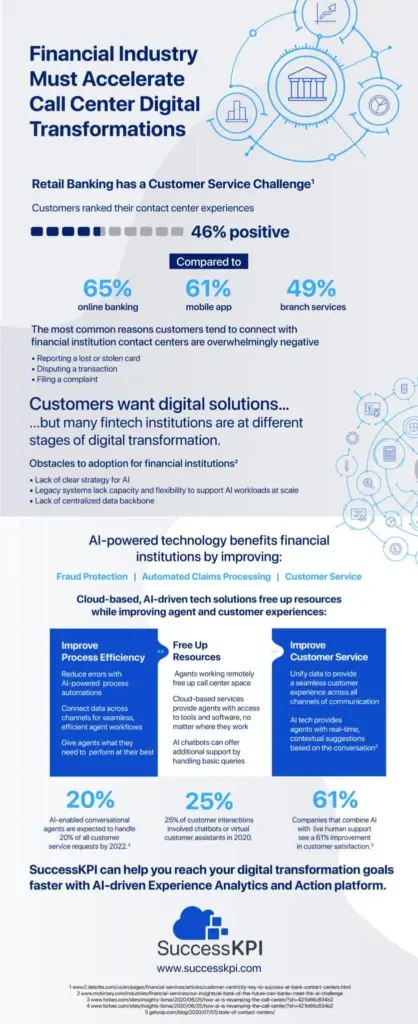
Financial institutions are a cornerstone of the economy yet they are one of the last institutions to fully embrace digital transformation in the modern age. While many offer website and mobile apps, their customer service contact centers and data operations remain woefully behind the curve.
A lack of unified data and outdated tech for agents contribute to the reputation for poor customer service many financial institutions face. To top it off, customers are much more likely to reach out when experiencing something negative and stressful, such as fraud or a lost or stolen card. This combination of an already unhappy customer and an agent that doesn’t have all of their information or ability to solve their issue results in an unsurprising increase in customer dissatisfaction.
Today’s customers want digital solutions and self-service options but many financial institutions fall short of their expectations. The key to fixing this is to accelerate your digital transformation through investments in cloud-based, AI-powered technologies. Unfortunately, common barriers to this are a lack of clear strategy for AI technologies, limitations in flexibility and scalability presented by legacy systems, and a failure to centralize and share key data between backend systems.
To overcome these challenges requires a shift in focus from legacy to the cloud. Cloud-based contact center tools enable you to improve process efficiency and free up resources, all while improving both agent and customer experiences. Many organizations talk about omnichannel communication with their customers, but this is the way to fully deliver on that promise.
Process Improvement and Automation
A key element of increased efficiency is a unified data infrastructure that makes all of your data actionable across the organization. AI-powered workflows can intelligently automate processes and adapt to your business needs while keeping you informed on all of your key metrics.
Efficient and Flexible Resource Allocation
Investment in effective cloud-based technologies unlocks the level of flexibility and rapid scalability that is made unattainable by legacy systems. By upgrading your tech tools, you empower your agents with everything they need, no matter where or how they work.
Improved Experience for Customers and Agents
Unified data means you can give customers what they truly want – a true omnichannel experience. Create a seamless experience no matter how they connect and interact with your business, whether online or in-person. AI tools ensure that agents not only have the data they need but also contextual guidance to provide exemplary service by rapidly identifying and solving customer problems.
Leveraging the cloud can help you overcome the biggest barriers to digital transformation faced by financial institutions and level up your customer experience. SuccessKPI can help you reach your digital transformation goals faster with the cloud-based, AI-driven contact center of the future.
Check out our infographic to learn how SuccessKPI can help with your Call Center digital transformation goals:
In recent years, customer experience has come into sharp focus as a prime indicator of organization health. As customers become more empowered, their expectations of customer service have risen exponentially and can be more difficult than ever to meet. To keep your finger on the pulse of your customer’s expectations and experience, you must look beyond the information gleaned from software user interfaces and web analytics to the true information gold mine: your contact center.
With every contact center interaction, your organization has an opportunity to connect with a customer under the best and worst circumstances. The goal is that every agent is able to give a consistent and positive experience each time they interact with a customer. How can you be sure that’s happening? By establishing clear methodologies for contact center quality management that appropriately balance productivity with quality.
New era of customer expectation
Today’s customers have many tools at their fingertips to help them decide how they want to do business, and with whom. There is little room for error when it comes to meeting customer expectations. Not to mention, these expectations span across multiple channels – email, chat, and phone – and customers expect a seamless and consistent experience across all. In fact, studies have shown that 78% of consumers will permanently change how they feel about a business based on a single contact center interaction (Forbes).
Ensuring a high quality contact center experience can provide a competitive advantage to your business. This means the focus must be customer-centric, not driven solely by costs or out-moded measures of agent productivity. Some key expectations that must be met include seamless omnichannel experiences, a strong sense that they are valued and appreciated, and most importantly, heard, and that their issue is being addressed quickly. When assessing your contact center quality management, these factors must be considered and effective measures of success determined.
Evolution of the contact center
Customer expectations are not all that has changed in recent years. The contact center has rapidly evolved from the old school call center model to a far more decentralized one. Flexible staffing needs (as well as the pandemic) have given rise to remote agents, primarily working from home. The drive towards omnichannel communications means contact centers rely on smarter, cloud-based and AI-driven tools to support customers across channels (Contact Center World).
This evolution can be a double-edged sword for contact center quality assurance. On one side, it is far easier to provide agents with the tools and data they need to support customers effectively. On the flip side are the challenges with quality monitoring to ensure consistent and positive customer experiences. As the contact center and it’s arsenal of tools and communication channels continue to evolve, so must the metrics and methodologies organizations use to monitor and manage contact center quality.
Supporting today’s agents
Contact center agents bear an important weight of responsibility for ensuring that your company’s customer-centric initiatives are being met. They need access to the tools, data, and training required to meet the expectations of both customers and management. Agent metrics need to measure and monitor more than simplistic stats like call time or case volumes. They should focus on meaningful measurements that are channel-appropriate and measure outcomes over inputs.
Contact center quality management must also focus on identifying agent training or knowledge gaps, as well as monitoring adherence to scripts, policies, and regulatory standards. Agents will be their most successful when they are well-supported with training and growth opportunities, have clear performance goals, and feel a sense of ownership towards overall business objectives. A high quality contact center will utilize powerful, cloud-based tools to support agents, providing them with key customer data and context-aware solutions. These tools will also provide management with reporting, analytics, and monitoring tools to fully support their workforce while reducing burnout and churn.
Using QM to Evaluate
In the end, contact center quality management rolls back to metrics and data. These metrics can be key indicators of your organizational health, as customer-centricity comes from the top down. But standard customer service metrics alone cannot paint a complete picture. You must clearly identify your organization’s primary objectives, business goals, and opportunities.
As you establish your key performance indicators that monitor your progress, strategically align them with your customer experience goals. These metrics should include measures from these five categories: customer satisfaction (CSAT), customer loyalty, brand reputation, operational quality, and employee engagement (Gartner).
Many of the metrics in these categories can be monitored through the contact center and related customer data. By implementing effective contact center tools or partnering with a cloud-based contact center provider, you can easily report on metrics that not only monitor contact center quality assurance but overall organizational performance and health. These partnerships can be the key to achieving your customer-centric business goals and advancing ahead of the competition. While your customer-centric approach needs to start from the top down, your strategic monitoring needs to come from the ground up.
Learn more about contact center quality assurance evaluation methods here.
In the face of changing regulations in the debt collection industry, specifically Regulation F, many organizations are rethinking their approach to compliance and operations. To discuss this challenge and the sea of change it is sure to bring, I met with Mike Gibb of AccountRecovery.net, Jim Beck of MRS BPO, and Tim Collins of Indebted. We discussed Regulation F, how to adapt (and thrive) in today’s communications landscape, and how contact centers focused on debt collection can improve efficiency while increasing value and revenue through key investments in technology. Let’s explore some key takeaways from this powerful discussion.
An industry poised for change
We live in a highly digital world. The generation that grew up with computers and experienced the rise of the internet and the proliferation of mobile technology first-hand is now approaching their 40s. Text-based communications mediums have grown and prospered — email and text messaging are the preferred means of communication for many digital natives. Making contact with a consumer with an outbound call is less likely now than ever before.
What does this mean for an industry that has traditionally worked via snail mail and telephone? Debt collection agencies must be prepared to embrace regulatory change and leverage preferred communication channels in order to better serve today’s consumers. This change is long overdue and stands to benefit both sides — customers benefit from increased options that meet their needs and preferences and organizations have the opportunity to add value while increasing revenue and collection rates.
Shift focus from compliance to operations
Across every industry, we are seeing a major shift in focus to be more customer-centric. But how does that apply to debt collection? Most collection agencies have spent the majority of their efforts on maintaining compliance with regulations and laws regarding when and how they connect with consumers while maintaining appropriate audit records.
A common target KPI is the number of calls made, yet these numbers tell us little about the actual success rates, much less how to grow and improve. In order to be successful while navigating all the changes afoot, organizations need to shift their focus from compliance towards operations. These operational changes must cover improving the customer experience by offering better tools for self-service, unified cross-channel communications, as well as robust controls for opting in or out of specific channels.
Gain efficiencies
With this shift in focus towards operational excellence, not only can businesses improve the customer experience and increase engagement, they are also setting themselves up to increase efficiency across the board. That said, to fully make the leap, businesses must invest in tech that supports updated operational workflows. As Tim Collins of shared, “There’s an opportunity here where you can grow revenue, but do it more effectively using the technology, using self serve, and thereby empowering the customer.”
“There’s an opportunity here where you can grow revenue, but do it more effectively using the technology, using self serve, and thereby empowering the customer.”
Tim Collins, Chief Customer Officer, InDebted
This tech can come in several forms, from the platform a business uses to manage and run their contact center, to updating their website to include a customer portal, and utilizing CRM-style tools to manage customer data and communications. This also means leveraging artificial intelligence (AI) for self-service. Whether that looks like AI-powered chatbots as an alternative to speaking with an agent and/or AI-fueled data analysis to help improve information flow to agents, AI can improve customer experience and operational efficiency by upwards of 25%.
Increase value and revenue
With the right approach, not only can you realize great gains in efficiency, you can simultaneously increase value to your customers and increase revenue. To achieve this, you will need to fully commit –– not only to smart tech investments that include AI, but to rethinking your communications approach and all of your service options.
Today’s consumers want control over their communications and more self-serve options. One major industry change is the switch towards inbound over outbound communications. This can come in several forms:
An online self-service portal where customers can pay their account, handle disputes, assess options, chat with an AI-bot, and/or schedule time with a live agent. A great example of this is MRS BPO’s portal
Robust communication controls that allow customers to opt in or out of specific communication channels, select their preferred methods, and set availability timeframes
A completely unified cross-channel approach where customer information is accessible no matter where or how communication takes place. This should extend beyond phone calls to email, chat, direct messaging, and social media.
By doing this, you give consumers options and control, which makes it far more likely to make an initial connection and maintain communication long-term. Jim Beck of MRS BPO summed this up well, “We need to think about how we can reach customers in a way where it’s easy for them to respond and they’re not embarrassed by the situation.” It may take multiple touch points to actually collect payment but by giving them flexibility and control, you are more likely to succeed. Your revenue goes up as you successfully collect on more debts, customers experience more value and better outcomes, and this is all thanks to an efficient, customer-centric process.
“We need to think about how we can reach customers in a way where it’s easy for them to respond.”
Jim Beck, Chief Operations Officer, MRS BPO
Data is key for operations and compliance
While we may see a shift in primary focus to operations and customer experience, compliance is never far behind. More communication channels means a much stronger need to leverage technology that brings them all together on the backend — with proper tools, all communications can and should be tracked in the customer record.
The next extension of this unification is using AI-powered tools to monitor customer data, identify patterns and predictive models, and build proactive workflows. Through AI, you can better understand when and how your customers communicate, and what tools they are using on your portal. You can also use AI data analysis to provide better information and feedback to your contact center agents in real-time.
While we may see a shift in primary focus to operations and customer experience, compliance is never far behind. More communication channels means a much stronger need to leverage technology that brings them all together on the backend — with proper tools, all communications can and should be tracked in the customer record.
The next extension of this unification is using AI-powered tools to monitor customer data, identify patterns and predictive models, and build proactive workflows. Through AI, you can better understand when and how your customers communicate, and what tools they are using on your portal. You can also use AI data analysis to provide better information and feedback to your contact center agents in real-time.
Bringing this all together to build the contact center of the future
It is possible to increase value by improving customer experiences and outcomes, while simultaneously improving operational efficiency and increasing revenue. Mike Gibb of AccountRecovery.net put it perfectly, “Your agents, technology and reporting practices can be a competitive advantage.” To do so requires smart technology investments that leverage AI to help reduce friction for consumers, leveraging a true multi-channel communications approach, and using advanced data analytics to stay out in front of the competition.
“Your agents, technology and reporting practices can be a competitive advantage.”
Mike Gibb, Editor, AccountsRecovery.net
To learn more about how SuccessKPI can help you use AI to power the contact center of the future, visit us here.
Technology is changing business operations across industries, and organizations are under increasing pressure by the day to achieve digital transformation to remain competitive. Contact centers often turn to Business Process Outsourcing (BPO) organizations to help them cross this critical bridge.
Simultaneously, the spotlight is intensely focused on the customer experience, and their expectations are higher than ever before. BPO contact centers are in a unique position to help organizations achieve their customer-centric objectives. To do so, they must round the corner on digital transformation in order to offer maximum value in a complex and competitive landscape.
Digital transformation is no longer optional
The BPO industry is primed for high growth. The customer care BPO market is projected to grow from US$ 22,598.82 million in 2022 to US$ 34,570.73 million by 2028; it is estimated to record a CAGR of 7.5% from 2023 to 2028. (The Insight Partners). Both BPOs and the companies seeking to outsource operations are facing the reality that digital transformation isn’t a question of if, it’s when. For BPO contact centers, achieving high levels of digital transformation rapidly positions them to offer undeniable value to partner organizations and their customers.
Forward-thinking BPOs can help organizations address challenges with the explosion of data and digital tools that make up modern business ops. To be a key partner, BPOs must be prepared to help break down data barriers to streamline business processes. The BPO contact center must take a modern approach to CS tools, customer data, and communications. The question that remains is how to get there.
The regulatory landscape is growing more complex
The world of customer communications is in great flux. Customers want cohesive, omnichannel experiences while also wanting greater control over how businesses communicate with them. At the same time, new rulesets like Regulation F for the debt collection industry are changing the game.
Digital transformation helps BPO contact centers treat these regulations as a new opportunity to add value.
Get the inside line on the hows and whys of contact center digital transformation as a BPO. Download the whitepaper today.
Modern BPO Contact Center: Achieving Competitive Advantage with Digital Transformation
How can BPOs keep up, provide value, and ultimately, get the job done, all while also maintaining a positive work culture for agents and staff? In this white paper, we will provide guidance on how to evolve as a BPO contact center in the age of digital transformation.
One thing businesses learned during the pandemic was the value of cloud-based applications. Organizations benefited from the ability to work-from-anywhere with all the security, scalability, and functionality they needed. Those businesses also began to realize they can save as much as 40% in Total Cost of Ownership (TCO or the sum of all costs involved in the purchase, operation, and maintenance of a given asset during its lifetime) simply by migrating applications to the public cloud. This was especially true for contact centers; unlike their on-premises solution, CCaaS solutions made it easy to add new customer communication channels such as web chat, social channels, and messaging apps; expand self-service with voice bots and chatbots; and enable work-from-home for contact center agents and support teams.
Add those to the already well-known benefits of cloud applications, such as scalability, global reach, and resiliency, and together they make the business case for migrating to the cloud extremely compelling. But there’s one more area that doesn’t get as much attention when we consider the benefits of migrating to the cloud – and that’s the extraordinary leaps in real-time and historical reporting and the actionable insights that can be gained.
Do you have a single source of truth?
Every enterprise has amassed dozens of systems and applications – from HR and CRM to marketing, customer service, support tickets, and more. The problem is that information from and about all of these applications is typically siloed even within the most data-conscious organizations. So when the business or the CX service center wants to understand their performance and make decisions for future success, do they have access to all of the relevant data? Is there a single source of truth? Because without it you’re only seeing part of the story, yet making decisions that can impact the entire company.
What data are you leaving untapped?
The term ‘Big Data’ became mainstream during the 1990’s as companies grappled with the massive amounts of data that was being generated through web-based and social media interactions. Not only was the amount of data growing exponentially, but much of the content was highly unstructured making it that much more unmanageable nor useful. This last decade has seen the growth of mobile content including location data and context-relevant analysis, as well as internet enabled IoT devices that are generating zettabytes of data every day. (How many zeroes is that?)
Even if you’re not utilizing IoT, it’s probably fair to say there’s a whole lot of customer experience data your organization is leaving on the table – but as you make your move to a cloud-based contact center solution, the time is right for making your reports extraordinary! One key step is tapping into your unstructured data.
Structured and unstructured data
Structured data is quantitative, pre-defined data that can be quickly input, searched and manipulated – and is at the core of customer relationship management (CRM) applications and their insights. For example, a customer’s address, phone number and items purchased. Unstructured data, on the other hand, is qualitative making it unable to be processed in the same manner as structured data, even though it is estimated that over 80% of all enterprise data is unstructured. Examples of unstructured data include social media posts and mobile activity.
More accessible data = more insights
As part of your migration to a cloud-based contact center application, make sure you’re expanding what you know about your customers and your operations. Looking through the lens of structured and unstructured data, here are steps you can take.
Structured data. Your cloud migration is an ideal time to start breaking down the data silos within your organization. Folding in existing stand-alone applications and their structured data into your ‘single source of truth’ is low-hanging fruit for CX analytics applications because data connectors and pre-built integrations via cloud-based open APIs make it lower effort. By combining data from multiple sources, you’ll get a clearer view of your entire business – across channels, agents, interactions, and regions.And when you connect data from your CRM, marketing, campaign, billing, collections, case management, and other operational and business support systems, you’ll end up with a much more complete 360° view of your customers and your business.
Unstructured data: There’s a lot of unstructured data within your organization. Making it usable necessitates an additional step, but it’s well worth the effort. And the best place to start is with real-time AI powered speech and text analytics. Once a conversation is transcribed, the now “structured” data can be included in any or all of your contact center metrics, including IVR outcomes, chat conversations, Average Handle Time, Agent Performance data, call duration, After Call Work. Now that the specific content has “structure,” the data can now be imported, curated, and blended with the speech and text analytics layer.
In addition to bridging structured and unstructured data, SuccessKPI uses Natural Language Processing engines to transcribe, understand, and analyze voice and text streams in 30+ languages. From there, you’re able to understand themes and topics, as well as detect sentiment from real-time interactions such as calls and texts – then immediately execute the best next step(s) in the customer’s journey.
And one of the biggest benefits is that you’ll never have to contend with two answers for the same data element again because SuccessKPI uses a unified data warehouse plus business intelligence layer that’s utilized by every dashboard and report.
The result is a single source of truth and the ability to make highly-informed decisions using extraordinary reports.
Looking to make the leap to the Cloud? Get your copy of Tested Strategies for Greenfield Cloud Deployments featuring three real-world greenfield deployments that our customers have achieved spanning multiple industries and scale. Uncover lessons learned and avoid the common pitfalls in a cloud contact center deployment, including retaining and gaining access to insightful data for your business.
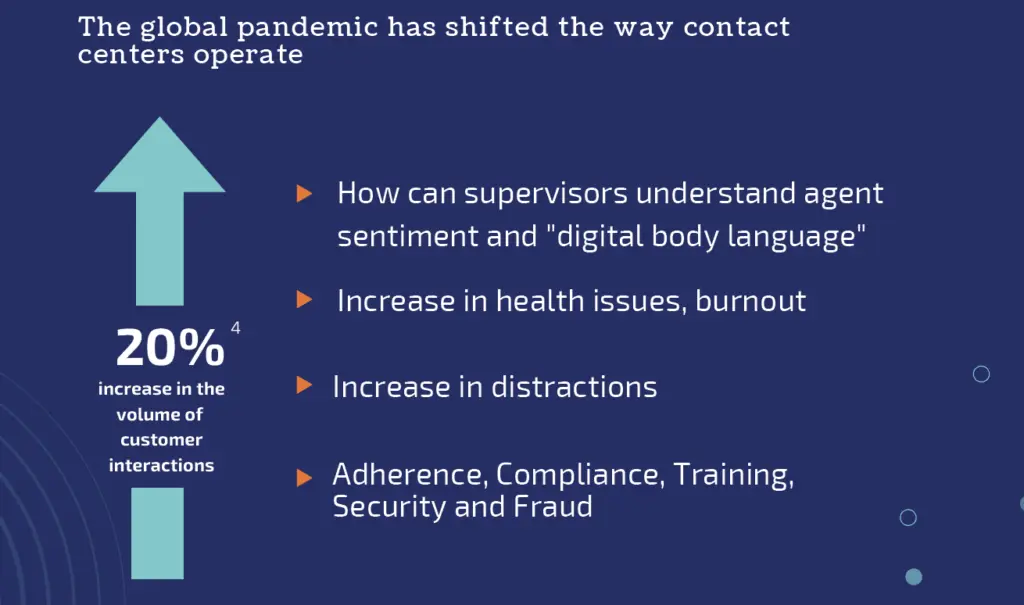
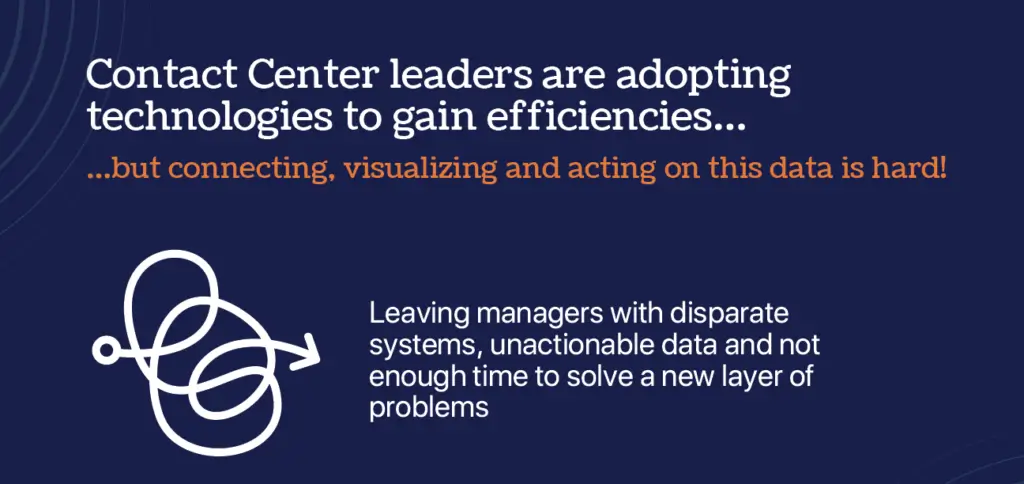
Running a contact center has inherent challenges — striking the perfect balance between customer satisfaction, agent satisfaction, and efficiency isn’t simple. Most organizations seek to understand their contact center performance by measuring agent and customer metrics but, as anyone who’s ever had a call center job can tell you, accessing all the information you need to do so isn’t always as straightforward as you need it to be. To further complicate matters, the major shift during the pandemic has left agents stretched thin with high levels of burnout, management struggling to oversee, coach and ensure compliance, and technology systems needing drastic transformation to support the digital and remote first era.
Agents are struggling
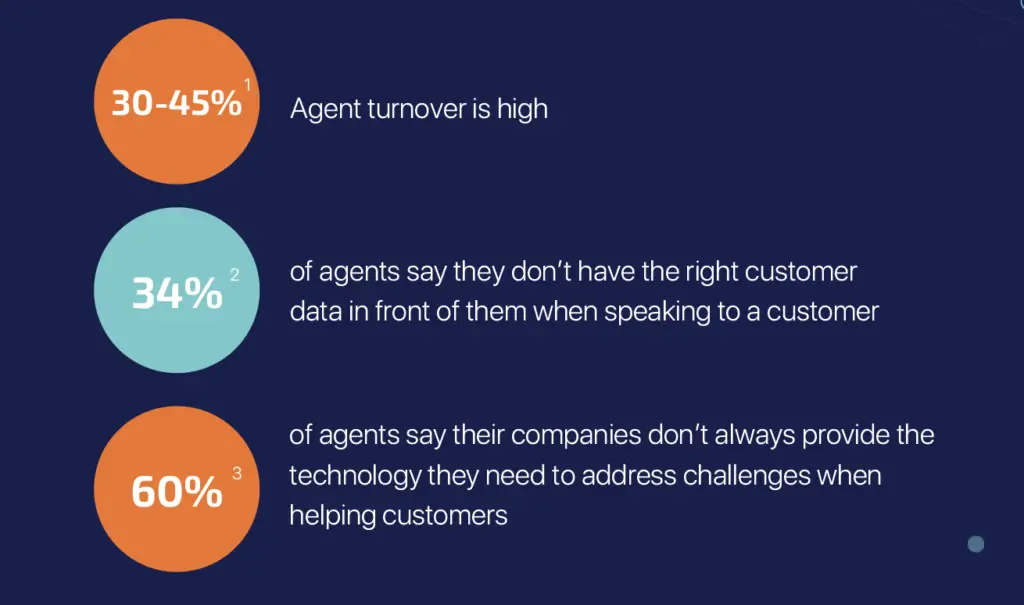
Customer expectations have never been higher. Today’s contact center agents are struggling with multiple challenges that make meeting them more difficult than ever. Most contact centers are short-staffed due to high turnover and agent burnout. Furthermore, many agents feel that their companies aren’t providing the tools and customer data they need to successfully assist and resolve customer issues. Those with remote call center jobs may feel disconnected from the resources they need to upskill or just get the support they need when problems arise.
Supervisors are struggling
Not only are customer expectations higher overall, but they are connecting with contact centers at 20% higher rates. Meanwhile, the ability to oversee their agents has shifted dramatically, especially for contact centers that have moved to remote, home-based agents. It is harder than ever to identify agent training gaps while ensuring compliance to policy, maintaining security, and identifying (and preventing) fraud.
Gain new levels of efficiency with tech
With high burnout leading to increased turnover, businesses need to be able to do more with less while making it easier for their contact center employees to succeed in meeting company goals and customer expectations. In other words, they need to help solve burnout at its root cause (rather than simply working around it) by providing better tools and data to both agents and supervisors. They must also leverage performance metrics that provide high business value for customer satisfaction and business growth. This means that new, smarter tech and a new approach overall are needed.
A new approach for contact center success
The future of contact center technology lies in AI and connected data. An AI-powered contact center will allow you to serve your customers more effectively while increasing efficiency and reducing burnout. But to be successful in leveraging an AI-powered contact center, businesses should follow five key steps.
First, clearly identify business goals and objectives for their desired growth. Second, assess the options and select the right platform that solves for specific business and contact center challenges, and is designed for business users so that the data and insights are accessible and actionable. Third, bring together all customer experience data into one place for a holistic, cross-channel approach. Fourth, define the workflows and metrics that help agents succeed and drive progress towards their business goals. These workflows should be enabled by AI to reduce workload burden, increase accuracy and improve business outcomes. Finally, use the results to identify training and coaching opportunities. Setup business rules to automatically score as many as all your conversations against the coaching criteria, making it easy to identify what can be measured automatically and what needs to be sent for evaluation with a supervisor for coaching.
Learn more about how SuccessKPI leverages the power of AI and machine learning to solve the most critical and challenging contact center issues.
Customers demand quality service at all times. While it’s easy to provide quality services, maintaining that for a long time makes the difference.
Large enterprises leverage quality assurance to improve customer satisfaction and gain a competitive edge. The process of quality assurance helps identify flaws and shortcomings in service provision. With great call center quality assurance software, you can easily monitor calls and detect areas that need improvement.
What Is Call Center Quality Assurance Software?
Call center quality assurance software helps to evaluate all interactions between agents and callers. This software has all the functionalities call center managers need to gauge agent performance and ensure customers derive the ultimate satisfaction.
There are several forms of interaction, such as call, e-mail, text, and chatbot. Managers can create a scoring model for each to determine the quality of interaction. When leveraging the quality assurance software, you can improve agent performance, productivity, and the overall customer experience.
How a Call Center Quality Assurance Software Can Revolutionize the Enterprise
The ability to monitor and interact with calls in quality assurance software in real-time is very beneficial in many ways. These include:
1. Train Agents Effectively
Training call center agents, especially in large enterprises, is a continuous process. Business goals, processes, competition, and culture keep changing. Therefore, managers should train agents to meet those changes. They will need the skills and knowledge to handle even the most demanding customers.
Call center quality assurance software replaces the traditional methods not based on any facts or data. Instead, it evaluates each agent to identify his or her weaknesses and strengths. With that in mind, managers can create training programs that improve the agent’s performance.
2. Adhere to Compliance Requirements
There are a set of rules and requirements that agents need to follow when interacting with customers. It is incumbent on every organization to maintain customer privacy and data security.
Call centers ought to mitigate regulatory compliance risks. Every call center should comply with the requirements of these regulatory standards:
HIPAA
The National Do Not Call Registry (DNC)
General Data Protection Regulation (GDPR)
Fair Debt Collection
The call center should also comply with protocols, such as call monitoring consent and obtaining credit card data.
The call center quality assurance software allows you to implement robust control measures that reduce vulnerability.
3. Improve Customer Retention
The cost of acquiring a new customer is by far higher than retaining the ones you have. Since customers play an integral part in any organization, keeping them happy pays off significantly. But to keep customers happy, you have to meet expectations. When your organization does not meet customers’ expectations, it’s easy for them to abandon your products or services.
Through monitoring interaction with the call center quality assurance software, the enterprise can maintain a consistent service quality over time. Pulling customer data from multiple touchpoints provides crucial intel that agents can utilize to enhance service delivery.
4. Driving Customer Experience Improvements
A great customer experience is a driving force in any organization. It helps retain customers and boost revenue.
With call center QA software, you can measure the extent to which you are providing a great customer experience. You can perform a root cause analysis, identify the causes of problems, and drive customer experience improvement.
The Bottom Line
Call center quality assurance software is a smart and effective way to manage interactions. An efficient QA software can enhance customer service and retention and boost stronger employee motivation.
SuccessKPI AI-powered quality assurance software utilizes powerful analytics and KPIs to empower agents and streamline your call center operations. With our software, you can monitor interaction in real-time and improve how agents communicate with customers throughout the customer journey. Also, it allows you to utilize KPIs to gain deeper insights into your contact center operations for better customer service.
Contact us today to see how we can enhance quality assurance with SuccessKPI software!
Speech Analytics has been around for a long time within contact centers but less than 5% of contact centers out there leverage this technology. Based on the latest survey conducted by SuccessKPIs, more than 80% contact centers find speech analytics useful. That’s a huge gap between a ‘business need’ and actual ‘market penetration’. There are various reasons for this:
Accuracy – Traditionally vendors have relied on technologies like Nuance for speech to text conversion and then build linguistic models on top of it. Today, Amazon not only has made it less expensive for a vendor to offer this service but also with better accuracy through AI driven services. And its only getting better every passing day.
Time & Cost – It was always considered an elite product meant for rich businesses. Most of the cost was partly driven by the cost of underlying components but most importantly due to lack of a solid business model. Server-less architecture, multi-tenancy and leveraging amazon services have brought the cost significantly down. Can old players adopt these themes? If yes then how fast? That is yet to be seen.
Business Intelligence Integration – All the customers we have talked to want to blend speech analytics data with that of IVR and Contact center. Most of the vendors talk about supporting BI Tools but yet again fail to offer this integration out of box. When it does come, it comes with big price tag and long time to deploy.
Call to Action – What do you do as a business when a specific topic or phrase is found? Well, most of the platforms would probably tell you the calls on which a specific phrase or topic is found but we need to take it to the next level where customers could take automated actions based on some rules. If a customer is likely to churn, a task should be created in Salesforce and automatically assigned to the respective Account Rep.
Focus on business outcome – Most of the current vendors who have focused on technology and business outcomes are mostly left to marketing. What is really needed is to bake the business outcome into the product. If a customer is looking to drive down the Churn or improve Agent Performance, product should allow them a quick way to get there in a few clicks and not months of deployment and tuning.
So if you are looking to leverage speech analytics for your business and hit the ground running, there is no better time to do that. Speech Analytics is indeed becoming mainstream, thanks to vendors like SuccessKPIs and Amazon.
The first time I heard about speech analytics I was in awe. I was running an IVR company and could barely get the IVR prompts to be understood. How on earth could anyone be analyzing whole sentences? I spent a few days in a contact center with a friend to see the fuss and was disappointed. Turns out they weren’t getting all the words but even these early products were starting to make progress by spotting really troublesome and pervasive problems. The problem was it took millions of utterances and thousands of hours to make this stuff work. Fast forward a decade and everything has changed. New technology from the likes of Amazon and Google have fundamentally changed the raw materials and speech transcription JUST WORKS! And in dozens of languages. With the advent of tools like SuccessKPI, the setup takes MINUTES! I know I am not supposed to break character this early in the blog but the magic created by the likes of Amazon is nothing short of breathtaking. But it needs to be accessible. And that is where the magic starts to happen! Let’s take a closer look at what is happening.
AI-Powered Call Center Speech Analytics Is the Future of Enterprise Customer Service Post-COVID-19
Artificial intelligence sits at the intersection of call center speech analytics and quality management. Once considered a pipe dream for contact centers, AI is actively changing the contact center as we know it. According to a survey by Gartner, AI is one of the top five customer experience (CX) trends in 2020. The survey concluded enterprises could use AI to solve problems in the customer journey they can’t solve with traditional technology. But how can we use it? Speech Analytics is a fast lane to AI in the contact center!
Today, enterprises use natural language processing and speech technology to analyze and transcribe customer support calls on a massive scale. With tools that enable instant setup, we can now analyze 100 percent of customer conversations to improve agent performance and improve customer experience.
COVID-19: And the Pandemic Helped these AI Tools to Bloom!
COVID-19 has changed the call center’s dynamics by disrupting global supply chains, employee work patterns, operations, and interaction channels.
A report published by Information Services Group said the pandemic’s global effects have forced call centers to change the way they operate. In reality, lockdowns have led to a spike in call volumes in many industries. Meanwhile, most enterprises have had to adapt to work-at-home arrangements for call center agents.
From a short-term perspective, moving agents from the office to working from home is a solution to the crisis. However, the bigger challenge enterprises have to deal with is ensuring that the work-at-home model is sustainable long term. How do we know what is happening inside conversations we cannot see OR hear?
Meeting the COVID-19 Challenge
Enterprises can invest in effective remote call center work environments to help agents continue to successfully work from home. With the right support technology in place, agents can perform their work with supervisors able to manage, coach and empower remotely. The result is a higher level of customer experience and exceptional customer experience delivered remotely.
Through the power of AI based speech analytics and machine learning, contact center management and customer experience (CX) leadership can now “listen” to millions of customers and understand what improvements are necessary. Capturing key signals across the whole customer journey helps drive operational improvements and delivers a seamless experience management 360-degree view.
Speech Analytics Is Proving New Value in Troubled Times
Across dozens of industries, we can help call center leadership reduce operational costs, enforce regulatory compliance, and identify and close knowledge gaps.
Today, speech analytics tools are helping enterprises to see customers through the COVID-19 crisis. These tools record customer calls and analyze them to extract actionable insights. Management can use these insights to:
1. Assess the Impact of COVID-19 on Customers
Organizations can use contextual analytics to identify how COVID-19 is affecting customers.
2. Identify and Solve Visibility Issues
Identification of the visibility that supervisors and managers lack to guarantee compliance, quality, and effectiveness.
3. Prioritize Business Changes and Customer Response
Intelligence gathered from speech analytics tools can help management uncover and weigh the issues affecting customers. They can use this information to prioritize response and action through data-driven evidence.
4. Ensure Agents Respond Accurately, Effectively, and Sensitively
Contact center management can analyze how agents are responding and equip them to improve outcomes.
5. Improve Remote Performance
Speech analytics can help organizations identify and address the challenges affecting the ability of work-at-home agents to serve customers.
Conclusion
Customers will remember the good and the bad from 2020 and 2021. But they will also remember how the enterprises treated them. They will remember those that supported them and got better DESPITE the crisis and gave them the information they needed to make critical decisions. They will remember those that responded with empathy and understanding. And they will also remember those that failed them. Contact center speech analytics tools can help organizations put their best foot forward in these trying times. Find out more here.