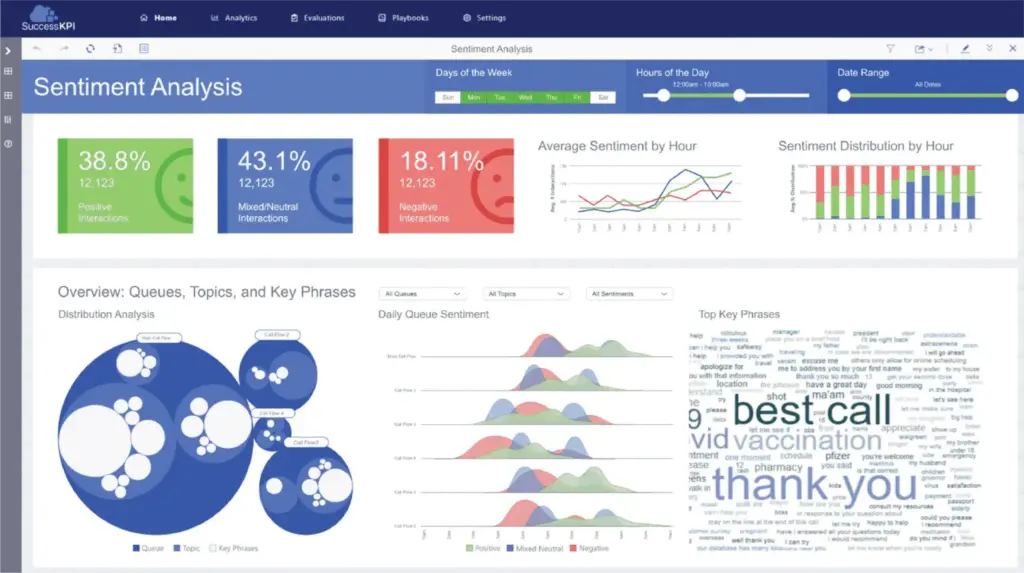
Call center managers play a crucial role in meeting organizational goals. Since the call center is the point of contact between customers and the business, it requires top-notch management. Luckily, managers can utilize a wide range of call center analytics metrics and reporting capabilities to gauge success.
Proper call center analytics and reporting can improve campaign success significantly. Thanks to modern call center tools, managers can measure, review, interpret, and review results for the call center campaigns. This helps them to make informed decisions on how to improve operations.
Let’s look at six crucial call center metrics analytics and reporting tools a call center manager should watch.
This call center metric measures the productivity of agents against their capacity. This figure is the percentage of time spent on calls and other call-related tasks against the total duration spend on all other call center activities. For instance, an agent spends four hours on calls from a total of six hours on the other tasks combined. The percentage of agent utilization would be 67 percent.
Agent utilization provides vital insights into the call center’s effectiveness. A high utilization ratio of around 80 percent is ideal for any call center.
Agent utilization is crucial for call center managers in a variety of ways. Managers use it to gauge the effectiveness of agents and spot potential problems. A very high utilization ratio can indicate agent burnout or overwork and translate to a dip in productivity. On the flip side, a low agent utilization ratio can indicate the call center has excess staff, which translates to high costs.
Both the manager and the team stay in touch with the number of calls in the queue. You need to continuously check the number of calls so you can pace the agents accordingly. It gives real-time knowledge of the agent’s workload.
Every call center manager should monitor the busiest hours when the call center receives the highest number of calls. This analytics metric helps prepare for the high influx of calls and ensures the team is ready for more call work.
This information comes in handy when you want to staff the call center and schedule agents. Proper staff scheduling during peak hours guarantees you have the most skilled agents on board.
This metric is essential for call center managers who want to improve cost efficiency. Managers should monitor the cost per call to identify the situations that add to the total costs. Ideally, managers should track the cost per call against a set value to ensure it does not exceed a certain amount
The average on-hold time is the percentage of the total call spent on hold. Agents can put customers on hold to confirm something, transfer the calls, etc. A high average on-hold time could result in low customer satisfaction. For some customers, it’s expensive to stay on hold. This eventually results in a poor customer experience.
Managers need to keep an eye on the hold time to ensure agents don’t keep customers waiting too long. Ideally, managers should set a maximum hold time that a customer should stay on hold before the agent checks back.
You need to maintain a low call abandonment rate to limit churn, enhance performance, and stay compliant with the SLA. Ideally, the abandonment rate should be lower than 8 percent at all times.
A high abandonment rate is bad news for customer retention. Therefore, every manager should aim for as low an abandonment rate as possible.
In this article, we looked at the ultimate call center metrics and reporting guide for every manager. These metrics help you to monitor the critical areas of the call center that contribute to organizational goals. As long as you stay in touch with these metrics, you’ll easily improve the call center’s performance.
SuccessKPI provides all the essential metrics that you need for call center management. Our technology provides deeper insights into customer interactions and gives a 360-degree view of the call center. Contact us today or book a demo to understand how SuccessKPI works!
A recent survey showed, 86% of buyers are willing to pay more for a great customer experience. A Walker Study found that at the end of 2020, customer experience will overtake price and product as the key brand differentiator. But how are businesses going to build great customer experiences? There is no magic wand. They must listen to their customer to learn. Speech and text analytics becomes the most critical tool towards that goal. But leveraging this technology is as much Science as Art. Let’s discuss why Speech and Text analytics delivers on that promise.
Speech and text analytics tools have become an integral part of exceptional customer experience. Enterprises have discovered that interactions with customers and prospects hold valuable business intelligence and customer satisfaction insights.
The Cisco Contact Center Global Survey 2020 found 90 percent of organizations consider customer journey data analytics an essential function of the contact center. Unfortunately, many organizations fail to take full advantage of these insights. They leave opportunities to improve customer service on the table.
Managing a contact center often feels like herding a bunch of cats. While enterprises focus on improving one area, another area goes haywire. As a result, leaders are in a constant state of damage control. For this reason, organizations must get analytics right. Here are some of the mistakes enterprises must avoid:
Many organizations have invested in call centers that function in silos. As a result, there’s no easy way to integrate the data into a single truth source that can help leadership make decisions.
In some cases, organizations use ad hoc tools to solve specific problems instead of having a single integrated speech and text analytics platform. Even worse, teams across the organization don’t have access to the same data.
Often, organizations generate insight from analytics tools but fail to translate the insights into meaningful action. For example, some companies run speech and text analytics to calculate customer satisfaction and first call resolution (FCR) metrics. However, they fail to use the feedback to redesign or transform internal processes.
Most times, operations managers don’t know what to do with the analytics.
Analytics give contact center managers and agents the boost they need to perform at their best. Organizations can use analytics to identify best practices, measure performance, guide agents, and improve coaching. In short, analytics helps organizations to provide the best possible customer experience. But how can organizations get analytics right?
Organizations must have a coherent and clear enterprise-wide vision for analytics. Leadership should link the vision to the overall business strategy and have a clear road map for implementing specific use cases. For example, an organization may want to offer more self-service options to reduce call center demand.
Coping with dramatic and sudden changes requires organizations to be agile and resilient. This is particularly true today as the world tries to respond to the changes caused by the COVID-19 pandemic.
To create an agile culture, organizations must build strong in-house talent in analytics that aligns with their strategic goals. Moreover, organizations need agile mechanisms that can help them take advantage of analytics-driven insights.
Getting the right speech and text analytics tools is a critical step toward getting analytics right. Organizations must create a comprehensive data strategy and ecosystem that supports the broader analytics strategy of the organization.
Also, organizations must invest in building data lakes. These data lakes act as a single source of all data on agents, customers, surveys, product performance, and other sources.
Very few organizations can meet all their analytics and data needs internally. For this reason, they must identify the conditions they can handle in-house and those they should outsource to experts.
Leading organizations make decisions based on data rather than instinct. Some decisions data can help include hiring, coaching, performance-based bonuses, and other initiatives that improve outcomes.
Call centers are a gold mine for enterprises that want to understand customer pain points. Unfortunately, many enterprises miss out on a clear opportunity by failing to use the data generated to differentiate themselves from the competition. Using speech and text analytics tools the right way can help enterprises smash down data silos and unlock a 360-degree view of the call center.
Find out more here: Speech and Text Analytics
Organizations use various contact center channels to interact and understand customers. These numerous channels create a problem when it comes to sorting out customer data. Interaction analytics provides the solution to analyze customer interaction data as a whole to solve this problem.
Ideally, interaction analytics is an omnichannel approach to analyzing data from all channels in the call center. It allows managers to get insights from interactions, provide support to agents, create the best interaction practices, and enhance performance. This results in consistent customer experience and high customer retention.
Here are some of the ways how interaction analytics improves call center productivity:
Interaction analytics enables organizations to analyze data from all conversations rather than a small sample. Organizations that interact with customers across different channels, such as IVR, text, voice calls, etc., can leverage interaction analytics for better analysis.
When analyzing interactions from a single channel, you are highly likely to end up with biased data. With interaction analytics, you get accurate insights from all communication channels, and this eliminates any biases.
Interaction analytics picks up different sentiments, such as needs, wants, intentions, desires, and emotions, to help you understand customers better. With powerful interaction analytics software, you can easily understand why customers are unhappy and boost their satisfaction. Also, it’s a better way to understand their concerns about your brand.
Interaction analytics monitors each conversation in real time and provides immediate feedback to call center managers. The real-time analysis gives insights into each interaction and helps implement training and business strategies easily. If a conversation gets out of hand, the agent or the manager can rely on the insights to get it back on track.
Another benefit of real-time analysis is that it optimizes engagements via de-escalations that may otherwise lead to customer dissatisfaction.
There are several ways interaction analytics maximizes efficiency. It drives a higher First Call Resolution rate, reducing the length of calls and the need for transfers. This boosts customer satisfaction as you can provide a solution without making the customer wait too long.
Call centers that utilize interaction analytics have a lower average handle and hold times. This can reduce the amount of time a customer spends on hold or speaks with agents. These analytics provide agents with handy solutions.
Through interaction analytics, agents can easily discover the root causes of customer dissatisfaction based on their current sentiments. It helps identify key phrases in customer’s communications and hot points that require more emphasis. Also, this strategy helps identify patterns of interactions and works tactically to reduce customer churn.
Organizations that handle critical customer data are subject to strict compliance mandates. However, some contact centers handle thousands to millions of calls, making it impossible to track regulatory requirements. With interaction analytics, organizations can review compliance adherence on all interactions rather than a small sample.
nteraction analytics monitors communications at scale. This ensures it can detect issues as they arise, allowing managers to patch vulnerabilities in the call center. This is possible through a combination of AI and Natural Language Processing (NLP). It’s a great way to tweak the agent’s approach and ensure he or she can deliver interactions beyond compliance.
Leveraging interaction analytics helps to improve engagements in the call center. They help you to assess all interactions as a whole and strengthen agents for better performance.
SuccessKPI’s interaction analytics combines the latest AI, NLP, and ML capabilities to analyze communication from all interaction channels. Its unified reports and dashboards provide actionable insights that help improve FCR, customer satisfaction, and retention. Contact us today or book a demo to harness the power of interaction analytics!
AI-powered speech analytics provides contact centers with real-time customer insights. As a result, supervisors and agents can understand and respond to customer needs.
Even so, AI in the contact center is just starting. By 2022, AI-enabled agents will handle 20 percent of all customer service requests. Indeed, contact center leadership cites customer experience (CX) as the main reason for investing in AI.
Here’s how AI-powered speech analytics is helping revamp the contact center and redefine CX.
AI can help organizations to automate simple and repetitive tasks in an expedited manner. In essence, speech analytics tools transcribe, translate, and analyze each customer interaction and automate repetitive tasks for the agent. The tools can identify negative sentiments on calls and escalate critical issues with an e-mail or SMS alert to a supervisor in real-time, log a ticket into your CRM system or invoke rest API to log events into your backend database. This way, agents can resolve problems faster and focus on delighting the customers.
Previously, some hidden business rules, such as data patterns in large contact centers, would go under the radar because of sampling analysis. Using AI to process data from billions of interactions makes it easier to extract actionable insights that optimize agents and drive predictive recommendations. Overall, AI makes the contact center more efficient.
Most contact centers have prediction models in place that help improve efficiency. But traditional measures that relied on surveys don’t provide the complete CX picture. A disgruntled customer is unlikely to respond to a survey. As a result, management may never know why he or she walked out the door.
Speech analytics allows organizations to capture emotions, keywords, themes, and phrases from conversations. As a result, management can predict and anticipate customer needs and pain points. Even it can replace post-call surveys.
Organizations can empower agents with AI guidance to recognize patterns in real-time and suggest the best actions to help resolve customer issues faster.
Contact centers are continually accumulating and processing enormous volumes of data. When something goes wrong, AI-powered speech analytics can send an alert about the issue. Identifying agent errors in real-time can help reduce both long- and short-term training efforts.
An Aberdeen survey concluded that enterprises with a data lake outperform similar companies by 9 percent in growth revenue. Harnessing the power of data lakes allows organizations to utilize more data quickly, leading to faster decision-making. Consequently, enterprises can improve customer interactions and increase operational efficiency.
Intelligent speech analytics tools stream results from departmental silos directly into a customer data lake. As a result, organizations can identify sales optimization opportunities and improve self-service.
Organizations can use AI-powered speech analytics to optimize the metrics that define the contact center’s day-to-day performance. As an illustration, management can improve customer satisfaction by eliminating search and browsing tasks by agents. Hence, organizations reduce agents’ stress and boost their productivity.
AI-powered speech analytics can discover the most common use cases to build the virtual assistance bot and bring additional automation opportunities.
Transcriptions, interaction metadata by tagging with the best resolution can be leveraged as Knowledge Management and training agents.
AI-powered speech analytics tools analyze every customer interaction across the customer journey. This gives 100 percent visibility into all omnichannel interactions in the contact center. As a result, leaders can uncover insights that affect both the agent and the customer.
AI and machine learning go beyond basic metrics and KPIs by providing analytics insights to identify areas where organizations can improve. Integration with back-office and CRM systems allows contact center software to access customer information to provide intelligent self-service experiences.
AI is taking contact centers to the next level by working with agents, not replacing them. Contact centers can take advantage of AI-powered speech analytics to make better decisions from every sale, service, or conversation. Leveraging AI-powered Speech Analytics, Enterprises can reap significant benefits by realizing the hidden value in the massive amounts of caller-agent audio recordings from their contact centers. By deriving meaningful insights, enterprises can enhance both efficiency and performance of call centers and improve their overall service quality to end customers.
SuccessKPI provides out-of-box integration with Amazon Connect, Genesys Cloud, and UJET based contact center platforms with integrated speech & text analytics and Quality Monitoring tools to give organizations a 360-degree view of the contact center. SuccessKPI SaaS platform achieved PCI-DSS Level 1, SOC 2, Type 2, HIPAA Compliant with BAA support through 3rd party Auditors. Find out more here: Speech and Text Analytics.
In my next blog post, I will discuss how SuccessKPI has been using advanced features to optimize transcription costs, supporting global languages, and redaction for PII data.
There are multiple KPIs that are available today. It is essential to understand which ones are key to your business. Often what comes to that decision-making is understanding the structure of those KPIs and how they impact your business. Once you have the KPIs you want to track — building them, tracking them, and taking the correct action at the right time is critical to success.
This blog outlines some best practices and lessons learned from various industries to help your drive a strategy toward measuring critical KPIs.
Amazon Connect speech-to-text (STT) is helping revolutionize the contact center as we know it. With many employees now working remotely, contact center operations have become complex and geographically dispersed. Real-time speech-to-text technology helps contact center customers and employees to thrive in this environment and the future. As a result, contact centers can achieve the following:
How can Amazon Connect speech to text help modern-day contact centers make the above a reality?
Real-time speech-to-text tools enable organizations to identify customer needs and address them on the fly. For a start, contact centers can deploy advanced conversation AI to perform routine tasks through bots. These bots answer questions using human-like natural language.
Consequently, agents are free to focus on more pressing needs that demand their attention. STT can assess the customer’s needs and route calls to the right agent for faster resolution.
AI-powered STT tools can offer agents just-in-time information about the caller. The tools do this based on the caller’s tone of voice and other relevant cues. This information allows agents to take the next best action for both the customer and the business at all times.
With such a system in place, an agent can respond faster to a caller’s questions, optimizing call outcomes. Agents also know when to suggest additional services and products based on AI offer and selling recommendations.
With constant guidance from the system, agents become proficient and remain engaged in their work. There’s significantly less manual supervision and training needed.
One of the most challenging roles for contact center agents is completing post-call notes and summaries. Real-time STT transcription can help eliminate this work by putting in place a streamlined post-call process.
Organizations can ensure there are automatically generated summaries with no agent time or effort required. As a result, agents can focus on what they do best — serving customers and solving problems.
Amazon Connect speech to text doesn’t just benefit agents. The tool also enables contact center managers to provide more timely and effective guidance to their teams remotely. These systems can transcribe and analyze live calls, so managers immediately know when there’s an issue.
This works well in situations where agents could benefit from on-the-spot support or additional training. Managers also have instant access to real-time call analytics on agent performance. More importantly, they have access to automated summaries of all customer interactions.
Management can tailor reports to highlight what is most important for business needs and team goals. Faster feedback loops and improved coaching systems enable employees and customers to experience the benefits of STT immediately. At the management level, leaders can ensure they always have a finger on the organization’s pulse. After all, they have access to real-time business insights, changing trends, and team performance metrics.
SuccessKPI allows organizations to launch quickly on the Amazon Connect call center platform to reap the benefits of STT faster.
Find out more on the SuccessKPI Website.
Text sentiment analysis software helps analyze text communications in real time to detect callers’ intent, tone, and emotions. It can analyze conversations and uncover more context better than the human aspect. With reliable text sentiment analytics software, you can acquire valuable customer feedback and use it to enhance satisfaction.
Most organizations are turning to text analytics to decipher communications and improve customer experience. It helps analyze unstructured customer interaction data so you can understand the customers’ feelings and preferences.
Thanks to AI, ML, and Natural Language Processing (NLP) technologies, there are many text sentiment analysis software to choose from. Knowing what to look for can help you make better product decisions.
Here are some of the top features to consider before choosing a sentiment analytics software:
The primary purpose of any call center software is to analyze sets of data. You need to monitor certain metrics and KPIs, such as customer satisfaction score, Net Promoter Score, etc.
Therefore, it’s always wise to choose software that delivers key metrics that the company is targeting from customer interactions. Also, how the software reports the data after the analysis is essential. The software should have intuitive dashboards that display the metrics properly.
Currently, most text sentiment analytics software is only available in English. However, it’s best to consider software that can analyze multiple languages, especially if you want to expand into foreign countries. Also, if you operate a global company, a multilingual tool can help you receive customer feedback in other languages.
What’s better than an intuitive, user-friendly text sentiment analysis software for your call center? Consider a user-friendly tool that your staff can easily navigate.
Most modern sentiment analysis software tools are complex and require technical know-how to operate. Others require coding skills to use and aren’t practical. This poses a challenge in implementation, forcing companies to provide extra training and support.
The best text sentiment analysis software should not require any additional technical skills. Users should master it quickly without the need for intensive training. Choose simple, user-friendly software that different people can use easily.
The ideal text sentiment analysis software should have robust training tools that provide actionable insights. Before choosing an analysis software, it’s best to consider whether its insights can help you prioritize actions. Can the software point out issues in real time?
Make sure you choose software that can help you make data-driven decisions. This way, you won’t spend time trying to figure out what you need to improve.
Text sentiment analytics software establishes numerous categories based on the analyzed texts. Called tagging, it helps the software to start learning. Software tools that allow tagging are easy to set up and save valuable time and resources. These tools require feeding with certain keywords and word combinations to generate optimal results.
You need to ensure that the software you choose aligns with your needs and your organization’s goals. Sentiment analysis is essential if you want to derive more feedback from interactions. It helps you retain more customers, improve the customer experience, etc.
SuccessKPI text sentiment analytics software has all you need to help you improve customer experience. Its top features include 25+ language transcription, Playbook Builder for themes and keyword tagging, and intuitive dashboards. Schedule a demo or contact us today for help on text sentiment analysis!
CX analytics is a systematic process that involves discovering, collecting, and analyzing customers’ data to understand their points of view. This lets a business gain intelligent insights that allow better decision-making. According to a study by McKinsey, CX analytics can reduce average handle time by 40 percent.
The rise of predictive analytics has made it easier to design a great customer experience. Companies have invested in technologies that help them gain a deeper knowledge of customer experience.
Customer experience analytics software helps organize and track key metrics to optimize customer relations.
If your company wants to enhance customer engagement, investing in the latest CX analytics trends can be helpful. Some of the latest trends include:
The majority of CX analytics software has integrated IoT-enabled CX software to improve the overall customer experience.
IoT helps gain real-time data. With a CX analytics software tool that is IoT-enabled, you can easily capture important insights in real-time. This helps deliver better customer interaction. Besides, IoT sensors can send real-time alerts regarding the customer’s behavioral change. This allows agents to deliver personalized communication, increasing customer satisfaction.
Chatbots have emerged as beneficial when moving from outdated simple queries to more advanced predictive analytics. AI chatbots are self-learning. This means they can help create contextual customer engagement.
With chatbots, it’s easy to understand the customers’ needs. This is crucial as you can easily deliver a personalized customer experience and a lasting relationship. Also, chatbots allow sentiment analysis to collect the user’s emotional quotient.
Prescriptive, predictive, and descriptive analytics can work together to provide a high-quality customer experience. Modern CX analytics software combines all the above functions to enhance interactions.
Predictive analytics uses AI algorithms to sort massive amounts of data and forecast various trends. These algorithms help pinpoint customer dissatisfaction and abandonment.
Prescriptive analytics gives insights into potential customer actions and outcomes. Companies can leverage these insights to make decisions that reflect the customers’ needs and demands. On the other hand, descriptive analytics helps businesses leverage past data to oversee the future.
Recently, the number of analytics tools has increased rapidly. Several trends have emerged, and choosing the best analytics software for your call center has become challenging. Some of the top features to consider include:
A robust CX analytics software should map the entire customer journey from the time of initial engagement. This feature allows the company to solve any issues that customers face by leveraging their data. Also, it helps businesses to identify customer dissatisfaction in real-time.
It is best to choose CX analytics software with dashboards that present customer data intuitively. Dashboards that present comprehensive yet simple analytics are highly valuable to any business. Ensure your dashboard and reporting capabilities are interactive and easy to understand.
Having an analytics tool with a publicly available API is essential. It allows you to import your data to your business CRM or any other application. Also, it’s best to ensure you have a tool that allows you to export data to CSV, Excel, PDF, or any other format of your preference
The future of any organization lies in customer satisfaction. With CX analytics tools that can enhance your interactions and improve the overall customer experience, you are good to go.
At SuccessKPI, you provide a futuristic CX analytics tool with the ultimate features. It’s intuitive and interactive, can integrate easily into your ERP, and allows the organization to map the customer journey. Get in touch with us to see how we can help enhance customer experience!
Occupancy rate is an incredibly important metric in any call center. A call center that wants to improve its efficiency and overall customer satisfaction must develop a more holistic approach to the occupancy rate.
Occupancy rate represents the percentage of time that agents spend on calls against idle time. However, some call centers confuse this rate with the agent’s productivity, especially in large enterprises. This is because a well-equipped call center may have a low occupancy rate but still achieve high productivity. This article discusses the significance of occupancy rate and how contact centers can optimize it.
Occupancy rate is a measure of effectiveness in the call center. A low occupancy rate implies the call center isn’t operating optimally. Ideally, when the occupancy rate is low, likely it’s because the call center isn’t fully utilizing its employees.
On the other hand, a high occupancy rate puts the enterprise at risk of attrition. It could also mean that call center agents are overwhelmed and might be less productive. Also, if your contact center has a very high occupancy rate, queues can build up, leading to call abandonment.
For large contact centers that handle thousands of engagements, it’s best to maintain an 80 percent to 90 percent occupancy rate.
The occupancy rate should guide your company during capacity planning. Depending on your occupancy rate, it’s best to ensure you have the right number of personnel.
Occupancy rate is a crucial metric for the following reasons:
The occupancy rate is a great measure of your agent’s performance. When this rate goes high above 90 percent, it implies your agents might become burned out, and you need more staffing. Also, when it goes below 80 percent, it means you are paying more for less.
In call center analytics reporting, you can compare the performance of different agents. It helps determine the agents who perform exceptionally, as well as the poor performers.
Call center managers should ensure consistent occupancy rates at all times. Some of the best ways to maintain optimal agent efficiency include:
Call monitoring is an effective strategy to maintain call center occupancy rates. This is because call volumes fluctuate throughout the day, and measuring at specific times could be misleading. In addition, proper monitoring allows call center managers to plan staffing appropriately during peak periods. Deploying more staff during peak periods helps decrease customers’ waiting time.
You can set up self-service options with tools, such as IVR and chatbots, to ensure customers can self-serve for routine activities. This helps provide information while reducing the burden on agents.
Call center outsourcing will highly likely solve your occupancy rate inconsistencies. In addition, outsourced call centers are highly scalable and can easily adapt to your business needs, unlike in-house call centers.
An outsourced call center can manage call volume surges more efficiently. As a result, you don’t have to juggle between hiring during peak periods and laying off staff during low seasons.
You can opt to outsource the call center operations partially during peak periods. This helps accelerate customer service delivery while keeping customer service costs low.
The call center occupancy rate is useful in determining how well agents perform. Getting this metric right could be beneficial toward achieving your business goals.
SuccessKPI provides the ultimate call center analytics reporting dashboard to help gain insights into the key business metrics, such as occupancy rate. As a leading contact center tool, SuccessKPI allows you to analyze the key business metrics that define your KPIs.
Contact us today to revolutionize your call center analytics reporting.
More change is afoot in the collections space, with the three main credit reporting agencies, TransUnion, Equifax, and Experian changing the way they will report medical debt. This presents a critical challenge and opportunity for those focused on revenue cycle management. Much like with the case of the changes due to Regulation F, a customer-centric and empathetic approach to debt collection will be an important part of weathering this latest storm.
In a live conversation with Sameer Maini, Chief Information Officer at State Collection Service, we discussed the impact of these changes on medical debt collection companies as well as how compassionate collection practices will continue to play an important role in shaping the future of the industry at large.
Americans had a reported $88 billion in medical debt as of June 2021, making up 58% of all third-party debt collection tradelines, according to the Consumer Financial Protection Bureau. Once the second phase of the change in reporting goes into effect, the number of debts reported will be significantly reduced, with bills lower than $500 becoming ineligible to be reported at all. Debts that do qualify will not be eligible for reporting for one year.
Medical debt most often rises from unexpected circumstances – whether injury or illness – that ultimately outstrip a patient’s ability to pay. Under- or uninsured patients are even more heavily impacted by such debts, putting the already financially vulnerable in a more challenging position. Regardless of any changes in the industry, these facts alone are a key driver for empathetic collection practices.
Employing an empathetic collections strategy means that organizations may have to consider a different approach. For one, those performing debt and payment collection need to have a stronger emphasis on empathy throughout the process. While empathy is often a topic medical providers receive training on, back-office staff might not be as familiar, making intentional empathy a huge coaching opportunity.
As an organization, one way to connect with consumers on a more compassionate level is by considering the channels through which they can reach you. The recent changes around Regulation F have already presented an opportunity for organizations to provide more convenient conversation channels, including digital and self-service forms of communication, that remove barriers to helping people pay.
It has already been established that direct calls and voicemails are less effective during the collection process so it’s no surprise that, in addition to being more convenient, these types of discrete conversations seem to be the preferred mode of communication for those looking for customer service. Text-based interactions between consumers and businesses reached 2.7 trillion in 2020.
Make no mistake-empathy training is not strictly for humans. Organizations need to train their artificial intelligence and machine learning bots as well. This can be done by programming bots and IVRs to use language that evokes feelings of empathy. For example, phrases in response to common questions can be updated to use language like, “Thank you for bringing this to my attention” or “I’m sorry you’re facing this issue.”
A Forrester study found that a customer service phone costs an average of $15.50 per interaction. By contrast, the cost of a text chat ranges between $1 to $5 per session.
Considering the impending decrease in liquidation, lowering the overall cost of communicating with debtors will help retain more margin. “At State Collection Service, we’re re-evaluating our complete technology stack. We have a portal, SMS, outbound calling, and an intelligent virtual agent (IVA). They’re all very silo-ed. We’re investing deeply into mapping the customer journey to ensure we can keep tabs and metrics on the expense of collection,” shared Sameer. Simply put, by tracking what works, you can be sure that you’re communicating in a way that aligns with the patient’s everyday actions thereby increasing the number of recovered payments.
“What should be measured is changing as well. As many are aware, in-patient collection KPIs [straddle between] the quantitative and qualitative. [Whereas] at the provider level, there’s a shift away from quantitative to qualitative analytics [and] a new focus on what is happening within conversations and interactions.”
– Sameer Maini
Ultimately, organizations using fair and empathetic tactics focused on the fair exchange of quality service and goods for money, interactions with even potential patients will likely improve. Sentiment monitoring across the patient journey through to payment will allow you to have eyes on how many of your conversations result in positive or negative outcomes. You can also keep track of collection items, trade lines, the volume of exchange, and channels of exchange to help learn from daily interactions and apply those insights to not only artificial intelligence-fueled patient collections but live agents and debt collectors as well.
In the past, the role of IT was relegated to data centers and servers. Today, IT helps draw different data sources into one central point so that it’s available to the organization as a whole. Healthcare is no exception. Having the right data available to the right people helps providers build a complete picture of how their patients are communicating, what their preferred mode of communication is, and whether or not it’s effective. That’s where effective cloud solutions come into play.
“You need to look at where you are today and where you want to go to be able to see the challenges. You have to have a very, very, clear vision of what your future [tech] stack should look like. Many organizations have siloed platforms and without the in-concert integration, you can’t truly create a stack that serves your agents or patients.”
– Sameer Maini
Empathetic communications can only be achieved by clearly understanding what the KPIs behind your collections strategy are, and why. This can be achieved through strong data management and collaboration between collection-informed IT partners. By leveraging tools that have not only been designed to address both quantitative and qualitative data but are purpose-built for the industry, organizations collecting medical debt will be able to do so more successfully.
Missed the live webinar? Watch “The Future of Empathetic Collections: Preparing for Credit Reporting Changes 2022” on-demand.
Successful contact centers thrive on data. But for too many, that data can be incredibly difficult to access and synthesize into meaningful information for a variety of reasons: unclean or incomplete data, data that is spread across multiple platforms, or even a lack of understanding of what metrics to focus on, just to name a few.
Speech and text analytics help extract meaning from your contact center agents’ conversations with customers so you can better understand their needs and address them more effectively.
Below, we’ll be walking through how you can combine advanced analytics like speech and text to build a clearer picture of what decisions need to be made to amplify your contact center’s success.
In 2019, McKinsey reported that contact centers that leveraged advanced analytics like speech and text were able to reduce average handle time by up to 40%, increase self-service containment rates by 5 to 20%, cut employee costs by up to $5 million, and boost the conversion rate on service-to-sales calls by nearly 50% — all while improving customer satisfaction and employee engagement.
While implementation also includes coaching and streamlining your data and internal processes, when done correctly, you can leverage this information to drive better outcomes, without the need for specialized data experts such as:
In a fast-paced world with ever-evolving changes, businesses need timely access to accurate data and insights to plan for future success and pivot quickly when the opportunity arises. Lacking a foundational approach to tracking and understanding data leaves too many opportunities on the table for failure. Take a look at common signs that there might be gaps in your data foundations.
While basic data and analytics are fast becoming the norm, McKinsey reports that in 2019 only 37% of contact centers felt that they are using advanced analytics to create value. The report also points out that early data and analytics solutions helped companies understand the past and the present performance of their contact centers, “advanced analytics generate actionable insights regarding what will happen next, through both internal and customer-facing applications.”
Contact centers generate plenty of data but that data often gets lost. This can be due to data silos, which happen when raw data is accessible to one department but not another, incompatibility between legacy tools and newer ones, or an overly complex approach to tracking, scoring and reporting. Not only are you left with an inaccurate picture of your business as a result, but you waste valuable time and resources trying to make sense of the data in the end.
When you don’t have enough or the right insight into each interaction between your agents and customers, you cannot effectively address problems on either end. Monitoring the right metrics unlocks your ability to make data-driven decisions rather than guessing or going off a “hunch.” When your agents are struggling, it can mean they are feeling unsupported or lack the tools or training needed. With the right information, you can make data-driven improvements to your staffing, tech stack, or training and mentoring programs. Tracking contact center KPIs across the customer lifecycle gives you an end-to-end view of how your customers interact with your business, and how they feel about it.
Considering the above, you’re likely wondering:
Speech and text analytics go beyond the “what” and give you deeper insight into the “why” by surfacing relevant data such as sentiment analysis and topic trends. This equips you with information to make key decisions for the organization, all the while empowering your agents with what they need to better serve customers.
With the ever-growing need for businesses to understand a customer’s full journey, the global speech analytics market size is expected to grow from USD 1.5 billion in 2020 to USD 3.8 billion by 2025 while the text analytics market is set to reach a value of $14.84 billion by 2026. These numbers come as no surprise as only real-time advanced analytics can provide precise numbers needed for the full picture. Let’s take a deeper look at how tracking speech and text analytics is a critical piece of that 360-degree view.
Speech and text analytics allow your businesses to learn what you may not yet know. It has the power to analyze millions of transactions across all channels – from traditional phone call recordings, call transcriptions, to even emails and text messages – to surface trends and patterns that lead to critical business insights.
Through both speech and sentiment analysis, you can learn more about your customers’ pain points and identify business or product areas that require investigation. You will also be able to quickly hone in on changing customer trends so that you can proactively adapt to best meet customers wants and needs.
Feedback is the key to agent success, but it’s impossible for contact center managers to monitor and analyze every call. With the ability to tease out the sentiment of both the customer and the agent and identify topics such as “Lack of knowledge” or “Lack of compliance,” you can coach agents who need guidance and improvement while providing positive feedback to agents who effectively display concepts like politeness and ownership. Agents who feel supported and rewarded are more likely to stay.
Ultimately, when you know better, you can do better. By using both speech and text analysis, you can derive meaning from interactions across all channels and turn what would otherwise be unstructured data into structured, actionable, and even visual information that can be easily understood throughout the organization at large.
Understanding what sort of hiccups come up in your multi-channel environment, how your organization is viewed by customers, and where agents fall short are all helpful tools to arm yourself with when it comes to making better, more data-informed decisions.
An AI-powered contact center will allow you to serve your customers more effectively while increasing efficiency and helping you achieve organizational goals. But it’s not as simple as finding the tech, setting it, and forgetting it. To be successful in leveraging advanced analytics in your contact center, you need to:
It’s time to put yourself above the competition by leveraging the treasure trove of information at your fingertips and turning it into actionable insights. Speech and text analytics help you make the most out of each and every conversation with a customer by helping you go beneath the surface of just what they’re saying into the meat of their inquiries in real-time. Furthermore, AI-driven analytics also offers predictive insights, thanks to the constantly learning, automated technology, so that you can proactively address any gaps in your customers’ needs or your agents’ actions.
Ready to transform your contact center? Get in touch to see how SuccessKPI’s all-in-one platform brings all of your data into a single view powered with speech and text analytics and automated actions to transform your enterprise-grade contact center.