Real-Time Insights and Automation (Webinar)
Join CX experts Erin Stewart and Jim Whatton as they share real-world examples of powerful reporting and automation that puts those insights into action and drives measurable business outcomes.
There are tried and true ways of understanding customer satisfaction – Net Promoter Scores (NPS), Customer Satisfaction (CSAT) surveys, and Customer Effort Score (CES) are some of the most common. Each of these metrics are in essence measures of the past. A good look in the rearview mirror can certainly help you tune actions for future similar interactions. But with advances in artificial intelligence (AI) and machine learning technologies, so much more is possible.
After-the-fact (post-call) surveys and call reviews are an important part of managing customer interactions and agent performance. But today, analysis and actions can be taken in real time.
Imagine being able to:
Whether you run a contact center, lead a team of agents, or take calls from customers, so much of your job depends on the data and information available to you. But data in-and-of-itself is hard to glean insights from unless it can be assessed, categorized, analyzed and then presented in a way that’s actionable. And when that data is combined with information about an interaction that’s happening real-time (such as sentiment analysis), that’s when the magic happens!
Join CX experts Erin Stewart and Jim Whatton as they share real-world examples of powerful reporting and automation that puts those insights into action and drives measurable business outcomes.
Sentiment analysis allows you to understand agent and customer sentiment, sentiment over time, sentiment by channel and sentiment around entities like brands, locations or custom products. You can combine positive, negative and neutral scores with other data to derive knowledge of what correlates to emotions within your conversations.
How does it work? Sentiment analysis listens for specific words and phrases, as well as understands customer sentiments during live conversations. That data is fed real-time into an AI-powered application that’s capable of taking any number of actions including:
So rather than only assessing your call center operations after-the-fact, use the power of AI to understand each interaction as it’s happening – and interject with the best course of action – no matter if a customer is talking with an agent or trying to self-serve. Understand what was said, what was meant, and what was felt throughout the conversation and across every channel. With these new tools, you can rethink your conversation strategies, improve agent effectiveness, and transform digital conversations with this deep contextual understanding across the contact center.
Equipped with the right toolset, you can identify how people feel about their interactions with your company and ways you can assist agents real-time.
See how understanding intent and sentiment in real time can unlock valuable insights for your company and reveal opportunities for powerful automation.
The cloud offers compelling benefits for contact centers. Businesses can certainly reap benefits such as faster implementations, resource-saving deployments, greater flexibility, transformed processes, and overall experiences and outcomes.
However, the reality is that moving your contact center to the cloud is not a simple lift-and-shift process that automatically brings better outcomes. Many organizations face hurdles with resources and complexities, leading to limited success in their CCaaS migration efforts. In a recent study by Forrester Consulting commissioned by SuccessKPI, 40% of respondents reported such limitations.
The cloud presents opportunities to achieve many benefits including reducing hardware and software to manage, the ability to flex and scale on-demand, and built-in operational security features. It opens the opportunity to simplify how systems are modified and configured. This simplification saves significant IT resources. With the right strategy, greater redundancy and uptime and performance can be achieved in addition to savings.
The cloud also presents potential challenges that can catch contact center leaders underprepared. Navigating these challenges is made easier by learning from the insights of previous cloud deployments.
First, you need a meaningful understanding of what specific outcomes you are truly hoping to achieve. Next, you need the right toolset, resources, and strategy to achieve and measure those outcomes. While shifting people and platforms, the tools that you use are pivotal.
An important blend of art and science goes into understanding people and performance, and how technology interweaves with it all.
Key areas to prepare for:
The cloud is one of the best decisions your business can make. But you need to do with an improvement mindset, a business mindset, and a cloud toolset able to navigate the complexity of the evolution.
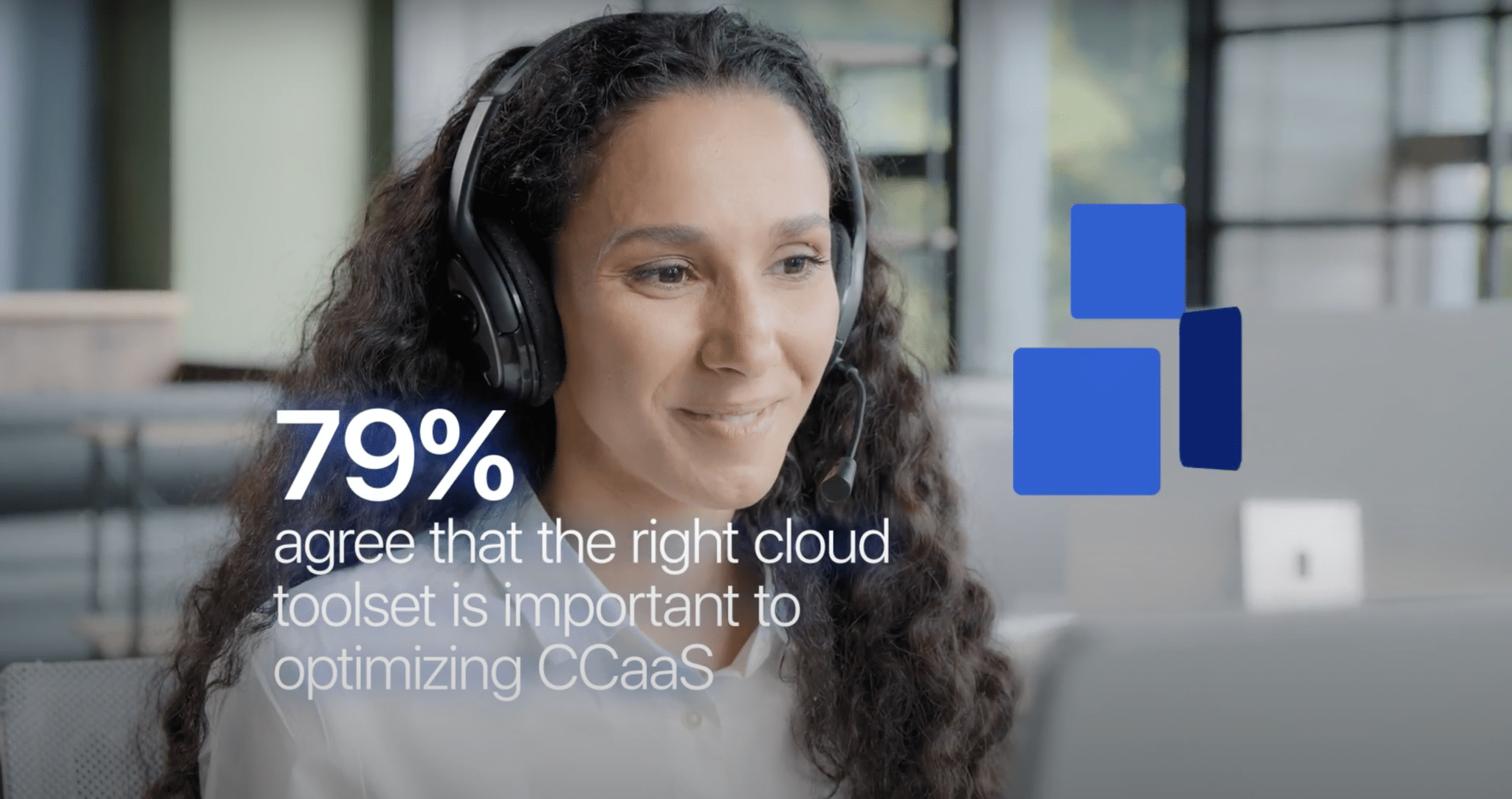
If done right, cloud toolsets can drive quality, revenue, and efficiency to your environment. The right strategy and toolset can bring you a unified analytics framework, advanced AI/ML technology business users can leverage, and leapfrog legacy workforce management and speech tools. In that same Forrester Consulting study, 79% of respondents agreed that the right cloud toolset is important to optimizing their CCaaS.
Cloud toolsets play a critical role in facilitating a smooth shift to better outcomes for cloud contact centers. The ability to leverage the intersection of new APIs survey system, CRM system, in addition to your CCaaS system, the ability to automate and provide action and transactional services on top of your analytics framework makes the difference between lackluster or slow outcomes and truly transformational results. The right toolset will help you synthesize data efficiently and enable real-time actionable insights along with the automation to put those insights to work. The same toolset can bridge operational knowledge and skills gaps and ensure better CCaaS deployments and outcomes. This turns what many have experienced as a frustrating or challenging cloud transition into a smoother, navigable journey with limitless outcomes.
Moving to a CCaaS platform is not just about moving the contact center platform, it is about evolving the entire ecosystem. Leveraging and a toolset like SuccessKPI helps you accelerate migration and improve outcomes in the process.
Modernizing the government contact center has never been more critical to improving the citizen experience. Citizens look toward the public sector during some of their most vulnerable life challenges–from seeking vaccine information during a global pandemic to unemployment benefits from unexpected job loss. Receiving a prompt response from government agents makes a marked difference.
To unpack this opportunity, SuccessKPI VP of Sales Emil Modugno and Maximus VP of Citizen Engagement Michelle Paiz provided a live webinar about their experience spearheading government modernization with AI-powered, advanced data analytics. In this article, dive into highlights from the discussion, including tools and tips for driving agency modernization in the cloud, yielding an overall improved citizen and employee experience.
The COVID-19 pandemic changed the world in many ways, including the way we work and communicate. Prior to COVID-19, much of the agency workforce worked on-site but with a push to move toward remote work, agencies were forced to adapt and modernize their experience. Zero trust and cloud-first became a priority for government leaders.
While agencies were forced to adapt quickly to hybrid work environments, cloud success remains a separate topic to be tackled in the aftermath. There are many reasons why state, local, civilian, defense, and intelligence agencies are seeking cloud solutions, including increasing efficiency and providing a better experience for their constituents, members, and employees. Overall, the consensus is that better work environments, whether hybrid or fully remote, yields happier employees, and thus, better experiences for citizens receiving their service.
However, despite a shift in agencies moving to the cloud, many are still experiencing challenges in achieving a full digital transformation.
“As we work through these modernizations with our customers, we’ve noticed…many agencies are data-rich, but they’re very insight-poor,” said SuccessKPI’s VP of Sales Emil Modugno.
A recent study conducted by Forrester Consulting on behalf of SuccessKPI revealed that nearly half of all contact center decision-makers have little to no success with their cloud migration efforts. And within that study, only 23% of survey respondents say they experienced a completely successful migration to a CCaaS solution.
Due to technical complexity and lack of resources, leaders in contact center spaces have been left frustrated, and at a loss of how to fully adapt to the cloud environment and create a roadmap to success.
Conducted by Forrester Consulting on behalf of SuccessKPI, the commissioned study “The Frustrating Journey to Cloud Contact Center Success” indicates the move to the cloud has been a frustrating journey, and that cloud toolsets are essential to success in the cloud.
Travel and hospitality businesses know how critical consumer and customer loyalty is to driving business outcomes. Ratings and loyalty contribute directly to a business’s reputation, with customer experience being the driving force behind those reflections. But how are businesses facing these challenges in the ever-changing landscape of consumer needs?
In this article, see how cloud toolsets unlock businesses’ ability to optimize and improve customer experience.
Among the top challenges facing the travel and hospitality industry in 2023 are guest experiences and increasing expectations around personalized customer experience, according to Digital Guest. Providing an exceptional customer experience is the new normal, and the changing digital landscape is forcing businesses to consider new ways of understanding their customers.
Customer insights can become lost due to internal technology silos or inflexible systems and applications–and customer data is only as valuable as a business’s ability to understand those insights. It’s critical to understand how a guest might be feeling–are they experiencing a negative, positive, or neutral experience? Deepen your insights through the decoding and visualization of conversations with the help of artificial intelligence, machine learning, and highly accurate language translation identifying keywords. Sentiment analytics combined with automated actions help identify emerging issues and trigger immediate responses before they escalate–resolving conflict at the first point of contact.
A shift toward digital toolsets is critical, and the optimization of those toolsets is just as important for unlocking insight and driving successful business outcomes.
A recent study conducted by Forrester Consulting on behalf of SuccessKPI revealed that only 25% of global contact center leaders are completely satisfied with their CCaaS solution. The truth: contact centers are moving to the cloud yet dissatisfied due to missing functionality, incomplete optimization, or lack of training according to the Forrester study.
The contact center is a core customer touchpoint and crucial to maintaining guest satisfaction. The Forrester study indicates that over 40% of respondents have had limited success with their CCaaS migration efforts which is cause for concern.
To achieve a seamless guest experience, agents need real-time reporting combined with speech and sentiment analytics to gain insight into their guest’s journey. A cloud contact center that is integrated with data across all guest experience touchpoints will power automation and drive efficiency leading to a superior customer and agent experience.
Conducted by Forrester Consulting on behalf of SuccessKPI, the commissioned study “The Frustrating Journey to Cloud Contact Center Success” indicates the move to the cloud has been a frustrating journey, and that cloud toolsets are essential to success in the cloud.
SuccessKPI provides cloud toolsets that help contact agents quickly shift consumer preferences and meet customer demands. These toolsets allow travel and hospitality teams to customize their services and provide an exceptional customer journey. By providing agents with a view of every interaction, coupled with real-time guidance and coaching during customer conversations, a seamless customer experience occurs at the first point of contact–affording airlines, hotels, and other service-forward businesses with a 360-view of a traveler’s journey.
Automating critical business actions based on the true guest experience not only increases their satisfaction and brand loyalty, but it also provides an accelerated path to problem resolution at first contact–reducing agent churn and guaranteeing a positive contact center agent experience.
See how travel and hospitality businesses are meeting customer demands and optimizing their cloud contact centers with SuccessKPI.
Only one-third of retail and ecommerce businesses are confident about maintaining or improving profit margins, according to Deloitte’s 2023 Retail Industry Outlook.
Retail businesses are feeling the repercussions of a volatile business cycle in such a condensed time frame due to shifting customer expectations driven by the pandemic. Massive demand fluctuations during this time period forced ecommerce and retail businesses to rethink archaic systems in favor of more pliable operations. They learned that rapidly evolving consumer preferences requires more effective analytics and cloud toolsets to reduce friction and maintain customer loyalty.
This insight combined with the knowledge that the cost of acquiring a new customer can be up to seven times more than retaining old customers, lead businesses to adopt retention strategies critical to evolving for their customers.
These findings synchronize with the study conducted by Forrester Consulting on behalf of SuccessKPI, which indicated that digital optimization was challenging for businesses due to many reasons including IT and operational complexities.
One of the most critical functions for a retail and e-commerce business is the contact center, the bloodline of customer experience is shaped by every incoming interaction–minute by minute, and through multiple sources of digital communication. The source of the challenge is that these interactions happen across countless channels, and the sources of digital communication spans phone calls, SMS, emails, social media, chatbots, and more. With the ever-evolving customer experience landscape, it makes sense that. Yet only 25 percent of all survey respondents–contact center decision-makers from across North America, South America, and Europe–are content with the performance of their contact centers.
Conducted by Forrester Consulting on behalf of SuccessKPI, the commissioned study “The Frustrating Journey to Cloud Contact Center Success” indicates the move to the cloud has been a frustrating journey, and that cloud toolsets are essential to success in the cloud.
The good news is that ecommerce and retail businesses are choosing not to be stuck and taking the opportunity to innovate during these unprecedented times. More than 70 percent of respondents agree that optimizing the performance of their Contact Center as a Service (CCaaS) is critical for business success, according to the Forrester study.
Businesses can deliver a next-generation shopping experience by unifying customer insights and automating time-consuming processes with the right cloud toolset in place. Cloud toolsets enable businesses to unify customer insights, so that contact center leaders can better understand the customer journey and increase customer loyalty. Problems within the customer experience can be identified and escalated quickly, and automated responses including agent-assistedassisted scripts can be triggered before a negative interaction escalates.
A leading insight and action platform, SuccessKPI, deciphers and displays consumer insights and patterns by integrating real-time and historic contact center data with interactions from a range of channels such as text chat, email, and virtual assistants. Insights are illuminated by artificial intelligence and machine learning engines that can identify keywords in over 40 languages.
Beyond technology, contact centers are an exchange between people. The customer journey is improved by empowering agents to succeed and create joyful experiences. Cloud toolsets like SuccessKPI provide agents with a complete view of every interaction, including coaching and real guidance during live calls so that they are supported every step of the way. By automating business actions and step-by-step script guidance, agents are equipped to provide a seamless experience that reduces customer–ultimately leading to positive interactions and a joyful customer experience.
See how retail and eCommerce businesses are transforming the customer journey and empowering agents with SuccessKPI’s insight and action platform.
Transforming Government call center satisfaction has never been more critical for the public sector, and agencies are working hard to meet the expectations of their constituents with cloud toolsets.
Customer experience is more important than ever in the public sector. In fact, “satisfied customers are nine times more likely to trust their government or agency,” as highlighted in McKinsey’s 2022 report, Prioritizing Customer Experience in Government.
In this article, explore key findings on how to get the most from your cloud contact center solution deployments––increasing efficiency, driving improved results, and leading to a better citizen experience.
A recent study conducted by Forrester Consulting on behalf of SuccessKPI indicated contact center operators around the world revealed that nearly half of all contact center decision-makers are having little to no success with their cloud migration efforts.
Only 25% are content with their contact center performance and due to technical complexity and lack of resources, leaders are left frustrated and at a loss after migrating to the cloud with only 23% of survey respondents saying they experienced a completely successful migration to CCaSS solutions.
Agents are challenged due to staffing and resource limitations, and they are unable to offer the lifeline available for citizens in need of critical government support. From unemployment benefits to mission-critical information required by CDC––a successful cloud-based remote contact center is the key to unlocking government satisfaction.
Organizations face a future where call centers will be cloud-based. From economics to versatility––collecting and applying analytics, AI and automation to an array of data sources is only viable in the cloud vs. legacy on-premise contact centers. However, the Forrester study revealed that data, functionality and familiarity very often get lost in the migration to cloud.
“The move to the cloud has been a frustrating journey for many,” according to the Forrester study. “Gaps in capabilities, like automation and intelligence, mean many organizations are not seeing the promise of CCaaS.”
SuccessKPI enables government agencies to see a complete view of a citizen’s customer journey by drawing on direct interactions from channels such as SMS text, email and virtual assistant dialogue. Agencies gain deeper insights and understanding by decoding and visualizing conversations with AI engines running accurate transcripts of live conversations with suggestions for the next best actions in more than 30 languages.
Protecting citizens and their data is as critical as serving them, and agencies can trust that secure experiences for their constituents and employees will be met, while mitigating risk and exceeding compliance standards with SuccessKPI’s revolutionary insight and action platform built for federal, state, and local government agencies.
The platform provides above recommended security features including automatic PII redactions and all key relevant certifications such as FedRAMP, ISO 27001, HIMPAA, SOC2 among others.These protections help maintain compliance with relevant regulations.
SuccessKPI also unifies agent location data with timesheets and login information to display a reconciled view of actual and reported performance. Risks are further managed by detecting and filtering crisis calls, automatically triggering supervisory attention to AI-identified threats or emergencies.
See how government agencies are transforming the citizen experience with SuccessKPI.
Conducted by Forrester Consulting on behalf of SuccessKPI, the commissioned study “The Frustrating Journey to Cloud Contact Center Success” indicates the move to the cloud has been a frustrating journey, and that cloud toolsets are essential to success in the cloud.
Consulting on behalf of SuccessKPI indicated that only 1 in 3 contact center operators were completely satisfied with their ability to drive better business outcomes. A range of reasons for this disappointment center around increasing complexity in contact center technology, a skills shortage, and a loss of functionality and familiarity when contact centers move to the cloud, which they inevitably will do.
These issues may not seem endemic to the financial services industry, but they make day-to-day operations more difficult for banks, insurance providers, collections agencies and financial management firms who are navigating a highly competitive and regulated environment. Both businesses and consumers are suffering from a crisis in customer confidence––the Conference Board reported a continuing decline in consumer confidence overall with a pessimistic view of economic conditions, while news outlets such as the Wall Street Journal reported on negative impacts and consumer sentiment toward banks.
It has never been more critical to fully engage and understand customers’ aspirations, fears, and preferences to rebuild their confidence amid these uncertain economic conditions.
SuccessKPI’s Insight and Action Platform enables a complete view of a customer’s experience by unifying real-time and historical contact center data with interactions from all customer touchpoints across channels. This fully transparent view yields deep customer insights, bolstered by sentiment analysis and data captured across multiple languages through next generation natural language processing engines.
Through the automation of contact center processes, SuccessKPI enables instant, intelligent guidance for contact agents during and after customer interactions. By empowering agents with AI-guided insights and next-best actions, cloud toolsets improve agent performance and reduce employee turnover leading to increased satisfaction on both sides of the brand and /client relationship.
Furthermore, financial institutions can be rest assured with SuccessKPI’s key security services such as automatic PII (Personally Identifiable Information) redactions, and industry-leading payment card industry (PCI) compliance, GDPR, SOC2, and more.
It all adds up to improved business outcomes – what most Forrester survey respondents wanted but lacked – from informed decisions based on timely customer experience insights simplified by custom reporting with detailed dashboard visualizations and integrated data from all sources.
See how financial institutions are transforming customer experience with SuccessKPI.
Conducted by Forrester Consulting on behalf of SuccessKPI, the commissioned study “The Frustrating Journey to Cloud Contact Center Success” indicates the move to the cloud has been a frustrating journey, and that cloud toolsets are essential to success in the cloud.
It’s a turbulent time for travel and hospitality companies.
This past holiday season was the third busiest year for holiday travel since AAA began tracking, and according to Forbes, “most destinations are busier than they were in 2020 and 2021.” The trouble is that almost all airlines, hotels, and others in the industry had massive layoffs during the onset of the COVID pandemic in 2020, and found themselves unable to hire fast enough when business surged again.
The latest report from the Bureau of Labor Statistics shows openings in leisure and hospitality were trending positive with fewer job openings in November versus October 2022, though 1.5M positions still remained unfilled. Now, high inflation is forcing people to rethink their priorities for their discretionary income, so it’s unclear if the travel boom of the last year will continue during 2023.
These are just a couple of the external forces causing the massive swings of up and down across the industry. But all of that is at a macro level. What makes the customer experience crucial in this industry is that to their customers, a travel experience is very personal with high expectations.
People saved all year for their vacation and they want it all to go smoothly and as anticipated. Or that person traveling for business has a specific purpose that justifies making the trip. And when things don’t go as planned, making it right and getting to “thank you for the help” as quickly as possible is key.
Here are a few ways AI can help – even with all those macro forces swirling around.
As you engage, it’s important to objectively understand how the customer is feeling, aka if their sentiment is negative, positive or neutral. Understanding sentiment can unlock new and highly valuable data by identifying how people are feeling as they interact with your company. It helps you understand what was said, what was meant and what was felt – then automatically take the next best action to get to the best resolution, such as escalating to a supervisor, flagging for follow-up or automating an agent’s scoring.
Collectively, sentiment data can also be used as attributes and metrics for data discovery and business intelligence reporting. And sentiment analysis can show information by channel, brand, entity, agent and customer to provide insights along the customer journey.
Let’s start by stating the obvious – that there are many, many tasks that require the human touch – housekeeping, valet, bartender, security, baggage handling, and much much more. That said, the travel & hospitality industry has collectively experienced a lot of success with automation. Mobile apps allow customers to get a mobile key, reserve a spot in line, buy a ticket, or change a flight. It’s now the norm to see kiosks that help check in and upsell unsold seats.
Keep challenging yourself and your teams on what other tasks can be automated that are a win-win – ones that create consistent experiences, help companies stay closer to their brand experience and can help cut down on human error. With the power of AI, there’s so much more that can be automated and accelerated that couldn’t have just a few years ago. And the biggest benefit of automation is that it can scale both up and down as needed.
The travel & hospitality industry is one where the lofty goal of “delighting your customers” is table stakes. Other industries talk about it, and for some of the reasons mentioned earlier, your customers expect you to deliver on that promise. Personalization is key. Make sure you’re maximizing what you know about each customer – and that those insights aren’t lost due to internal technology silos or inflexible systems and applications. Your customer data is only as valuable as your ability to use it to execute ideal and personalized customer journeys.
As you challenge your organization to expand ways customers can self-serve, it’s imperative to build multiple paths out of the self-service app and to a customer service agent. And when it gets to that agent, they have all the context and history so they can readily pick up where the customer left off.
Inflation, an unstable labor market, pent-up demand for travel and the residual effects of the COVID pandemic are all factors that will impact the travel & hospitality industry throughout 2023. But by focusing on the customer experience and ways to continually and incrementally make it easier for your customers, there look to be clear skies ahead.
Learn more about how SuccessKPI can help you better understand the customer experience in each and every interaction as it’s happening in real-time – with opportunities to interject and better understand.
Creating customers for life is a core foundation at SuccessKPI and at the heart of this is a team of customer success professionals dedicated to solving customer problems and providing solutions every step of the way.
Meet Zumra Thweatt, Director of Customer Success, who brings over a decade of experience to lead this hard-working global team at SuccessKPI. Go behind the scenes to learn more about Zumra and what keeps the team so fired up for customer success.
I decided to join SuccessKPI because of the great people and customer-centric solutions. From leadership to my teammates, I could tell that SuccessKPI really cared for what it stands for: to build for and to connect with its customers. As the Director of Customer Success, my focus is to make sure that our clients are supported every single step of the way, from designing a successful roadmap to meeting business objectives and becoming an extension of the clients here at SuccessKPI.
My family keeps me inspired–as a mother, I want to set a good example for my daughters. After growing up in Bosnia and as a refugee in Germany, I came to the United States for college. It was scary to take such a big leap in life and enter an unknown chapter, but when you do the things that scare you it really pushes you to realize your full potential. I have found it important for me to be surrounded by people who share that same spirit of positivity and bravery. Working at SuccessKPI, I feel like these values are reflected in our culture. It’s a place where we are inspired to grow and to learn and are supported by amazing professionals, humans, and leaders who bring 120% of themselves every day. The result is an incredibly special working environment that feels like a warm hug.
Customer Success is an excellent place for people who love to make a difference. If you are a changemaker and understand that no matter how small a task might appear, it carries a significant impact––then this is a role for you. My suggestion would be to connect with a good mentor. A good mentor can help you define your goals and help you on your journey to achieve them. I feel grateful to have found opportunities and worked with people that believed in my ability to succeed.
Customer Success touches every part of the organization, but the heart of the organization’s success lies with the customer’s experience. The type of person who will succeed in this role is someone who really cares about the customer: who wants to learn, who understands that each day will never be the same, and is ready to support the customer through and through. When I shut down my computer after a workday, I leave knowing that I made a difference no matter how small the achievement.
At SuccessKPI we foster relationships with our customers for life. Each customer is paired with a dedicated customer success manager that works with stakeholders to design and create a roadmap to success. Each member of the team brings a diverse set of experiences in the field and ensures that each client is supported every step of the way from onboarding, and answering questions, to solving challenges. We are an extension of the client’s team at SuccessKPI, and we work to understand the business of our clients so well that we can advocate for and deliver the solutions needed for their success.
This is what makes SuccessKPI so unique: not only are we providing a powerful solution, but our team is also eliminating barriers and identifying opportunities for our customers every step of the way. A core value we uphold at SuccesssKPI is making simple things easy and complex things possible. Most of all, it is exciting to see firsthand when we make a difference for our customers and their customers. We are all on this journey together to transform CX.
Join our waitlist for Success Summit: Empowered CX on Wednesday, March 8, an invite-only virtual event with SuccessKPI customers, keynote speakers, and featuring innovative tools and practices for transforming your CX.
Patient experience expectations are at an all-time high. Dubbed the Amazon Effect, it is the phenomenon where retail and ecommerce companies have made it super simple to conduct business – and now consumers expect that same simplicity and ease from every company they do business with, no matter the industry.
That expectation can be especially challenging for those in highly regulated industries like healthcare and health technology. Privacy expectations and regulations are expansive, and given the inherent and expansive regulatory requirements, it’s critical to get every aspect of it done right.
And while expectations about the patient experience are changing, there are also numerous challenges facing hospitals and healthcare providers, including confronting affordability, digitizing healthcare and solving clinical workforce shortages. Each challenge area is expansive in its own right, though now there are ways technology like AI and virtual services can help to move experiences forward.
Here are three ways healthcare organizations can leverage insights and automation for a better patient experience no matter where they are in the customer journey:
Whether you’re a healthcare payor or provider, phone calls remain a crucial part of patient communication. For many years, healthcare organizations have utilized Interactive Voice Response (IVR) applications that can offer general information (address and directions, business hours, etc.), as well as menus that help get the caller to the right department.
But by their nature, IVRs are fixed and limited in their offerings or ability to personalize. Enter Interactive Voice Assistants (IVA), more commonly referred to as voice bots. They bring together the power of Natural Language Understanding (NLU), AI and machine learning – and have the ability to dramatically expand automation offered by healthcare organizations. And surprisingly, they are often easier to build, deploy and administer with easy-to-use applications.
By implementing voice bots, your 24×7 voice self-service could expand to:
And when you’re looking to expand your automation into chat bots on your website, the same flows, reporting and validation are available – making it faster and easier to deploy self-service capabilities across your website or mobile app With the ability to automatically scale, these applications are available during peak hours, disease outbreaks or public health crises. Voice bots will both expand access to your organization across your customer base, but advanced analytics will offer clearer understanding of both your operations and patient experience.
No matter the industry, the rationale for automation is simple: human capital is almost without exception the most costly part of operations and anything you can offload in the form of customer self-service can provide significant cost savings. The problem, however, is determining what makes the most sense to automate given regulatory restrictions, consumer preferences, and any technology limits such as data & system availability. It starts with a holistic view of the full patient journey – one that includes data from multiple sources (IVR, ACD, CRM/electronic record) and across various channels, such as phone calls, text messages, email, web chat and in-person interactions.
The best way to approach it is by mapping out different journeys based on what your customers are trying to do. As you map more and more paths, you’ll develop a deeper understanding of the complete customer journey. This holistic view can reveal where automation can reduce friction, increase accuracy, offer 24×7 access, speed the process, reduce costs – or all of the above.
Seek out repeatable interactions and tasks within the entire contact experience. This goes for both customers and agents. Can your agents be better served with real-time guidance and help? Providing the right in-the-moment prompts, assists, or automated call summaries can help agents to be more efficient in their job. Overall this increases efficiency and empowers agents to perform better.
When it comes to the patient experience, the goal is to take tasks and activities that are an important part of the healthcare experience and make them as straightforward, accessible and as beneficial as possible. You want to pinpoint bottlenecks and pain points in the customer journey to help them reach an ideal resolution. The potential results are powerful, and include a consistent experience across interactions, reduced human error and improved patient and business outcomes.
SuccessKPI can help you automate actions, analyze your patient interactions and turn them into a better overall experience. See how healthcare providers are transforming patient experience today.