Table of Contents
For two decades, the survey was the customer experience industry’s default instrument. NPS, CSAT, and CES all rode the same assumption: ask customers how they feel, average the responses, manage to the number. A generation of CX programs, executive dashboards, and quarterly reviews was built on top of that assumption.
The assumption is breaking, and the contact centers that recognize it first are quietly building a very different way of measuring how customers actually feel.
Customers stopped answering
The first crack is the simplest one. Customers are surveyed-out.
The average consumer now receives three to five feedback requests a week, and across most channels the response rate is falling. Industry analyses put the typical email survey response rate today between 5 and 15 percent — down meaningfully from the 20-to-25 percent range that was common less than a decade ago. Q4 2025 made the trend impossible to ignore: survey volumes nearly doubled while response rates dropped 44 percent compared with prior periods, as holiday-season fatigue collided with already-saturated inboxes.
The numbers vary by source and channel, but the pattern is consistent. Even Medallia, one of the largest survey vendors in the world, acknowledges on its own blog that good response rates are getting harder to come by. Fortune captured the consumer side in a piece on what it called “customer survey overload” — the sense that every transaction now ends with a request to rate it.
You cannot manage what you cannot measure. And you increasingly cannot measure what your customers refuse to answer.
The silent middle
The second crack is more dangerous, because it hides inside the responses you do get.
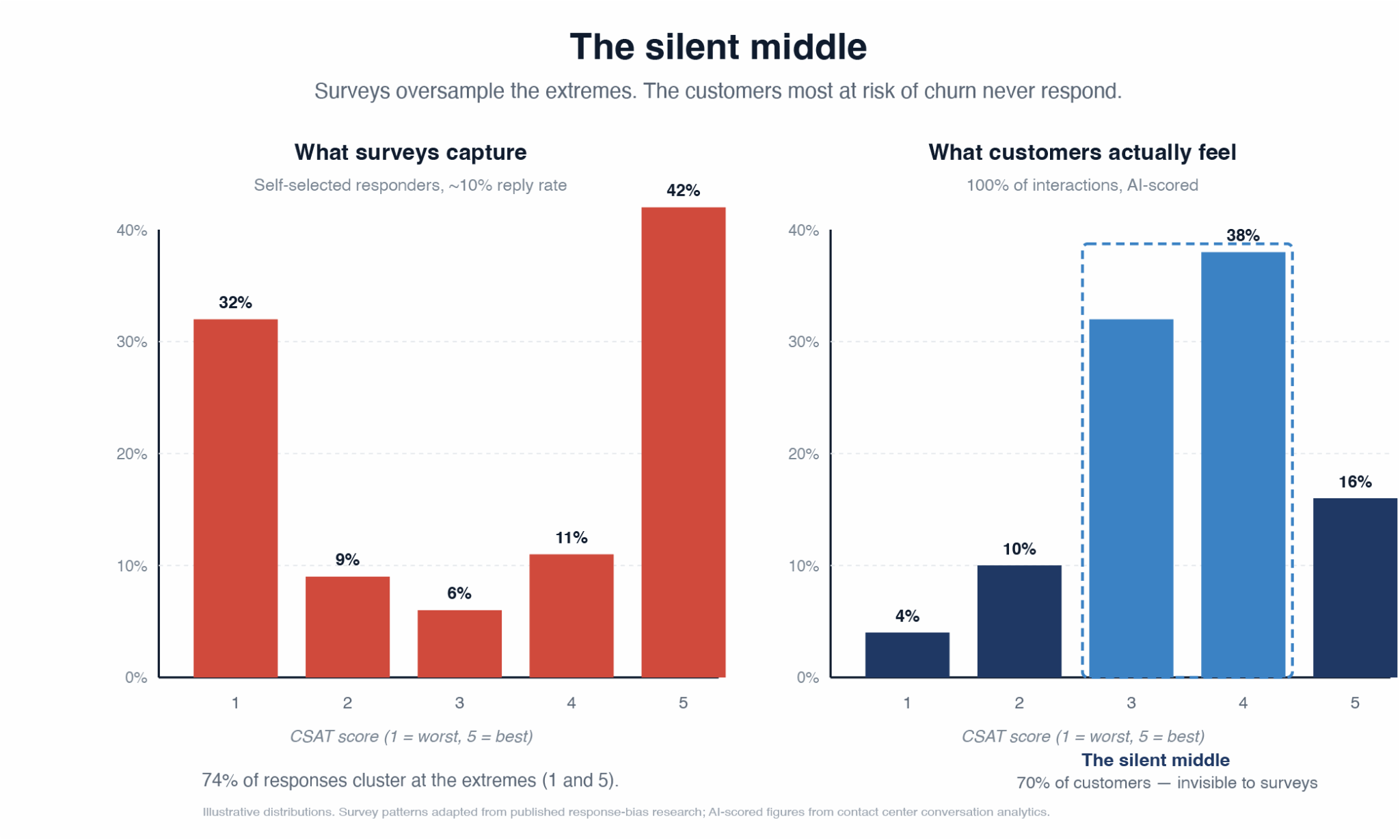
Surveys are voluntary. Voluntary instruments oversample people with strong feelings and undersample everyone else. In the NPS literature this is well-documented: as Retently lays out in its analysis of NPS bias, “the most satisfied (your Promoters) or the least satisfied (your Detractors) are more likely to fill out these surveys. Those in the middle (Passives) might not bother as much, thinking their experiences aren’t noteworthy either way.” Bain’s Rob Markey, one of the architects of NPS, has acknowledged the same pattern.
Translate that into a CX leader’s daily reality. Your survey data tilts toward the customer who loves you and the one who is furious with you. The customer who had a competent, forgettable interaction — the one whose loyalty is most at risk to a slightly better competitor — quietly closes the email and never tells you anything. That customer is the majority. And in most CX dashboards, they are invisible.
When a 10 percent response rate is biased toward the tails, you are only measuring the satisfaction of the customers who chose to talk about it.
A category under pressure
The market is starting to price this in. Qualtrics laid off roughly 780 employees — about 14 percent of its workforce — in October 2023, shortly after going private in a $12.5 billion deal with Silver Lake and CPP Investments. Medallia, taken private by Thoma Bravo back in 2021, has been the subject of repeated restructuring and PE-distress coverage, tied in part to questions about how survey-led VoC platforms compete in an AI-first world.
These are not death notices. Both companies still serve large enterprises and continue to invest in AI. But the broader market signal is hard to miss: a category built on a single instrument — the survey — is being asked to defend itself against a different way of listening.
Listening to the conversation that already happened
The alternative is hiding in plain sight, and most contact centers already have the raw material for it: every customer call, chat, and email they have ever recorded.
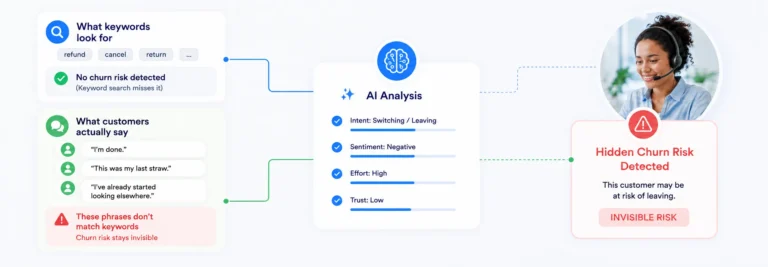
Modern AI can transcribe, analyze, and score those interactions at scale. Instead of a 1-to-3 percent QA sample listened to by a human, AI can score 100 percent of conversations against a structured rubric — including a CSAT-style or NPS-style judgment for each one. Industry analysts increasingly position conversation analytics as a complement, then a successor, to traditional survey-led VoC, precisely because it covers the conversations customers actually had, not the ones they later opted in to grade.
The implications for measurement are significant:
The silent middle becomes visible. Every customer who interacted gets scored, not only the ones with strong enough feelings to click a link. The distribution you see is the distribution you have, not a self-selected slice of it.
The signal becomes continuous. Instead of waiting for survey waves, leaders see scores update with every interaction, with the underlying transcript a click away when a number looks off.
The “why” travels with the score. AI can extract the reason for the score, the call’s purpose, and where an agent or process could have improved the outcome — on the same record, in the same workflow.
What it looks like in practice
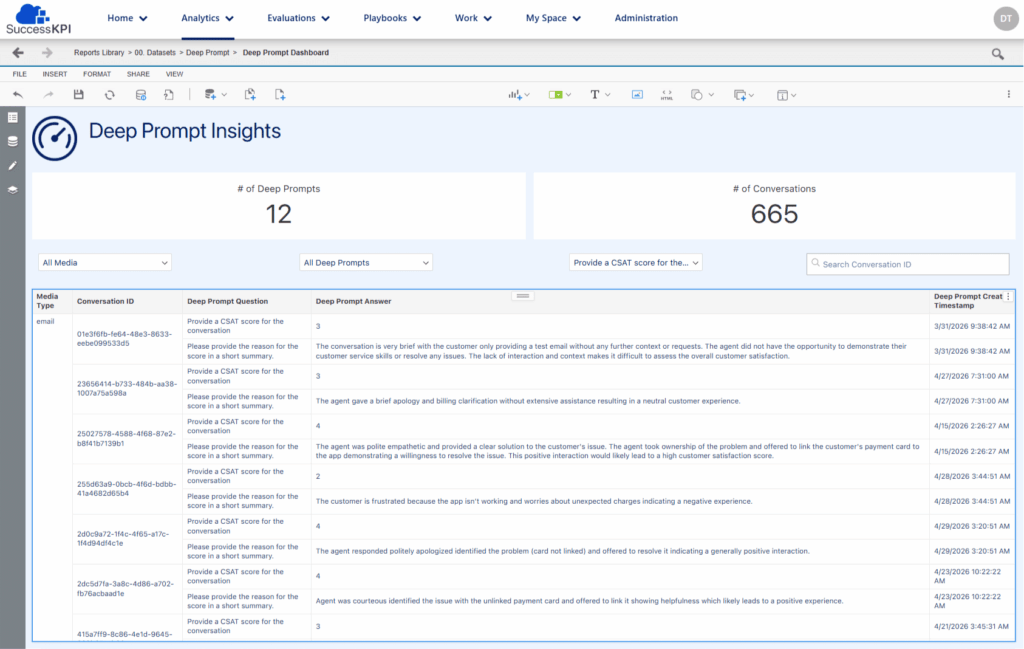
This is the model SuccessKPI customers are running today. Auto-QM scores 100 percent of contact center interactions against the customer’s scorecard, while a 2-to-3 percent human calibration sample runs in parallel to keep the AI honest. On top of that, Deep Prompts let CX leaders ask the same structured questions of every conversation, for instance a CSAT score on a 1-to-5 scale, the reason behind it, and what would have moved the score upward, and see the answers in a queryable dashboard rather than a stack of recordings.
The point is not that surveys go away. They still capture intent, brand perception, and post-purchase reflection in ways a service interaction cannot. The point is that surveys should no longer be the only signal — and increasingly should not be the primary one — for how a contact center understands the customer it just spoke to.
The future of customer satisfaction measurement looks less like a quarterly response rate report and more like a live, evidence-backed read on every interaction the customer ever had with you. The contact centers that get there first will not be flying blind in the gaps their surveys never filled.