For two decades, the survey was the customer experience industry’s default instrument. NPS, CSAT, and CES all rode the same assumption: ask customers how they feel, average the responses, manage to the number. A generation of CX programs, executive dashboards, and quarterly reviews was built on top of that assumption.
The assumption is breaking, and the contact centers that recognize it first are quietly building a very different way of measuring how customers actually feel.
The first crack is the simplest one. Customers are surveyed-out.
The average consumer now receives three to five feedback requests a week, and across most channels the response rate is falling. Industry analyses put the typical email survey response rate today between 5 and 15 percent — down meaningfully from the 20-to-25 percent range that was common less than a decade ago. Q4 2025 made the trend impossible to ignore: survey volumes nearly doubled while response rates dropped 44 percent compared with prior periods, as holiday-season fatigue collided with already-saturated inboxes.
The numbers vary by source and channel, but the pattern is consistent. Even Medallia, one of the largest survey vendors in the world, acknowledges on its own blog that good response rates are getting harder to come by. Fortune captured the consumer side in a piece on what it called “customer survey overload” — the sense that every transaction now ends with a request to rate it.
You cannot manage what you cannot measure. And you increasingly cannot measure what your customers refuse to answer.
The second crack is more dangerous, because it hides inside the responses you do get.
Surveys are voluntary. Voluntary instruments oversample people with strong feelings and undersample everyone else. In the NPS literature this is well-documented: as Retently lays out in its analysis of NPS bias, “the most satisfied (your Promoters) or the least satisfied (your Detractors) are more likely to fill out these surveys. Those in the middle (Passives) might not bother as much, thinking their experiences aren’t noteworthy either way.” Bain’s Rob Markey, one of the architects of NPS, has acknowledged the same pattern.
Translate that into a CX leader’s daily reality. Your survey data tilts toward the customer who loves you and the one who is furious with you. The customer who had a competent, forgettable interaction — the one whose loyalty is most at risk to a slightly better competitor — quietly closes the email and never tells you anything. That customer is the majority. And in most CX dashboards, they are invisible.
When a 10 percent response rate is biased toward the tails, you are only measuring the satisfaction of the customers who chose to talk about it.
The market is starting to price this in. Qualtrics laid off roughly 780 employees — about 14 percent of its workforce — in October 2023, shortly after going private in a $12.5 billion deal with Silver Lake and CPP Investments. Medallia, taken private by Thoma Bravo back in 2021, has been the subject of repeated restructuring and PE-distress coverage, tied in part to questions about how survey-led VoC platforms compete in an AI-first world.
These are not death notices. Both companies still serve large enterprises and continue to invest in AI. But the broader market signal is hard to miss: a category built on a single instrument — the survey — is being asked to defend itself against a different way of listening.
The alternative is hiding in plain sight, and most contact centers already have the raw material for it: every customer call, chat, and email they have ever recorded.
Modern AI can transcribe, analyze, and score those interactions at scale. Instead of a 1-to-3 percent QA sample listened to by a human, AI can score 100 percent of conversations against a structured rubric — including a CSAT-style or NPS-style judgment for each one. Industry analysts increasingly position conversation analytics as a complement, then a successor, to traditional survey-led VoC, precisely because it covers the conversations customers actually had, not the ones they later opted in to grade.
The implications for measurement are significant:
The silent middle becomes visible. Every customer who interacted gets scored, not only the ones with strong enough feelings to click a link. The distribution you see is the distribution you have, not a self-selected slice of it.
The signal becomes continuous. Instead of waiting for survey waves, leaders see scores update with every interaction, with the underlying transcript a click away when a number looks off.
The “why” travels with the score. AI can extract the reason for the score, the call’s purpose, and where an agent or process could have improved the outcome — on the same record, in the same workflow.
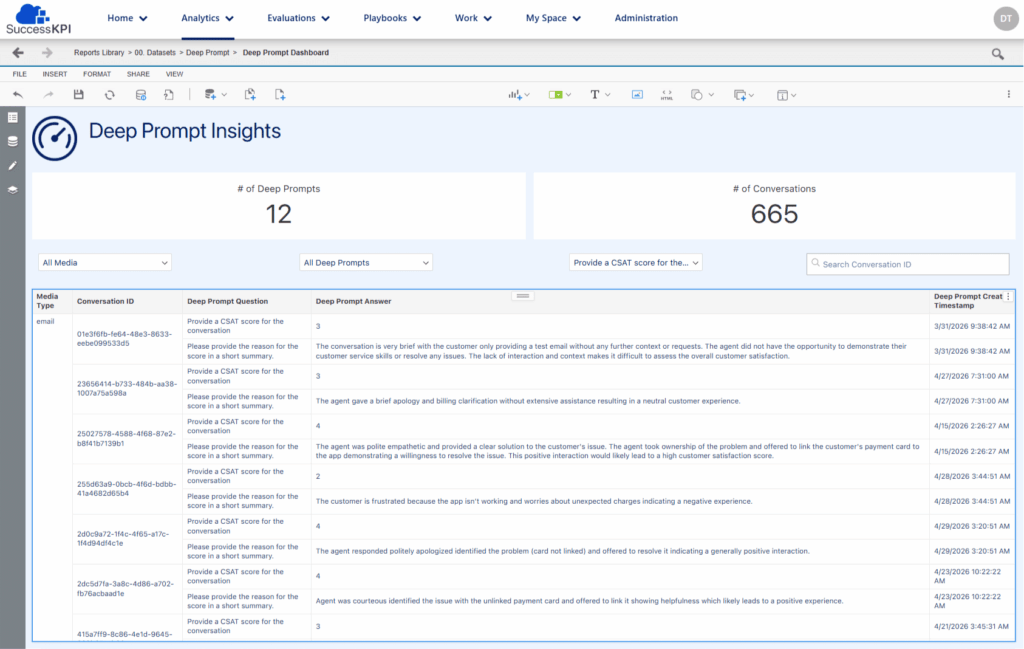
This is the model SuccessKPI customers are running today. Auto-QM scores 100 percent of contact center interactions against the customer’s scorecard, while a 2-to-3 percent human calibration sample runs in parallel to keep the AI honest. On top of that, Deep Prompts let CX leaders ask the same structured questions of every conversation, for instance a CSAT score on a 1-to-5 scale, the reason behind it, and what would have moved the score upward, and see the answers in a queryable dashboard rather than a stack of recordings.
The point is not that surveys go away. They still capture intent, brand perception, and post-purchase reflection in ways a service interaction cannot. The point is that surveys should no longer be the only signal — and increasingly should not be the primary one — for how a contact center understands the customer it just spoke to.
The future of customer satisfaction measurement looks less like a quarterly response rate report and more like a live, evidence-backed read on every interaction the customer ever had with you. The contact centers that get there first will not be flying blind in the gaps their surveys never filled.
Three months ago, Sarah joined your contact center as a new agent. From the day she started, you had a good feeling about this hire. Manual evaluations backed it up: she was ahead of her cohort, picking things up fast, asking the right questions. You weren’t worried about Sarah.
Then one morning, a report lands on your desk. Your AI-driven quality management engine has flagged a cluster of Sarah’s recent calls. Low engagement. Missed disclosures. Overall score: 62%. Recommended action: empathy coaching.
Within hours, Sarah submits a score dispute. She doesn’t agree with the rating, and honestly, neither do you. That 62% doesn’t describe the agent you’ve been watching grow over the past twelve weeks.
So you decide to dig in; maybe the AI caught something you missed. Maybe Sarah has been struggling in ways that don’t show up in a weekly check-in. But you also know that if the score is off — even slightly — the damage is real. A new agent who is genuinely trying, getting flagged for remediation three months in? That doesn’t feel like development. That feels like a warning. And that kind of signal, left unexamined, is how you lose someone you spent months recruiting and onboarding.
Your findings are disturbing. This isn’t an accuracy problem; it’s worse. The AI did exactly what it was designed to do — and still got it wrong. You uncover three gaps.
The model wasn’t broken. The context was incomplete.
Each gap represents data that existed somewhere in the organization, but never reached the AI that needed it to reason correctly.
At three months in, Sarah is still learning the ropes. But the QM system has no connection to the HR system: no hire date, no cohort assignment, no ramp stage, so it applied the exact same evaluation criteria and weightings it uses for five-year veterans.
Her 62% might actually be ahead of her peers with similar start dates. The AI couldn’t tell, not because the model was weak, but because tenure data, hire date, and ramp cohort all live in a system the QM tool cannot see.
The data exists. The scoring engine simply never had access to it.
That week’s volume forecast was off by 30%. The contact center was short-staffed, and Sarah was pulled into a split shift to cover the gap. By the time the flagged calls happened, she was in hour ten of her workday.
When QM and WFM aren’t in the same context window, the WFM schedule, shift start times, overtime hours, split-shift assignments, never reach the scoring layer. Thus, the AI can read fatigue as disengagement, and flag an operational staffing problem as a personal performance failure.
This isn’t an AI problem. The WFM data exists. QM and WFM simply weren’t connected.
In a contact center, a single call is just a snapshot. An agent might struggle because the customer was already escalated, or because a new script went live that morning and they’re still adjusting. Put a few rough calls together and it starts to look like a pattern. But maybe it isn’t.
Now zoom out. If the system had looked at Sarah’s full history, hundreds of calls over three months, the story changes. Her hedge phrases aren’t random; they cluster around one specific policy topic. Her scores dip consistently after hour seven of a shift. That’s fatigue, not lack of skill.
In 82% of her low-scored calls, customer sentiment actually improves by the end. She’s calming frustrated customers down, consistently. The system can see that turnaround. But the improvement doesn’t always carry enough weight in the final evaluation, so the interaction still gets marked down because of how it started.
The missed disclosures tell the same story. They aren’t isolated mistakes. They began right after a script update, and the same pattern shows up across multiple agents. This isn’t an individual gap; it’s a shared adjustment issue.
That’s the real gap: scoring a few calls captures incidents. Looking across hundreds reveals patterns, and leads to completely different conclusions
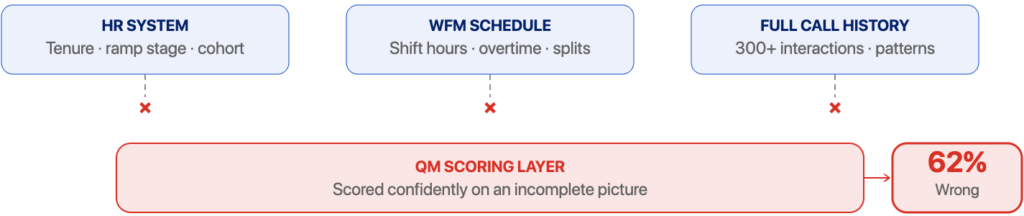
Figure 1 — Three sources of context that exist but never reached the scoring layer, producing a confident but incorrect result.
The industry talks about “agentic” like it’s a feature you bolt on. Add an LLM. Add a reasoning layer. Ship it.
But Sarah’s story reveals what actually breaks: the AI reasons confidently on an incomplete picture, not because the model is weak, but because the products behind it were never designed to share context.
A shared dashboard aggregates outputs from separate systems; it doesn’t unify the inference context. SuccessKPI’s shared data foundation means every module, scoring, scheduling, coaching, real-time Agent Assist, analytics, and speech analysis, operates on a single, consistent data model. The products don’t need to be integrated because they were never separate.
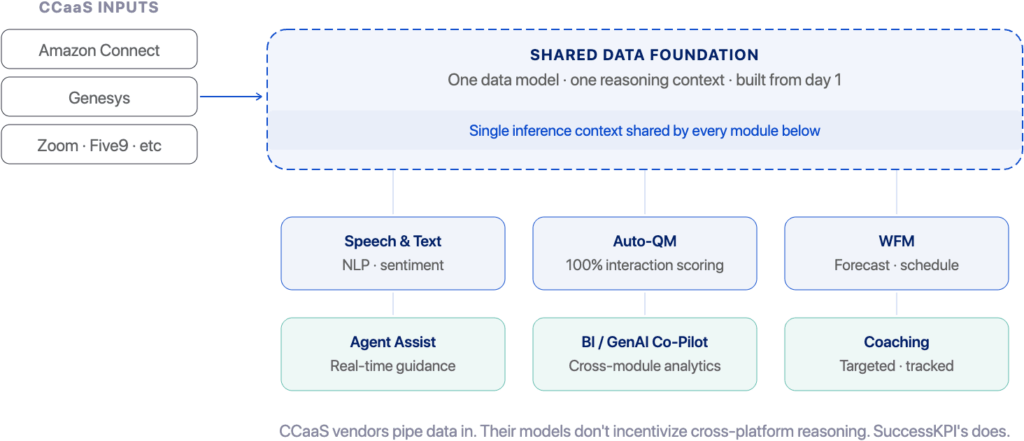
Figre 2 — SuccessKPI’s six platform capabilities — Speech & Text, Auto-QM, WFM, Agent Assist, BI/GenAI Co-Pilot, and Coaching — all built on a single shared data foundation.
SuccessKPI’s product strategy unfolds in two stages. First, embed purpose-built AI agents into each module — each one solving a specific, well-defined job inside the contact center. Then, connect those agents so they can work together: triggered by a single business intent and orchestrated through one unified workflow.
Both stages run on the same shared data foundation. That’s what makes the second stage achievable today — not three years from now. There’s no integration backlog to clear, no middleware to build, no eighteen-month project to connect systems that were never designed to talk to each other. The development of orchestrated, multi-module workflows is a natural extension of what’s already in production.
Each module gets its own AI agent — trained for one specific job, operating within clear boundaries, and delivering value independently. These are in production today.
When purpose-built agents share a data layer, they can be chained. A single business intent triggers a Playbook — an automated, governed workflow that spans multiple modules.
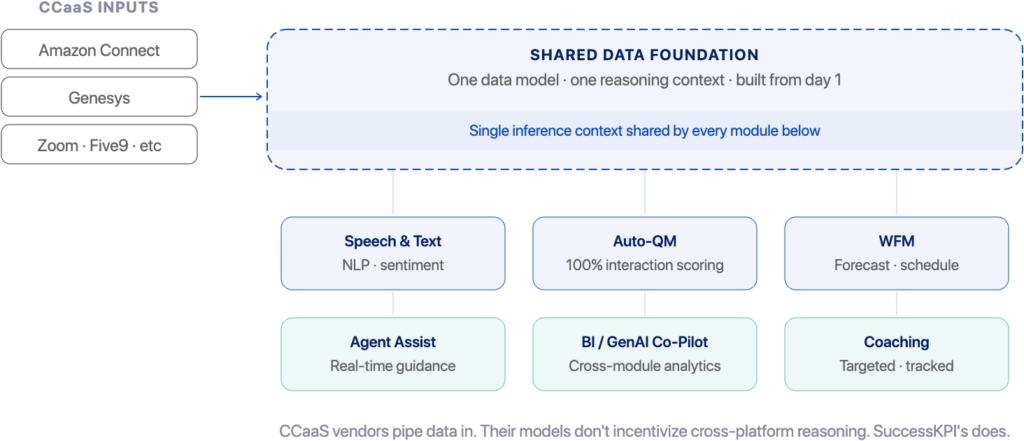
Figure 3 — Playbook orchestration: a single intent triggers a governed workflow across all six modules on the shared data foundation.
Autonomy levels are configured per step, per module — not globally. A single Playbook can mix all three levels. The AI operates exactly as far as you’ve authorised it. No further.
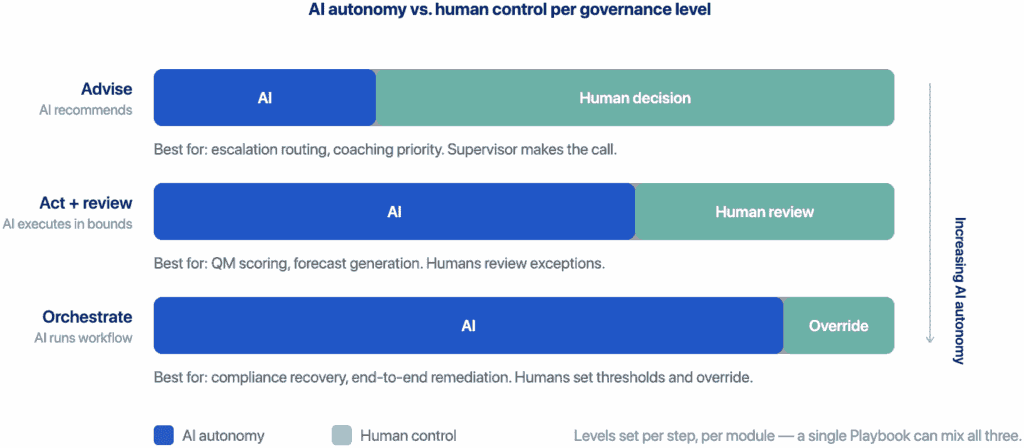
Figure 4 — Governance model: AI autonomy scales up as human oversight shifts from decision-making to exception-based review. Thresholds are configured per step.
Many vendors are acquiring point AI solutions and stitching them together after the fact: a QM tool from one acquisition, a WFM engine from another, a coaching platform from a third. Before those pieces can reason together, there’s an eighteen-month integration backlog just to unify the data. SuccessKPI was built unified from day one, which means the orchestration layer works today, not in 2028.
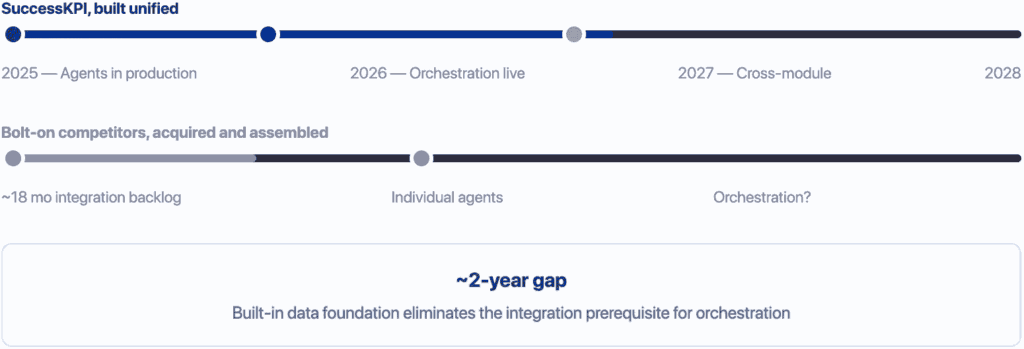
Figure 5 — Vendors assembling acquired point solutions face an integration backlog before agents can reason together. SuccessKPI’s unified architecture skips that step entirely.
The contact center stands at a critical inflection point. Technological disruption—spearheaded by AI, machine learning, and advanced analytics—is colliding with profound shifts in customer expectations, agent aspirations, and enterprise imperatives for operational excellence and profitable growth. Today’s CXOs are no longer satisfied with static dashboards and rear-view-mirror reporting. The mandate is clear: to evolve the contact center from a reactive cost center to a proactive value center, leaders require meaningful, real-time insights that are fast, on-demand, and directly actionable for driving customer loyalty and business growth.
This whitepaper addresses the central enabler of this transformation: a modern, integrated Contact Center Analytics strategy. While vast amounts of data are generated across the customer service ecosystem, most organizations remain mired in fragmented, siloed systems that produce descriptive or, at best, diagnostic reports. The leap to predictive and prescriptive analytics—the true engines of proactive value creation—remains elusive without a deliberate, strategic framework.
We present a cohesive approach to unify your data landscape and orchestrate analytics across the entire customer journey. By implementing a dimensional framework that connects digital front-door interactions to post-contact governance, enterprises can unlock actionable intelligence that systematically improves customer experience (CX), optimizes costs, elevates agent performance, and informs strategic decision-making with unprecedented speed and precision.
The current state of analytics in most contact centers is characterized by potential unrealized. Investments have been made in diverse tools—CCaaS platforms, CRM/ITSM, WFM, Quality Management, Voice of Customer—each generating its own stream of data. Yet, these data sources often operate in isolation, creating a fragmented view of the customer and the operations.
The result is an analytics maturity ceiling. Teams spend excessive time manually aggregating data to answer basic “what happened?” questions (descriptive analytics) or “why did it happen?” (diagnostic). This leaves little capacity for the transformative questions: ”What will happen next?” (predictive) and ”What should we do about it?” (prescriptive). This gap represents a significant strategic liability, preventing the contact center from anticipating customer needs, preventing churn, optimizing resources in real-time, and demonstrating its direct contribution to revenue and brand equity.
Moving from data chaos to intelligent insight requires a deliberate architectural and strategic approach. Our framework is built on four foundational pillars:
An effective analytics strategy must illuminate the end-to-end customer journey across interconnected dimensions that work cohesively to provide a 360-degree view and enable intelligent action at every touchpoint.
| Dimension | Purpose & Value |
| Bot Analytics & Containment | Measures self-service effectiveness (containment rate, fallback reasons), identifies intent patterns, and optimizes chatbot knowledge and flows to maximize deflection and user success. |
| Contextual Handoff | Analyzes the quality and completeness of data passed from digital channels or IVR to human agents. Ensures seamless transitions and prevents “start-over” frustration, reducing handle time. |
| Customer 360 / User 360 | Unifies all customer data (interaction history, sentiment, value, product usage) into a single view. Powers personalization and enables agents to understand the full context of a customer’s relationship. |
| Real-time Sentiment & Empathy | Applies NLP to live interactions to gauge customer emotion. Provides real-time alerts for at-risk customers and guides agents with empathy prompts to de-escalate and improve outcomes. |
| Real-time Agent Assist | Analyzes the live conversation to surface relevant knowledge articles, process guidance, and compliance prompts to the agent in real-time, boosting accuracy and First Contact Resolution (FCR). |
| Auto-Summary to ITSM/CRM | Automatically generates accurate, structured summaries of interactions and posts them to relevant systems. Ensures data integrity, eliminates manual note-taking, and provides perfect context for follow-up. |
| Interaction Analytics | Processes 100% of voice and digital interactions using speech and text analytics. Uncovers emerging issues, compliance risks, competitive intelligence, and root causes of customer dissatisfaction. |
| Quality Management | Automates and expands quality evaluation. Uses analytics to score 100% of interactions against custom criteria and generates targeted, data-driven coaching opportunities for agents. |
| Taxonomy & Unified Dashboards | Applies a consistent taxonomy (tags, categories) across all data sources. Enables apples-to-apples reporting and creates unified, role-based dashboards that provide a single source of truth. |
| Performance, Coaching & Training | Correlates data from WFM (adherence, occupancy), QA scores, and customer feedback (CSAT, NPS) to create holistic agent performance profiles. Identifies precise skill gaps and recommends personalized training. |
Implementing this orchestrated analytics framework delivers compounding value across strategic priorities:
The vision of an insights-driven contact center cannot be realized by technology alone. Success is contingent on four key pillars:
In the era of AI and hyper-personalization, analytics is no longer a support function; it is the central nervous system of the modern contact center. It is the critical capability that separates organizations that simply manage customer interactions from those that intelligently orchestrate customer relationships for mutual value.
For CXOs and Service Owners, the next steps are decisive:
The journey to becoming a true value center is paved with data. By implementing a strategic, dimensional analytics framework, you transform your contact center from a cost line-item into a dynamic source of customer intelligence, operational excellence, and sustainable competitive advantage. The time to invest in insight is now.
Despite decades of innovation in contact center technology, many customer experience (CX) leaders are still wrestling with the same fundamental problems they faced years ago. Tools have changed. Platforms have evolved. But the operational challenges — visibility gaps, manual processes, fragmented data, and unanswered “why” questions — remain stubbornly persistent.
One of the most important lessons from recent internal CX enablement discussions is this: success in CX isn’t about adding more technology — it’s about solving the right problems, in the right order, with the right questions. Below are four key takeaways that reflect what leading organizations are doing differently to improve performance, reduce risk, and drive measurable outcomes.
Many CX failures don’t originate in strategy or design — they happen at the edge. Audio quality issues, unstable connections, incorrect headsets, misconfigured environments, and remote work variability all contribute to what is often called the “last mile” problem.
What makes this especially dangerous is that organizations frequently don’t realize how widespread the issue is. When 15–20% of calls are affected by quality issues, the downstream impact is enormous: longer handle times, lower CSAT, repeat contacts, agent frustration, and missed revenue.
The takeaway: You can’t fix what you can’t see. CX leaders need real-time visibility into edge-level issues so supervisors can identify patterns, intervene quickly, and prevent small problems from becoming systemic ones. Operational awareness — not postmortem reporting — is what drives sustained improvement.
Quality management (QM) remains one of the most misunderstood areas of the contact center. Most organizations still rely on manual scorecards completed by supervisors or QA teams who are already stretched thin. The math simply doesn’t work: reviewing 1–3% of interactions cannot provide a reliable picture of agent performance or customer outcomes.
Generative AI has fundamentally changed what’s possible here. Instead of sampling conversations, organizations can now analyze 100% of interactions, using AI-driven prompts to assess behaviors, compliance, conversion moments, and customer sentiment.
The key insight isn’t that humans should be removed from QM — it’s that human effort should be applied where it adds the most value. Automated QM provides scale and consistency; human reviewers provide calibration, coaching, and judgment.
Modern contact centers generate an overwhelming amount of data — but that data is often scattered across tools, dashboards, and reports that don’t speak to one another. Leaders end up spending more time reconciling metrics than acting on them.
A growing best practice is to move away from “report-first” thinking and instead design command-center views aligned to specific operational goals. Rather than asking, “What data can we pull from the platform?” successful teams ask, “What decisions need to be made today — and what signals support those decisions?”
This approach enables real-time intervention, whether that’s identifying struggling agents, detecting compliance risks, or recognizing emotionally intense interactions where agents may need immediate support. The takeaway is clear: operational intelligence beats static reporting every time.
leaders are often asked to explain why. Historically, answering those questions required hours of manual analysis and educated guesswork.
A more effective approach is hypothesis-driven CX analysis. Start with a specific problem. Identify the data needed to diagnose it. Use AI, speech analytics, and interaction-level insights to isolate the moments that matter — not entire calls, but the exact points where outcomes changed.
This allows teams to move from surface metrics to root cause understanding. And while technology can accelerate insight, the real work still happens afterward: updating training, refining processes, and aligning teams around corrective action.
The lesson here is important: technology doesn’t solve CX problems on its own — but it makes solving them possible.
Across all four takeaways, a common theme emerges: high-performing CX organizations focus less on tools and more on problem clarity, operational visibility, and disciplined execution. They ask better questions, surface issues earlier, and act faster — not because they have more data, but because they have the right data, structured around real business objectives.
In a world where CX expectations continue to rise, the advantage belongs to teams that can move from insight to action with speed and confidence. Solving the right problems — and doing so systematically — is what separates incremental improvement from real transformation.
SuccessKPI is officially recognized as an active participant in the EU-U.S. Data Privacy Framework (DPF), the UK Extension to the EU-U.S. DPF, and the Swiss-U.S. DPF. This milestone underscores our unwavering commitment to data privacy, regulatory compliance, and ensuring the highest standards of data protection for our customers and partners worldwide.
Safeguarding customer data is a core mission of SuccessKPI. This certification further demonstrates adherence to stringent data protection principles that govern the secure handling of HR and Non-HR data across the European Union, the United Kingdom, and Switzerland. Participation in the Data Privacy Framework (DPF) reflects ongoing dedication to transparency, accountability, and safeguarding personal data in compliance with evolving international regulations.
SuccessKPI maintains a comprehensive privacy policy that ensures compliance with Federal Trade Commission (FTC) requirements, arbitration obligations, onward transfer liability, and robust compliance measures. The updated policy, effective February 27, 2025, outlines SuccessKPI’s commitment to handling personal data responsibly and in accordance with international best practices.
Privacy Policy: SuccessKPI Privacy Policy
Running a high-performing customer experience (CX) operation means managing, unifying, and acting on extensive amounts of data. Contact centers today rely on a broader array of data than ever before to enhance routing, handling, training, coaching, performance, and forecasting.
The result? Better, easier, and more contextualized customer interactions.
However, managing such a vast amount of data requires strategic processes, robust infrastructure, and a steadfast commitment to data security and privacy.
Data security and privacy are non-negotiable priorities for contact centers, especially with the rise of artificial intelligence (AI).
At SuccessKPI, safeguarding customer data is a core mission: “We take privacy, security, and compliance to heart,” says SuccessKPI’s CISO, Rajat Ravinder Varuni.
The types of data contact centers may handle include:
With such, Data Residency is also a critical factor for global companies considering compliance with local and international laws.
SuccessKPI employs a robust architecture to ensure comprehensive data protection:
Penetration testing—simulating cyberattacks—is regularly conducted to identify and mitigate vulnerabilities before they can be exploited.
SuccessKPI’s platform is built on AWS, leveraging serverless services designed to be “well-architected.” This ensures:
“SuccessKPI’s architecture is designed with redundancy and availability to automatically respond and recover without disrupting end users,” says Ravinder Varuni.
Artificial intelligence has amplified the importance of data privacy and security. As Ravinder Varuni explains, “AI has reshaped how data is used, making security and privacy even more critical. With regulations like GDPR leading the way, organizations worldwide are rethinking their approach to privacy.”
SuccessKPI’s GenAI policy ensures:
While security protects data from external threats, privacy ensures it is used responsibly and in line with customer expectations. Both are equally vital in today’s AI-driven world, where compliance with regulations like GDPR, CCPA, and HIPAA are paramount.
Commitment to Compliance
SuccessKPI adheres to over eight third-party-verified compliance standards, including:
This dedication to compliance underscores SuccessKPI’s commitment to maintaining the highest standards of data security and privacy.
The Secret Recipe: People, Strategy, and Innovation
“Our dedicated and innovative team focuses not just on tactical security measures but also on staying ahead of emerging threats,” says Ravinder Varuni. “It’s this blend of expertise, strategy, and a relentless focus on customer needs that sets us apart.”
Learn more about SuccessKPI’s security processes across people, product features, cloud infrastructure, and incident response.
As we know, artificial intelligence (AI) did not begin in 2023 with the public launch of ChatGPT, despite its meteoric rise and mass awareness. AI has been with us far longer than many people realize.
Oxford dubs AI as: “The capacity of computers or other machines to exhibit or simulate intelligent behavior.”
This is an automated process. Artificially intelligent machines can remember behavior patterns and adapt their responses to conform to those behaviors or encourage changes to them. Generative AI has taken this concept to a whole new level where AI can now reason, get creative, and have long memory and context.
SuccessKPI has been a leader in the development of AI for the CCaaS market which, of course, impacts a broad range of professionals, from customer service/customer experience (CX) to marketing, sales, business development and anyone in an enterprise that wants to better understand and reach their customers. We were the first in the industry to publish our AI strategy and roadmap for all to see.
SuccessKPI’s approach to AI strategy includes:
SuccessKPI started down a path several years ago of examining our solution set and determining our AI strategy. We did extensive research across markets and different industries. We detected a clear pattern around a big data science approach that pulls in the data, applies the large language model, trains the model, cleans the data, rinses and repeats.
This was very sophisticated and because of that, only a data scientist could work with those products and capabilities. Then there was another group of players who were using AI for solving specific problems. That is a use case-driven approach.
We also noticed another group of players who were applying AI in a very subtle way that is not obvious to the user. Their AI was under the hood, helping customers perform better and more efficiently without AI knowledge or deploying expensive resources. That really resonated with us. AI does not have to be a complex, intimidating thing. It should be baked into solutions, helping different customer personas function better as a seemingly natural extension of themselves.
This is how we arrived at SuccessKPI’s invisibly integrated AI strategy.
This concept of invisibly integrated AI is not entirely new. As with most things, it is built on previous innovations.
AI was conceived way back in the 1930s by British mathematician Alan Turing, who formulated the famous “Turing Test,” in 1950, a method to evaluate a machine’s ability to exhibit intelligent behavior equivalent to, or indistinguishable from, that of a human, which has yet to be achieved.
As long ago as the late 1970s, my father, who was a professor, wrote a paper about AI at his university in India. He described the principles and potential applications. But instead of reacting to this as a revolutionary thought, no one cared. It seemed too much like an unattainable fantasy, like the sentient supercomputer Hal from the movie 2001: A Space Odyssey. This period was called the AI Winter.
So much has happened since then. Siri, the iconic voice of Apple’s iPhone, may be the first application that entered AI into mass consciousness. Open AI’s ChatGPT took our public awareness of AI to a whole new level.
But before these came predictive analytics. We used to predict what is the best channel to contact a customer at what time of the day with the greatest probability of reaching that customer. It was, and still is, very effective. Gartner and other pundits thought the ultimate evolution of analytics was predictive analytics. They didn’t see the practical applications of AI on the horizon.
Look at Zoom, the popular UCaaS/meeting application. It performs call summarization, transcription and lists action items for participants, among other things. These features work automatically. They are part of an application experience.
Staying in the same product category, the new version of Cisco WebEx has a new feature called “Catch me up” that updates participants on what they’ve missed if they join a meeting late. This call summary reduces friction in the product by avoiding all the delays and distractions caused by questions and explanations on what was missed.
Other types of examples include:
Maps and Navigation – Google or Apple Maps know where to go and how to best get there. This is AI functioning on top of satellite-based GPS to give users a much more enhanced experience. Using machine learning, the application has been taught to understand and identify changes in traffic flow so that it can recommend a route that avoids roadblocks and congestion.
Facial Detection and Recognition – Using virtual filters on our faces when taking pictures and face ID for unlocking our phones are two examples of artificial intelligence that are now part of our daily lives.
Social Media – Social media applications use AI to monitor content, suggest connections, and serve advertisements to targeted users to ensure people stay invested and “plugged in.” AI algorithms can spot and swiftly take down problematic posts that violate terms and conditions through keyword identification and visual image recognition. Social media AI also has the ability to understand the content that is relevant to users and suggests similar content to them.
Similar to the earlier Zoom and Cisco examples, SuccessKPI leverages invisible AI to assist our users to be better and more efficient. Personas such as contact center agents, supervisors and evaluators are trying to do many different tasks. SuccessKPI’s platform helps make their jobs frictionless as they go through their daily routines.
What took them two days is now done in two minutes. It’s that transformative.
Our solution, for instance, would detect if an agent gets hung up on a certain topic or term. It would prompt them with a real-time assistive suggestion that could keep them functioning fluidly.
The AI would know what to suggest to the agent when they’re stuck because of their history when dealing with this particular type of situation. It knows the context of the conversation with the customer, and it anticipates the agent’s need, suggesting the relevant information because of all the other cases around this particular topic. It has the knowledge of that company-specific domain. It has insight into thousands of conversations that hundreds of agents are having every day.
SuccessKPI has a speech product that listens to thousands of calls and identifies emerging patterns around specific topics. People are talking about product problem X or about cancellation or perhaps payment related issues. When the agent goes to query or type something around that topic, it’s already there as a recommendation. As these experiences build, the agent can save or deselect certain AI prompts so they become more like a reviewer controlling and editing the content that works rather than having to create something from scratch.
Another wish-list capability that has manifested into reality recently is this concept of agentic AI. This is a virtual agent that can tackle a specific task or run its own workflow. We see a world coming where your virtual agents can react to changes in call topic patterns and adjust in hours to what now takes months or quarters to program the IVR or upskill human agents. The agentic AI workers can discover those changes in call patterns. They can spin off agentic workflows around those changed or new intents and then immediately serve them.
There is also now an opportunity through AI advances to reexamine the daily routines of the agents, supervisors, evaluators, speech scientists and other personas who play a role in the CX. All their work journeys need to be analyzed under the auspices of generative AI as an operating system (OS). Consider how one would design this application from scratch and rethink the whole journey given that the OS is a lot more intelligent, not just a powerful processing machine.
Completely reimagining those workflows could streamline, redefine, and automate many of the steps and create new functions delivering new value for the business. It’s a redefinition of user experiences based on GenAI as a platform. The problems that need solving are not going to disappear but how they are solved will completely change.
Yes, this means that an unknown number of agent jobs will be replaced with AI-powered virtual assistants. But that cycle of innovation and recalibration is nothing new. Throughout human history, the labor market has always rebalanced itself based on advances in technology as well as skills supply and demand.
There was a time when stagecoach drivers faced career extinction as automobiles became the de facto mode of transportation. As they went out of business, some found new roles. Today in the contact center, we see a similar winnowing process that favors those who evolve with the technology and advance into roles that leverage their skills in more impactful ways.
We evolved into a species where we learned a lot of things from our experiences due to our intelligence. Humans have never been the strongest or the fastest, but we developed to be the smartest, learning from our past experiences. For example, most IT professionals in India 20-30 years ago were software coders. When confronted with the rapid advances in technology and the talent competition in the US and China, Indians concluded that they needed to evolve to handle more complex roles, to create more value, get into the design architecture and become full problem solvers rather than just handling one link in that long value chain.
The global CCaaS industry today is no different. We need to evolve into that value chain and do things which are more complex, more valuable, that require more specialized skills and intelligence.
In summary, we need to stay ahead of the machine.
Now all the CCaaS players are trying to formulate an AI-driven story for their company, customers and product. This is an authentic, industrywide reengineering of brands. But it requires that evolution within the human workforce to adapt to the new technology to make it real.
SuccessKPI, by contrast, has already been working with many customers, demonstrating our AI capabilities infused into one, cohesive platform so they can experience it directly today, not in 2025 or 2030, but right now.
Going forward, we are headed for uncharted waters. The gap between a human-led CX and an agentic AI-driven experience will increasingly narrow in the coming years to the point where it will close and they become indistinguishable, e.g. the “Turing Test.”
It could arrive 10 years or 25 years into the future or much faster than we can imagine, like ChatGPT. When we hit that mark, the AI will so completely merge into the CX experience that it becomes invisible. At that point, there will essentially no longer be a need for a contact center. Think about it: CCaaS is a way to efficiently manage the routing of customers to agents. If a brand can create a million instances of an agent, it no longer needs routing.
This is similar, but not to be confused or conflated with, the concept of the singularity—the physical merger of humans and artificial beings to where we evolve into something completely new.
In our industry, the new agentic AI will be very human-like in behavior but will have the intellect of the entire brand/market/industry because each agentic instance will have the ability to access all the information that is available. This is a world without software or hardware products. Companies will build unique customer experiences around AI for every customer journey.
Imagine: A customer of a particular fashion brand visiting that brand or calling up their agentic AI brand ambassador who guides them through their journey to help them find, select, and try on new clothes, shepherding them all the way to final purchase. There’s no need to go to a contact center because that AI guide is the entire customer experience around that brand.
Many vendors will participate in that “invisibly integrated AI” future—companies like Adobe from the marketing side, Zoom from the UCaaS market, Microsoft from their cloud-based desktop position, Salesforce from the CRM end. All these adjacent players and others like them will work to create holistic AI-guided customer experiences. If anyone can spin up a million agents to help a million customers at any moment, scaling resources is no longer a problem.
SuccessKPI, for our part, is well positioned to be one of those experience creators for two reasons:
One size workforce engagement management (WEM) no longer fits all.
That’s the major theme in Frost & Sullivan’s 2024 customer experience (CX) survey.
It also showed that with most channels, satisfaction is virtually the same. So, what can contact centers do to improve?
To achieve better CX, contact centers need to focus on strategy, technology, and purpose.
That’s what Frost & Sullivan Global Vice President of CX, Alpa Shah, and SuccessKPI CEO discussed in the Global WEM Findings webinar.
Let’s take a deeper dive into the findings.
Though 89% of agents now work remotely, Frost & Sullivan’s survey showed that agent attrition is worse in 2024 than in 2020.
And 86% of contact centers reported average after-call work time has increased or stayed the same, despite working from home. Additional work from home agent challenges reported include:
One way to address these agent challenges and agent attrition is through technology.
Two out of three contact centers reported they will be investing in WEM over the next five years to solve some of these challenges. But only 30% of enterprises believe that CCaaS-WEM solutions are the best fit to meet their needs.
And 70% of contact centers surveyed reported having multiple CCaaS.
Independent, unified, and integrated WEM can help achieve a single source of truth, cost-efficiency, scalability, and innovation. But Shah and Rennyson said it must also meet contact centers where they are.
Artificial intelligence (AI) can help.
Frost & Sullivan’s survey showed 80% of contact centers plan to use AI to automate and improve supervisor and employee experience within the next three years. Key drivers for automation include:
During the webinar, we asked participants how they’d like AI to help their business in 2025. Here is what they said, and how SuccessKPI’s WEM works to address these areas:
Participants are focused on driving agent efficiency in 2025. They want to support their agents and help them become more effective.
SuccessKPI’s AI-powered platform helps by empowering agents with real-time coaching and guidance. It provides real-time coaching and context-driven guidance from pre-built scripts, FAQs, and a knowledge base.
Contact centers can use SuccessKPI’s Playbook Builder™ to automate which agent conversations are sent to evaluation using topics, themes, and sentiments. This ensures agents receive the evaluation and coaching needed without requiring evaluators to score every single conversation from every single agent every single day—which would be virtually impossible for most organizations.
AI and automation can also aid with agent efficiency by helping them to better understand customer interactions in real-time with sentiment analysis. This powerful tool listens for specific words and phrases and understands customer sentiments during live conversations. Then the real-time data is fed into an AI-powered engine that’s capable of taking any number of actions including:
This improves agent efficiency by providing them with both real-time data and assistance during customer interactions.
Learn more about SuccessKPI’s Playbook Builder™ and Sentiment Analysis.
Participants are also focused on protecting customer data and privacy in 2025.
Protecting your data and customers should be one of the most important objectives of any contact center. That’s why SuccessKPI makes the privacy and protection of the data on our network and platform our top priority.
SuccessKPI has established a full framework of operational systems policies and procedures orchestrated in such a way to protect data in transit and at rest in our SaaS platform. These meet the highest industry standard and are audited and certified regularly in accordance with leading security and operational performance standards including:
In terms of implementing automation with data security, SuccessKPI offers Redactions. The solution automatically redacts sensitive personally identifiable information (PII) from transcription results. It then replaces each identified instance of PII with a [PII] tag within the transcription. Contact centers can use redactions to protect privacy as well as comply with local laws and regulations.
Learn more about SuccessKPI’s data security and redactions.
Participants are also looking toward AI and automation to create more business using their contact center.
To earn additional business, delivering the best customer experience can be a game changer. SuccessKPI can help your contact center measure and improve its customer experience with business intelligence.
Robust business intelligence provides a full view of all customer touchpoints and puts insights to action in a secure AI-powered platform. It also offers:
Learn more about SuccessKPI’s business intelligence.
Participants are also looking for AI-powered internal forecasting.
SuccessKPI’s Workforce Management can help your organization make staffing and scheduling decisions with AI-powered forecasting and insights. Use AI to forecast your live channel traffic. Your contact center can precisely forecast traffic and staffing needs down to 15 min segments. It can also automatically detect traffic trends and anomalies using deep learning algorithms. Plus, it’s easy to quickly adjust forecasts.
Learn more about SuccessKPI AI-powered forecasting.
And these are just some use cases for AI and automation. The Frost & Sullivan survey highlighted additional use cases contact centers plan to implement:
AI-powered forecasting and scheduling and collaboration tools are the main investment priorities for the next two years, according to the survey. And it’s important to make sure your contact center moves forward with the strategy, technology, and purpose that is the best fit and meets its employees and customers where they are at.
Check out the entire Global WEM Findings on-demand webinar to see all of Shah’s and Rennyson’s advice on switching to an independent, integrated WEM.
What does it mean to take control of your customer experience (CX) with a workforce engagement management (WEM) solution?
That’s what Sheila McGee-Smith, President & Principal Analyst at McGee-Smith Analytics, and SuccessKPI CEO Dave Rennyson discussed during their fireside chat.
Next generation WEM can help contact centers take control of their CX by:
But WEM’s AI-driven use cases go beyond this list. During the fireside chat, we asked participants to finish the following sentence: “I wish AI could help me with…” In this post, we’ll share some of those responses and their answers.
Let’s get started.
“I wish AI could help me provide an appraisal of the outcome of the consumer interaction. How effective was it based on both consumer requirements and agent responses & vice-versa?”
Contact centers can evaluate 100% of conversations with SuccessKPI’s automated Quality Management.
Using Playbook Builder™, automate which customer interactions are sent to the evaluation workspace based on pre-defined topics, themes, and sentiments. Once evaluators are in the evaluation workspace, they can quickly filter calls by agent, topic, data range, call queue, and sentiment.
This helps contact centers:
Learn more about SuccessKPI’s automated Quality Management.
“I wish AI could help identify specific language in transcriptions that pose risk to our business based on policy and procedures and regulatory laws.”
SuccessKPI’s powerful Natural Language Understanding (NLU) and high-accuracy transcription engine can help contact centers decode conversations with more than 90% accuracy. They even go so far as to detect sentiment, topics, moments, themes, and custom phrases across your contact center’s customer channels and agent interactions.
Your contact center can use these tools to automatically identify any language within the customer interactions that could pose a threat and flag them to the Evaluation Center, where they can be further analyzed.
Learn more about SuccessKPI’s transcriptions.
The AI-powered platform supports more than 100 languages for transcriptions, including: Arabic, Chinese Mandarin-Mainland, Dutch, Australian English, UK English, US English, French, Quebec French, Farsi, German, Indian Hindi, Indonesian, Italian, Korean, Portuguese, Brazilian Portuguese, Russian, Spanish, US Spanish and Tamil.
This list continually grows, so you can contact us to learn about the latest language transcriptions supports.
“I wish AI could help with streamlining government processes!”
AI and automation can be applied to data security, which are essential with government contact centers. AI can handle automatic PII redactions, risk and threat detection, and many use cases mission-critical to government contact centers.
You can also get a complete view of a citizen’s journey by unifying real-time and historical contact center data with customer interactions from a myriad of communication channels like SMS, email, and virtual assistants.
Learn more about SuccessKPI’s AI for government contact centers.
“I wish AI could help our employees be more efficient with their work. I’m looking at AI augmentation so they can quickly make a data driven decision.”
AI can help enhance CX by empowering agents to better understand customer interactions in real-time. One way this happens is with sentiment analysis, which listens for specific words and phrases, as well as understands customer sentiments during live conversations.
This real-time data is fed into an AI-powered engine that’s capable of taking any number of actions including:
This helps make agents more efficient by providing them with both real-time data as well as assistance during customer interactions.
Learn more about how AI-powered sentiment analysis can help your contact center.
“I wish AI could help with overlooked insights, data points of interest I may have missed.”
Insights are the bread and butter of any contact center, so it’s important that your business is able to access them in real time.
That’s why SuccessKPI’s AI-powered platform is pre-loaded with 50+ pre-built dashboards and visualizations. Your contact center can also fully customize its dashboards, so they show the data it needs specific to its business.
Having access to these insights in real-time will help answer pressing questions regarding CX. And the fully customizable attributes, metrics, reports, and dashboards empower your contact center to dice and slice data any way needed. Plus, the subscription setting delivers insights to the right people at the right time.
Learn more about SuccessKPI’s real-time insights.
Do you want to dig even deeper into AI use cases and WEM strategies? Join us for our upcoming webinar where Frost & Sullivan will unveil its Global CX Survey.
Running a contact center without an exceptional workforce management (WFM) system is like planning for a vacation without knowing what the weather or location you sleep will be like at your destination.
Much like ending up in the Arctic with only beach clothing, lacking visibility within your contact center workforce will lead to some highly uncomfortable situations for agents, customers, supervisors, and customers.
However, traditional WFMs can leave you stressed out—much like a type A uncle during a family vacation.
Enter: SuccessKPI’s updated WFM
In this article, you’ll learn how this WFM can help your business:
Let’s get started.
This analogy is a bit on the nose, but much like needing to check the forecast for a vacation, your contact center will benefit significantly from forecasting what is coming down the line.
No matter what industry your business is in, there will always be fluctuations in contact center traffic throughout the year. For the retail industry, that can be the holidays. And for the travel industry, that can be summer.
Knowing when those fluctuations will happen empowers businesses to prepare their workforce for it. However, unlike your crystal-collecting friend, most businesses can’t claim to see the future, making it challenging to access accurate forecasts.
SuccessKPI’s WFM builds accurate forecasts using advanced AI and deep learning algorithms that automatically detect and account for trends and anomalies in your business’s traffic. It enables businesses to forecast traffic and, as a result, the staffing needed for as granular as 15-minute segments of time.
To do this, the WFM system considers:
And if anything changes, it easily and quickly modifies the forecasts to account for the needed adjustments, helping your business stay prepared.
Most people appreciate having a designated “planner” on a vacation—the person who can keep the flow going so everyone isn’t sitting around arguing about what to do next. This person enables everyone to know where to go, when to go there, and what they’ll be doing there. However, no one enjoys it when that person sends over a million spreadsheets or a controlling agenda.
The same goes for contact centers.
Many surprisingly large contact centers are stuck using spreadsheets to perform critical tasks because they can’t simply share data with APIs. This leads to inefficiency to say the least, increased manual work costs, and challenges connecting and monitoring performance metrics. Even more, it makes it nearly impossible to correlate staffing metrics with customer experience metrics such as EWT, FCR, NPS, with adherence—let alone fast enough to be actionable.
SuccessKPI’s WFM includes simple and fast automated scheduling based on shift plans and constraints as well as easy schedule editing for intraday changes. It also empowers agents with easy-to-use agent schedule views, which allows them to request schedule changes without hassle.
However, what really sets the updated WFM system apart is the built-in, powerful analytics and dashboards. This includes:
And the list goes on. This WFM system empowers businesses to gain a full picture of customer experience as well as employee experience, all in one place.
Circling back to the first analogy, vacationing without the proper clothing can lead to high costs. Similarly, running a contact center without the right WFM system can lead to unexpected, avoidable costs.
Most businesses are consistently searching for ways to do more with less, especially if they are working with tight budgets. That’s why it’s important to find a WFM solution that can meet you where you are.
When training and onboarding are tough to tackle, the burden trickles down to more agents’ work. And when scheduling time off and other operational parts of their jobs are challenging, they aren’t as motivated to stay. Agent churn adds up when the cost to hire and train new employees can be more than $4,700 per hire, according to the Society of Human Resource Management.
SuccessKPI’s WFM can provide businesses with just what they need with a faster time to value. This leads to better use of technology funds for tighter budgets and smoother adoptions. It also leads to a more satisfying employee experience, especially for agents.
Learn more about our updated WFM here.