Table of Contents
Transforming Data into Strategic Advantage
The contact center stands at a critical inflection point. Technological disruption—spearheaded by AI, machine learning, and advanced analytics—is colliding with profound shifts in customer expectations, agent aspirations, and enterprise imperatives for operational excellence and profitable growth. Today’s CXOs are no longer satisfied with static dashboards and rear-view-mirror reporting. The mandate is clear: to evolve the contact center from a reactive cost center to a proactive value center, leaders require meaningful, real-time insights that are fast, on-demand, and directly actionable for driving customer loyalty and business growth.
This whitepaper addresses the central enabler of this transformation: a modern, integrated Contact Center Analytics strategy. While vast amounts of data are generated across the customer service ecosystem, most organizations remain mired in fragmented, siloed systems that produce descriptive or, at best, diagnostic reports. The leap to predictive and prescriptive analytics—the true engines of proactive value creation—remains elusive without a deliberate, strategic framework.
We present a cohesive approach to unify your data landscape and orchestrate analytics across the entire customer journey. By implementing a dimensional framework that connects digital front-door interactions to post-contact governance, enterprises can unlock actionable intelligence that systematically improves customer experience (CX), optimizes costs, elevates agent performance, and informs strategic decision-making with unprecedented speed and precision.
The Analytics Imperative (As-Is): The Gap Between Data and Decision
The current state of analytics in most contact centers is characterized by potential unrealized. Investments have been made in diverse tools—CCaaS platforms, CRM/ITSM, WFM, Quality Management, Voice of Customer—each generating its own stream of data. Yet, these data sources often operate in isolation, creating a fragmented view of the customer and the operations.
The result is an analytics maturity ceiling. Teams spend excessive time manually aggregating data to answer basic “what happened?” questions (descriptive analytics) or “why did it happen?” (diagnostic). This leaves little capacity for the transformative questions: ”What will happen next?” (predictive) and ”What should we do about it?” (prescriptive). This gap represents a significant strategic liability, preventing the contact center from anticipating customer needs, preventing churn, optimizing resources in real-time, and demonstrating its direct contribution to revenue and brand equity.
A Strategic Framework for Unified Analytics
Moving from data chaos to intelligent insight requires a deliberate architectural and strategic approach. Our framework is built on four foundational pillars:
- Data Unification & Governance: The critical first step is to break down silos by integrating structured and unstructured data from all relevant sources (interaction channels, CRM, ITSM, WFM, surveys, backend systems) into a centralized, secure data lake or fabric. Robust governance ensures data quality, consistency, and accessibility.
- The Analytics Maturity Spectrum: The framework explicitly designs for progression across four levels:
- Descriptive: What happened? (Historical reporting, dashboards)
- Diagnostic: Why did it happen? (Root cause analysis, drill-downs)
- Predictive: What will happen? (Forecasting churn, demand, intent)
- Prescriptive: What should I do? (Next-best-action, automated coaching prompts, real-time routing adjustments)
- System Integration & APIs: A microservices-based architecture with robust APIs allows for seamless, real-time data flow between core systems, ensuring insights are generated within the context of live operations.
- Actionable Insight Delivery: Insights must be delivered in the right format, to the right person, at the right time—be it a real-time alert to a supervisor, a personalized coaching tip to an agent, a strategic trend report to a CXO, or an automated instruction to a routing engine.
The Dimensional Analytics Framework: Orchestrating the Customer Journey enabling seamless experience
An effective analytics strategy must illuminate the end-to-end customer journey across interconnected dimensions that work cohesively to provide a 360-degree view and enable intelligent action at every touchpoint.
| Dimension | Purpose & Value |
| Bot Analytics & Containment | Measures self-service effectiveness (containment rate, fallback reasons), identifies intent patterns, and optimizes chatbot knowledge and flows to maximize deflection and user success. |
| Contextual Handoff | Analyzes the quality and completeness of data passed from digital channels or IVR to human agents. Ensures seamless transitions and prevents “start-over” frustration, reducing handle time. |
| Customer 360 / User 360 | Unifies all customer data (interaction history, sentiment, value, product usage) into a single view. Powers personalization and enables agents to understand the full context of a customer’s relationship. |
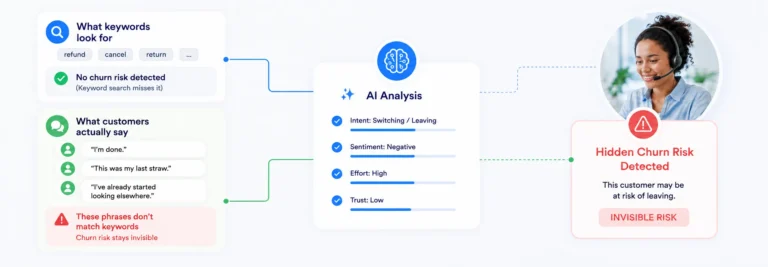
| Real-time Sentiment & Empathy | Applies NLP to live interactions to gauge customer emotion. Provides real-time alerts for at-risk customers and guides agents with empathy prompts to de-escalate and improve outcomes. |
| Real-time Agent Assist | Analyzes the live conversation to surface relevant knowledge articles, process guidance, and compliance prompts to the agent in real-time, boosting accuracy and First Contact Resolution (FCR). |
| Auto-Summary to ITSM/CRM | Automatically generates accurate, structured summaries of interactions and posts them to relevant systems. Ensures data integrity, eliminates manual note-taking, and provides perfect context for follow-up. |
| Interaction Analytics | Processes 100% of voice and digital interactions using speech and text analytics. Uncovers emerging issues, compliance risks, competitive intelligence, and root causes of customer dissatisfaction. |
| Quality Management | Automates and expands quality evaluation. Uses analytics to score 100% of interactions against custom criteria and generates targeted, data-driven coaching opportunities for agents. |
| Taxonomy & Unified Dashboards | Applies a consistent taxonomy (tags, categories) across all data sources. Enables apples-to-apples reporting and creates unified, role-based dashboards that provide a single source of truth. |
| Performance, Coaching & Training | Correlates data from WFM (adherence, occupancy), QA scores, and customer feedback (CSAT, NPS) to create holistic agent performance profiles. Identifies precise skill gaps and recommends personalized training. |
The Tangible Benefits: From Insight to Outcome
Implementing this orchestrated analytics framework delivers compounding value across strategic priorities:
- Enhanced Customer Experience & Loyalty: Predictive insights allow for proactive service, while real-time sentiment and 360-view enable hyper-personalized, empathetic interactions, driving higher CSAT, NPS, and retention.
- Operational Cost Optimization: Increased bot containment, improved FCR, and reduced handle time directly lower cost per contact. Predictive WFM optimizes staffing, minimizing over/under-staffing.
- Elevated Agent Performance & Engagement: Data-driven, personalized coaching improves skills and confidence. Real-time assist reduces cognitive load, empowering agents to succeed and increasing job satisfaction.
- Strategic, Agile Decision-Making: Leaders gain integrated, real-time visibility into performance across the entire operation. Predictive analytics inform strategic investments in technology, training, and process redesign.
- Risk Mitigation & Compliance: 100% interaction monitoring and automated compliance scoring identify risks early, protecting brand reputation and avoiding regulatory penalties.
Critical Dependencies for Success: The Enablers of Analytics Excellence
The vision of an insights-driven contact center cannot be realized by technology alone. Success is contingent on four key pillars:
- Strategic Technology Stack: Choosing an open, scalable, and integrable analytics and insights platform is paramount. The platform must be capable of unifying diverse data sources and evolving from descriptive to prescriptive analytics. A modern Workforce Engagement Management (WEM) platform is the ideal operational core, as it inherently unifies data from CCaaS, CRM/ITSM, WFM, Quality, Performance, and Voice of the Customer, serving as a powerful foundation for this broader analytics ecosystem.
- Specialized Talent & Strategic Partnership: Building and maintaining this framework requires skills in data engineering, analytics, AI/ML, and integration. Organizations must assess their internal capabilities and partner with experts who can accelerate implementation and ensure best practices.
- Data-Driven Culture & Change Management: Insights are worthless without action. Cultivating a culture that trusts data, encourages experimentation, and empowers employees to act on insights is essential. This requires deliberate change management, training, and leadership advocacy.
- Continuous Governance & Improvement: The analytics framework must include mechanisms for regularly reviewing data quality, refining models, updating taxonomies, and measuring the ROI of insights. It must be a living system that adapts to changing business needs.
Conclusion & Next Steps for Leadership
In the era of AI and hyper-personalization, analytics is no longer a support function; it is the central nervous system of the modern contact center. It is the critical capability that separates organizations that simply manage customer interactions from those that intelligently orchestrate customer relationships for mutual value.
For CXOs and Service Owners, the next steps are decisive:
- Conduct an Analytics Maturity Audit: Objectively assess your current state of data unification, tooling, and insight utilization.
- Define the Vision and Business Case: Articulate the specific business outcomes (e.g., reduce cost to serve by X%, increase customer retention by Y%) that a mature analytics capability will drive.
- Architect for the Future, Start with a Foundation: Begin by prioritizing the unification of your most critical data sources and implementing a platform, like an advanced WEM suite, that can serve as the engine for integrated insights.
- Foster an Insights-Driven Culture: Lead the change by demanding data-informed decisions, celebrating wins derived from analytics, and investing in upskilling your teams.
The journey to becoming a true value center is paved with data. By implementing a strategic, dimensional analytics framework, you transform your contact center from a cost line-item into a dynamic source of customer intelligence, operational excellence, and sustainable competitive advantage. The time to invest in insight is now.